

Explore the region
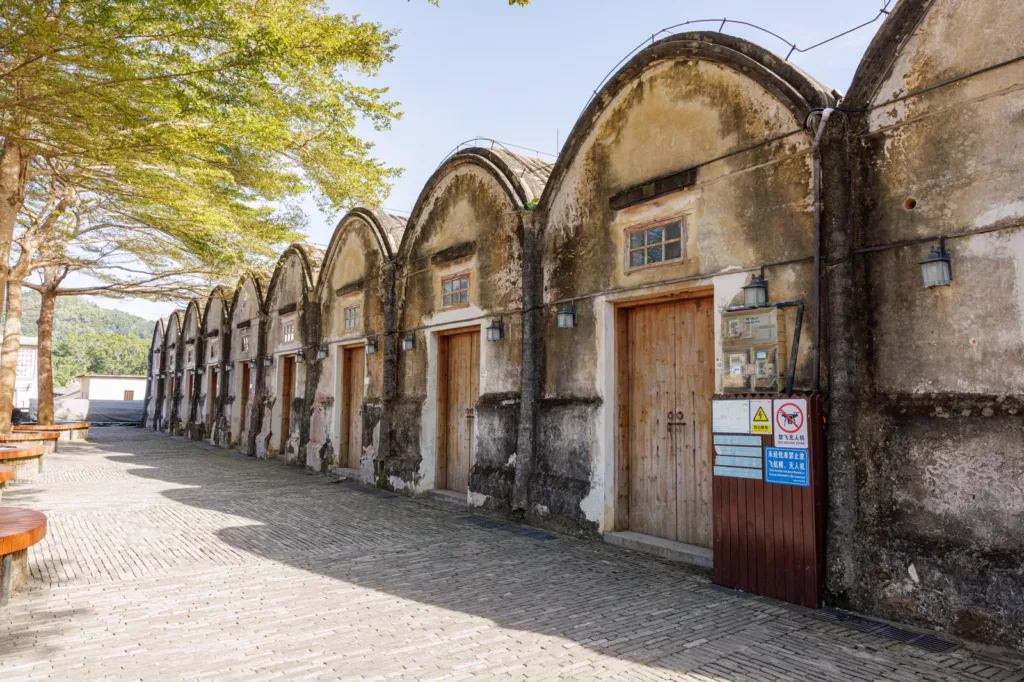
Dapeng Fortress (大鹏所城), formally the Dapeng Garrison City (大鹏守御千户所城), is a walled coastal garrison settlement founded in 1394. Its value is in seeing the military city as a lived-in street plan: gates, narrow stone-paved lanes, temples and Qing-era commanders’ residences remain within the old enclosure. It is not a single museum building or a modern replica.
What to look for
Start at one of the surviving east, south or west gates. The north gate was sealed in the Qing period. Inside, follow the lanes rather than rushing from one named building to another: the contrast between modest tiled houses and larger courtyard residences makes the hierarchy of the old garrison legible. The district’s heritage description identifies more than ten Qing residences, including the former residences of naval commanders Lai Enjue and Liu Qilong, alongside sites such as Tianhou Temple, Hou Wang Temple and the former military command office.
At the former residence of Lai Enjue, known as Zhenwei General’s Residence (振威将军第), look for the shift from the narrow street frontage into a formal residence with a principal hall and carved woodwork. Treat named halls, temples and exhibition rooms as separate interiors: the public description of the old town does not establish that every building is open whenever the lanes are accessible.
Access and practical planning
The Dapeng New District visitor listing describes the historic precinct as open all day. That is not a published schedule for each museum or residence, and the listing does not specify an admission charge or a reservation process. For the Dapeng Fortress Exhibition Hall, the district museum gives its address as 10 Laifu Lane, Pengcheng Community (鹏城社区赖府巷10号) and a contact number, +86 755 8431 9269; call ahead to confirm current opening, entry and document requirements, especially if you plan to visit an indoor exhibition. The visitor listing gives no separate nationality-based rule, so it should not be taken as confirmation of passport acceptance at every individual venue.
There is no metro stop at the fortress itself. Shenzhen Metro Line 8 now reaches Xichong Station (溪涌站); the district says it opened on 28 December 2025 and that feeder buses to Dapeng’s core attractions began alongside it. The district identifies E91 as the feeder route serving Dapeng Fortress and Jiaochangwei. For a rail-and-bus journey, take Line 8 to Xichong and transfer to E91 for the fortress; for the return, take E91 back to Xichong and rejoin Line 8. The published district pages do not give the feeder’s precise stop-side locations or timetable, so check live service and the return connection before setting out.
For a taxi or navigation app, use the official destination name 大鹏所城 (Dapeng Fortress); the district visitor listing does not verify the old draft’s more specific Nanmenwei Second Lane address or a designated curbside drop-off. The current district transport information describes the Xichong–Dapeng connection as metro plus feeder bus and does not document a water route to the fortress; do not plan a ferry leg without a separate current source.
The fort makes a better separate outing than a quick stop between central Shenzhen sights. The district lists Dongshan Temple as another nearby cultural stop, but confirm access and allow for the road journey back to the city before adding it to the day.
Combine your visit
Suggested order for the visit:
-
Fort entrance
Look at the boundary between the fortified settlement and its surroundings.
-
Old village lanes
Explore the historic building pattern.
-
Dongshan Temple
Add the nearby temple as a separate local stop if time and access permit.
This is an editorial sequence of named spaces or places. It does not imply a verified walking connection or promise opening, ticket availability or a journey time.
Find Dapeng Fortress
大鹏所城 · 深圳市
The pin marks the area, not the entrance.
More places nearby
Approximate straight-line distances between map pins, not travel distances.
Wutong Mountain 梧桐山
30 km awayWutong Mountain rises beside the Luohu and Yantian districts and forms a sharp natural boundary to Shenzhen’s urban landscape. Big Wutong and Little Wutong are the principal named summits. The mountain is also the source area of…
View guide →Luohu Commercial City 罗湖商业城
41 km awayLuohu Commercial City is a multi-level shopping complex immediately on the Shenzhen side of the Luohu border crossing. Numerous small shops occupy its enclosed floors, selling clothing, accessories and other merchandise. Its…
View guide →Shenzhen Museum 深圳博物馆
47 km awayShenzhen Museum operates several sites, and the History and Folk Culture branch in the Civic Center is the useful starting point for understanding the city. Its displays move from locally excavated objects to life in the Qing…
View guide →Sources & visit information
Sources checked on 22 October 2026. Hours, tickets, reservations and transport can change; confirm with the operator before you go.
Image credits & notes (1)
- Arched, tiled-roof houses along a paved lane inside Dapeng Fortress, Shenzhen; photographed on 16 December 2024. Photo: Dinkun ChenPhoto: CC BY-SA 4.0