

Explore the region
On Shenzhen’s southeastern peninsula, Dapeng New District is a functional management area rather than a tenth administrative district. Its strongest contrasts are the Ming-era coastal fortress at Dapeng, Hakka food traditions in Kuiyong, and coastal communities around Nan’ao. These are separate outings, not a single walkable attraction.
A peninsula with distinct stops
Dapeng was established in 2011. Under Shenzhen’s municipal rules, the management area covers the Kuiyong, Dapeng and Nan’ao subdistricts; its management committee is a municipal government agency, not a separate district government. The area faces Daya Bay to the east and Dapeng Bay to the west, with Huizhou adjoining its northern side.
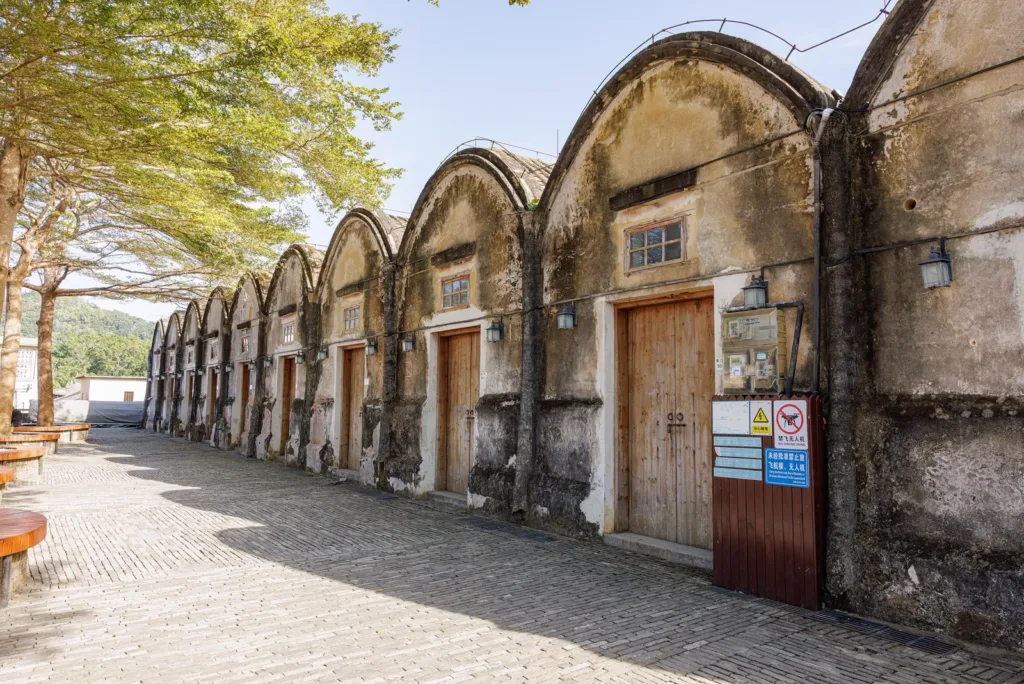
For a history-focused visit, start with Dapeng Fortress (大鹏所城) in the Dapeng subdistrict. Its South Gate and lanes lead to a cluster of preserved houses and museum-managed displays. The fortress dates to 1394; within it, the official museum describes the South Gate’s masonry and later repair layers, as well as the 1844 residence of naval commander Lai Enjue. Look closely at the gate wall rather than treating the settlement as a generic “old town”: the visible fabric includes distinct building and repair periods.
Kuiyong offers a different thread: Hakka customs and food rather than fortress architecture. Nan’ao is represented by coastal culture and the foods of its fishing communities, including sea-urchin zongzi. Treat these as distinct destinations rather than adjacent attractions.
What to taste
Kuiyong Hakka tea cakes (葵涌客家茶果) are a family of festival and seasonal foods, not one fixed recipe. Rice and glutinous-rice flours are worked into a dough, filled, shaped and steamed. Sweet versions can use sesame, peanuts, coconut and sugar. One savory type, radish cake (菜头角), can combine white radish and celery with small clams, dried shrimp and cured pork products. The steamed rice skin is chewy, while sweet fillings taste nutty and savory fillings bring a sea-scented note. The local craft is as much about preparing food together for seasonal or family occasions as it is about a single flavor.
Nan’ao sea-urchin zongzi (南澳海胆粽) puts fresh sea urchin over a richer filling of dried scallop, peanuts, dried shrimp, pork belly and salted duck-egg yolk, wrapped in local mangrove leaves. The rice is soft and sticky; the egg yolk and seafood make the bite savory and dense. These are specific local food traditions, not a guarantee that every restaurant in the district serves them. Ask what is in the filling, especially if you avoid seafood, pork, or egg.
Plan transport by area
Dapeng has no single visitor entrance or district-wide ticket. For the Dapeng Fortress museum venues, Shenzhen’s government lists opening hours of Tuesday to Sunday, 09:00–17:00, with Monday closure; holidays and special circumstances may differ. It lists M471 and M457 as bus routes serving the Dapeng Fortress venue, though the page does not give current stops or directions. The page does not state ticketing, booking, or foreign-passport procedures. Check current details with the museum before setting out; the listed contact number for the Fortress venue is +86 755 8431 9269.
A metro connection now reaches the peninsula at Xichong Station (溪涌站) on Line 8. A district transport notice describes the E90, E91 and E92 feeder network; it identifies E91 as serving Dapeng Fortress and Jiaochangwei. This can be used as a metro-plus-bus approach for those destinations, but the notice does not give a dependable day-by-day timetable or full stop list. Check the current operator or transit app for the outbound and return direction before relying on a particular departure.
For other parts of Dapeng, build the trip around the specific village or coast you intend to visit. Do not assume that the metro station or a bus serving the Fortress also brings you to Nan’ao or a remote trailhead. No regular public passenger boat service or district-wide water connection could be confirmed from the official visitor transport material reviewed; do not plan a water arrival or return without a separately verified service.
The latest vehicle-control notice located for Dapeng covered weekends and public holidays from May 1 to October 8, 2026, on roads south of and including Diefu Mountain Tunnel. During that period, unregistered cars with nine or fewer seats needed a successful advance vehicle reservation; buses and taxis, including ride-hailing vehicles, were exempt. That 2026 window has ended, and the notice does not establish the rules for a future season. Check Shenzhen Traffic Police’s latest notice before driving in a later holiday period. These are vehicle rules, not a stated nationality-based entry restriction.
The official pages reviewed do not establish a passport-specific exclusion for international visitors, but they also do not confirm that every venue’s booking system accepts foreign passports. Carry your passport and contact the specific museum or venue if admission or reservation requirements matter to your visit. Do not assume that an identity-card-only booking interface proves foreign visitors are ineligible—or that it proves passport booking is supported.
Find Dapeng New District
大鹏新区 · 龙岗区
The pin marks the area, not the entrance.
Sources & visit information
Sources checked on 22 October 2026. Hours, tickets, reservations and transport can change; confirm with the operator before you go.
- Shenzhen Dapeng New District Management Regulations ↗
- About Dapeng ↗
- Dapeng New District Museum ↗
- Dapeng Peninsula Vehicle Reservation Notice for 2026 ↗
- Metro Line 8 Xichong Station and Dapeng Feeder Buses ↗
- Kuiyong Hakka Tea Cake Craft and Food Traditions ↗
- Spring Festival Feast: Dapeng’s Intangible Cultural Heritage Delicacies ↗
Image credits & notes (1)
- A lane of historic buildings inside Dapeng Fortress, Shenzhen, photographed on 16 December 2024; this is a street scene, not the South Gate. Photo: Dinkun ChenPhoto: CC BY-SA 4.0