

Explore the region
Dawan Shiju (大万世居), also called Dawan Ancestral Residence in Shenzhen’s English-language visitor guide, is a Qing-dynasty Hakka walled compound in Pingshan. Its square, double-walled plan gathers courtyards around the Zeng clan ancestral hall, with corner watchtowers and ponds linking the residence to an old irrigation work.
Read the compound from the outside in
The residence stands in Dawan Village, Maluan Subdistrict, Pingshan District. Construction began around 1763 under the Zeng lineage founder Zeng Chuanzhou and was completed before 1791. The main compound covers about 15,000 square metres; Shenzhen’s cultural-relic register classifies it as a Qing-dynasty historic building and Guangdong provincial protected site.
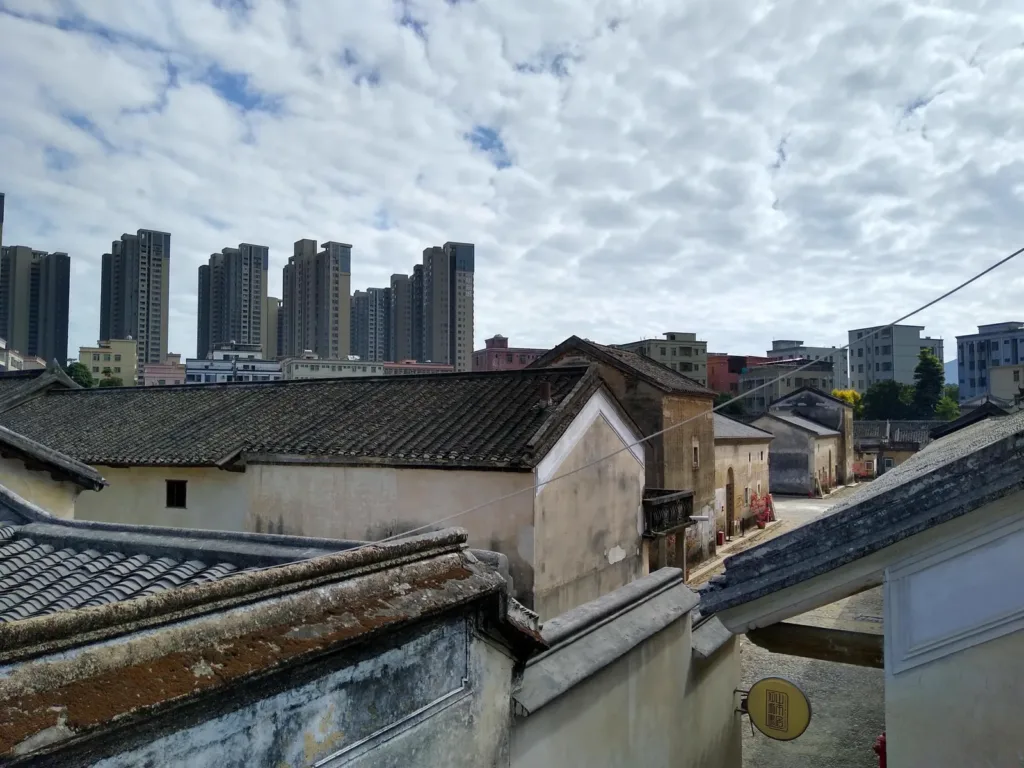
Rather than expecting a round enclosure, look for its square, fortress-like “baodou” outline and central axis. Two enclosing walls create nested courts. Three-storey towers mark the corners of both walls, while the ancestral hall anchors the courtyard arrangement. From accessible public areas, notice how the moon-shaped pond in front and a fishpond on the left sit in relation to the main enclosure; the historic Shadunbei water-control work adjoins the rear.
A useful visit is to walk the outside first, taking in the wall rings and towers, then look into the central court and toward the ancestral hall wherever access is allowed. The official descriptions identify wells, courtyards, dwellings, an inner enclosure range and a stone archway as parts of the complex, but do not say which rooms are routinely open to visitors. Do not assume that occupied rooms or every courtyard can be entered.
The site is listed as a Guangdong provincial cultural relic. A Shenzhen Municipal Culture, Radio, Television, Tourism and Sports Bureau visitor page published in 2023 printed hours of 10:00–17:30 and Monday closure; treat that schedule as dated rather than confirmed current opening information. The consulted official pages do not state a current admission charge or reservation process, nor a foreign-passport-specific entry rule. Confirm opening, entry arrangements and which areas are accessible before travelling; the absence of a published passport rule is not proof that every visitor or interior space is admitted.
Getting there and back
Take Shenzhen Metro Line 16 to Pinghuan Station (坪环站). Pingshan District’s English visitor guide says Dawan Ancestral Residence can be reached on foot from this station in about 20 minutes. It gives no station exit number, so do not plan around an unverified exit; follow current local wayfinding for the walk. Return to Pinghuan Station the same way for Line 16.
For a taxi or ride-hailing car, use the officially listed destination address: 大万世居,深圳市坪山区马峦街道坪环社区大万路33号. The sources confirm the address, not a particular vehicle entrance or curbside drop-off, so confirm the stopping point locally. No current bus route or water-transport connection has been confirmed here.
Find Dawan Hakka Walled Village
大万世居 · 坪山区
The pin marks the area, not the entrance.
Sources & visit information
Sources checked on 22 October 2026. Hours, tickets, reservations and transport can change; confirm with the operator before you go.
Image credits & notes (1)
- Rooftops in Dawan Shiju, a Hakka walled village in Pingshan District, Shenzhen, with modern residential towers beyond; photographed on 16 December 2019. Photo: Mx. Granger (Wikimedia Commons user Mx. Granger)Photo: CC0 1.0