

Explore the region
Tap any red Chinese text to hear it in Mandarin.
Why it is worth a stop
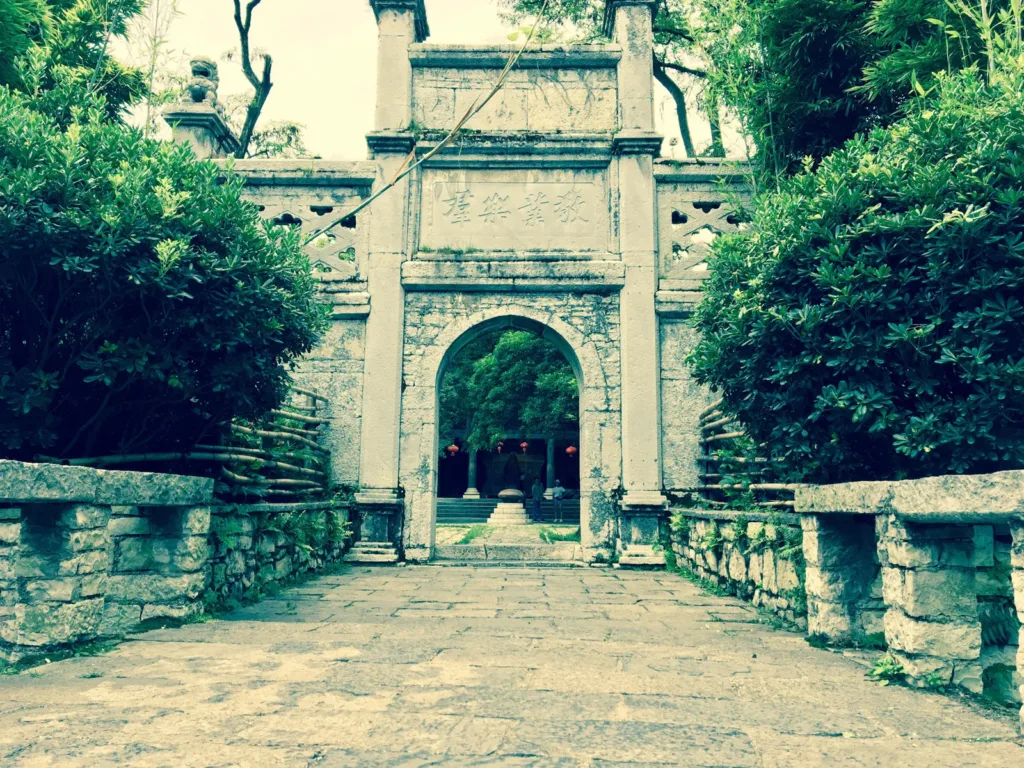
Tianlong is best understood as a settlement tradition that is still legible in the built environment, not as a single monument. In the village, local stone appears in houses, walls, lanes and everyday infrastructure. The layout reflects the defensive logic of a Tunbao settlement, while details such as carved lintels, patterned windows and column bases show a more decorative domestic side.
Walk slowly through the public lanes and look at the junction between defence and home life. The small “cat-eye” windows are especially instructive: the Guizhou culture authority describes them as narrow on the outside and wider inside, allowing residents to see out while limiting views in. Do not assume that every old-looking house is an open museum. Tianlong remains a lived-in village, so ask before entering a home or photographing residents.
Anshun dixi, or ground opera, is the other reason to come. Its performers use carved wooden masks and combine singing, speaking, movement and martial-style action; the tradition grew from the military and ritual culture of the Ming-period Tunbao communities. A May 2026 report recorded performances of The Battle of the Three Heroes against Lü Bu and The Generals of the Yang Family at the village’s Yanwu Hall, but that report does not establish a daily timetable. Treat dixi as a scheduled experience, not a guaranteed show, and check the notice for your date.
The hilltop Tiantaishan Wulong Temple (天台山伍龙寺) should be treated as a distinct uphill heritage stop rather than as another building in the village lanes. Anshun’s government describes it as a national-level protected cultural site and lists it alongside Tianlong School, Chen Yunyu’s former residence, the old Yanwu Hall, Tianlong Well and Sanjiao Temple among the area’s heritage remains. Confirm the separate walking, admission and opening arrangements if you plan to add it.
Practical visit
A current Qunar listing displays seasonal hours of 08:00–18:00 from 1 April to 31 October and 08:30–17:30 from 1 November to 31 March, with entry stopping at 17:30. These are listing details, not a substitute for the notice at the entrance on your day of travel. The same listing says advance reservation is required and publishes the scenic-area contacts 4008009998, 0851-33592716 and 0851-34295548.
The ticket listing’s redemption instructions are written around a mainland second-generation identity card and do not establish how a foreign passport is accepted for booking, collection or face-recognition entry. If you are travelling on a passport, contact the scenic area before paying and ask specifically about passport booking, the collection desk and any separate procedure. Do not infer acceptance from a generic online booking button. No current authoritative ticket price is included here because the sources checked did not establish one for international visitors.
Getting there and back
By rail, the Ministry of Culture and Tourism’s Anshun route page places Tianlong Tunbao about 12 km and roughly 20 minutes by road from Pingba South high-speed railway station. It also points to Pingba Route 2 and the Southwest Gas Station stop (西南加油站); verify the live route, stop position and last-mile walk in Amap before departure. A newer Guizhou government route places the journey from Anshun West high-speed railway station at about 47 km and 40 minutes, which is useful for planning but is not a promise of a station-to-ticket-office transfer.
From Anshun or Pingba, a current travel listing describes buses/minibuses travelling towards Pingba or Anshun with a Tianlong stop, and separately describes a walk of about 3 km from the Tianlong expressway exit. Because it does not provide a dependable current timetable or return guarantee, use it as a route clue rather than a fixed schedule. For the least ambiguous last mile, set Amap’s Chinese destination to 天龙屯堡景区售票处 Tiān Lóng Tún Bǎo Jǐngqū Shòu Piào Chù and use a taxi or ride-hail from Pingba South or Anshun. Arrange the return before entering the village, especially if you are relying on a final bus.
Combine your visit
Suggested order for the visit:
-
Stone village lanes
Look at the masonry and house arrangement.
-
Architectural details
Compare lintels, windows and column bases.
-
Ground-opera venue
Attend only a currently scheduled presentation.
This is an editorial sequence of named spaces or places. It does not imply a verified walking connection or promise opening, ticket availability or a journey time.
Find Tianlong Tunbao
天龙屯堡 · 安顺
The pin marks the area, not the entrance.
More places nearby
Approximate straight-line distances between map pins, not travel distances.
Anshun Confucian Temple 安顺文庙
25 km awayAnshun’s Confucian Temple rewards close attention to stone carving as much as to its formal courtyard plan. Lingxing Gate contains carved scenes associated with the examination system, while the columns at Dacheng Gate and…
View guide →Dragon Palace Cave 龙宫
39 km awayDragon Palace is a karst landscape in which part of the visitor route follows an underground river by boat. Tianchi Lake marks the watery approach, and illuminated stalactites and stalagmites line the accessible cave chambers…
View guide →Tianhetan 天河潭
43 km awayTianhetan combines water-filled caves, channels and a waterfall landscape in Guiyang’s Huaxi district. The cascade passes through a narrow rock opening, while the cave route reveals the underground side of the karst terrain…
View guide →Sources & visit information
Sources checked on 31 October 2026. Hours, tickets, reservations and transport can change; confirm with the operator before you go.
Image credits & notes (1)
- A stone gateway and bridge approach within Tianlong Tunpu in Anshun, photographed in August 2017; the arch is not asserted to be the current ticket entrance. Photo: Huangdan2060Photo: CC BY 3.0