

Explore the region
Tap any red Chinese text to hear it in Mandarin.
At a glance: Guiyang’s specialist natural-science museum uses fossils, karst and mineral resources to explain how Guizhou became the mountainous province visitors see today. Start with the Guanling crinoid fossil display, then follow the permanent galleries from ancient life to landscapes, resources and geological work.
Guizhou Geological Museum is a provincial natural-science museum in Guanshanhu District. Its collections and exhibitions connect the province’s deep geological past with the landscapes and resources encountered on a trip through Guizhou. The museum grew from the province’s geological records work and now also serves as a geological archive, so this is more than a general-history museum: it is a focused introduction to the fossils, rocks and landforms behind Guizhou’s scenery.
What to see
Begin in the entrance hall. A large Guanling crinoid fossil display gives the museum an immediate subject: sea-lily fossils preserve a marine world that predates the present-day mountain landscape. A 2025 Guizhou Radio and Television visitor guide identifies the Guanling crinoid specimen as a signature display, while the museum’s own guide describes the building as a sequence of one foyer, four permanent galleries, a temporary gallery and an interactive area.
The permanent galleries are arranged as Mysterious Guizhou (神秘贵州), Colourful Guizhou (多彩贵州), Resource-rich Guizhou (富饶贵州) and Advancing Guizhou (奋进贵州). Read them as four different questions: what lived here, how the karst landscape formed, what the province’s minerals and rocks contain, and how people have investigated and managed these resources. The official visitor guide confirms the four-gallery structure; the exact temporary displays can change, so treat the current exhibition notices as part of your planning.
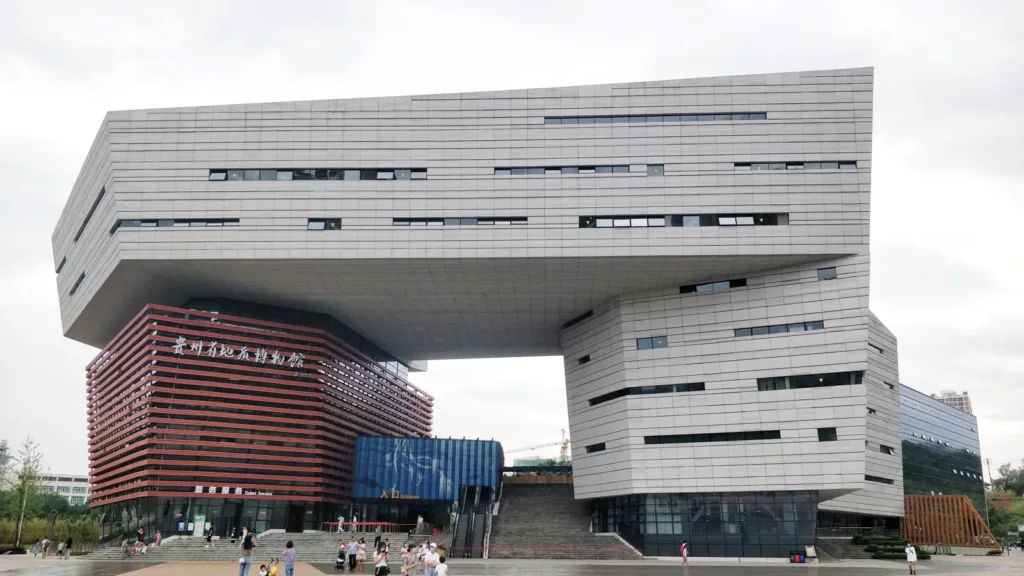
Look up as well as into the cases. The building’s design draws on Fanjingshan’s Mushroom Stone and other images of Guizhou stone, an architectural reference explained by the Guizhou People’s Congress and the museum’s institutional history page. That makes the exterior a useful preface to the galleries rather than just a photo stop.
Planning your visit
The museum’s published regular schedule is Tuesday to Sunday, 09:00–17:00; it is closed on Mondays, with statutory-holiday arrangements announced separately. The live reservation page currently shows 16:00 as the last admission time. Check the museum’s latest notice before travelling, especially around a public holiday or a temporary exhibition change.
The museum states that it operates an all-visitors reservation system. Use the personal-reservation link reached from the museum’s own website, choose a date and arrival time, and add each visitor. The current booking screen does not explain passport-specific fields. If you plan to book with a passport rather than a mainland identity document, confirm the current process with the museum at 0851-85801568 before relying on the reservation. A 2021 opening report mentioned passport information, but that older statement is not proof of the current booking interface.
The museum opened to the public free of charge in 2021, but the current official visitor pages do not publish a current fee schedule. Follow the live reservation channel rather than assuming that an old free-admission notice guarantees every future arrangement. Allow time for security screening. Food is not permitted in the galleries, and the current visitor notice restricts photography in marked areas and the use of flash, selfie sticks and tripods without permission.
Getting there
The venue is in Guanshanhu District at 607 Yuntan South Road (云潭南路607号), by the junction with Xingzhu Road/West Road (兴筑路/兴筑西路). The museum’s own guide gives several usable public-transport approaches:
- Metro: Take Guiyang Metro Line 2 to Xingzhu Road (兴筑路). Walk west for about 800 metres, crossing two signalised intersections, following signs towards the museum. The guide does not specify an exit number, so check the station’s current signs and the live map on arrival.
- Bus via Xingzhu West Road: Routes 70, 217, 219, 220, 225, 229, 256, 802 and 888 line 2 serve the Xingzhu West Road stop. From there, the museum guide says to walk west along Xingzhu West Road for about 200 metres.
- Bus via Yuntan South Road: Routes 291, Guanshanhu 217 and Guanshanhu 303 serve the Yuntan South Road stop; the guide gives a southbound walk of about 300 metres. Routes 208, 291, 888 line 2, Guanshanhu 1, 2 and 3 also serve the Yuntan South Road Olympic Sports Center stop.
- Taxi or ride-hailing: Give the driver the Chinese name 贵州省地质博物馆 Guì Zhōu Shěng Dìzhì Bó Wù Guǎn and the address 贵阳市观山湖区云潭南路607号. The museum’s official and government-linked pages use 607, while an Amap place card read for this entry still displays 601; if the map pin and the driver’s destination disagree, confirm the Xingzhu Road junction and the visitor entrance with the museum rather than following an unverified pin.
For the return, walk back to the same station or bus-stop area and check the live direction in Amap before boarding. The official guide lists the routes and approach walks, but it does not promise a particular return-side stop or a fixed service pattern for a future date. Keep the Chinese name and address visible on your phone until you have left the museum complex.
Combine your visit
Suggested order for the visit:
-
Entrance-hall crinoid fossil
Begin with the large marine fossil display.
-
Mysterious Guizhou gallery
Explore ancient life and its environments.
-
Colourful and Resource-rich Guizhou galleries
Connect the fossils with landforms and minerals.
This is an editorial sequence of named spaces or places. It does not imply a verified walking connection or promise opening, ticket availability or a journey time.
Find Guizhou Geological Museum
贵州地质博物馆 · 贵阳
The pin marks the area, not the entrance.
More places nearby
Approximate straight-line distances between map pins, not travel distances.
Guizhou Provincial Museum 贵州省博物馆
4 km awayGuizhou Provincial Museum’s main historical exhibition follows the province from prehistory through the Qing period. The collection includes bronze drums and an inscribed Ming bronze bell, objects that connect local material…
View guide →Qianling Park 黔灵山公园
9 km awayQianling Park rises through wooded hills within Guiyang. Hongfu Temple and the surrounding hilltop outlooks add architectural and scenic stops, while tea gardens provide a slower part of the visit. Wild monkeys also inhabit the…
View guide →Qianling Mountain 黔灵山
9 km awayQianling Mountain brings wooded hills and a lake into the edge of central Guiyang. The winding Nine Turns route leads towards Hongfu Temple, whose decorated halls form the principal cultural stop. Higher paths offer views over…
View guide →Sources & visit information
Sources checked on 31 October 2026. Hours, tickets, reservations and transport can change; confirm with the operator before you go.
Image credits & notes (1)
- Exterior of Guizhou Geological Museum in Guiyang, with the red ticket-service wing and the marked visitor entrance beneath the cantilevered main building. Photo: BuerniaPhoto: CC BY-SA 4.0