

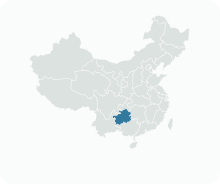
Get to know Guanshanhu District

- Administrative area
- District · 市辖区
- Part of
- Guiyang City
- Chinese name
- 观山湖区
- Local areas
- District guide
Area & population
- Area
- 309.48 km²
- Population · 2020
- 642,634
- Administrative seat
- Jinyang Subdistrict
Source: English Wikipedia, as of the dates shown.
In brief: Guanshanhu is Guiyang’s planned north-western district: a modern civic centre set among karst hills, lakes and large urban parks. Its strongest visitor combination is a walk in Guanshanhu Park followed by one or both provincial museums, rather than treating the district as one gated attraction.
Why this district feels different
Guanshanhu grew out of the Jinyang New Area, whose construction began around 2000; the State Council approved Guanshanhu District in 2012. That recent history is visible in the wide roads, civic buildings, convention facilities and new neighbourhoods. The district now contains Guiyang’s municipal administrative centre, Guiyang North Railway Station, the city’s convention centre and major provincial cultural institutions.
This is still a Guizhou landscape, not a flat extension of an inland business district. The official geographic description places the district on the second step of the Guizhou Plateau, generally around 1,250–1,300 metres above sea level, with karst landforms, low valleys and hills such as Jiangjun Mountain and Jiulong Mountain. The government lists the district’s area as 307 square kilometres and its administrative structure as three towns and seven subdistricts. Allow time for distances: “Guanshanhu” covers a substantial urban and rural area, not a single walkable centre.
What to see and how to read it
Start with Guanshanhu Park (观山湖公园). The district government describes this as an ecological urban wetland park of more than 5,500 mu. Amap places it on both sides of Guanshan Bridge, so it is better understood as a broad park landscape than as one compact gate. Look for the relationship between the lake, planted slopes and the surrounding civic skyline; a cloudy or rainy day can be part of the plateau experience, but paths and views are weather-dependent.
For the park, use the Chinese destination 观山湖公园 Guān Shān Hú Gōng Yuán in Amap/Gaode Maps. The map listing gives the address as 贵阳市观山湖区观山大桥南北两侧 Guì Yáng Shì Guān Shān Hú Qū Guān Shān Dàqiáo Nánběi Liǎngcè and identifies Line 1’s 观山湖公园站 Guān Shān Hú Gōng Yuán Zhàn as the relevant metro stop; choose the entrance and walking route shown for your arrival side rather than assuming that every exit reaches the same gate.
Use the museums to put the landscape in context. The Guizhou Provincial Museum (贵州省博物馆) at 107 Lincheng East Road, Guanshanhu District (贵阳市观山湖区林城东路107号) has a current basic display tracing Guizhou from prehistoric periods through the Qing era, with separate sections for the prehistoric, Qin–Han through Northern and Southern Dynasties, Sui–Yuan, Ming and Qing periods. It is a useful indoor counterpoint to the park: the displays explain the province’s long history while the district outside shows its newest urban form.
The Guizhou Geological Museum (贵州省地质博物馆), at the junction of Yuntan South Road and Xingzhu Road (贵阳市观山湖区云潭南路与兴筑路交汇处), takes a different route through the province. Its official guide describes four permanent exhibitions—“Mysterious Guizhou,” “Colourful Guizhou,” “Rich Guizhou” and “Progressive Guizhou”—alongside temporary and interactive areas, with collections including fossils, minerals and rocks. Together, the two museums make Guanshanhu more than a modern skyline: one explains human history, the other the geological conditions that shaped Guizhou’s caves, hills and stone landscapes.
At the district’s outer edge, the Guizhou Guiyang Baihua Lake National Wetland Park (贵州贵阳百花湖国家湿地公园) is a separate, more rural outing. The district’s geographic page places it about 10 km from the Jinyang urban area and describes it as an important water source and habitat; 117 bird species are recorded there. Do not plan it as a short walk from the museum cluster. The public sources checked here do not establish a current visitor gate, shuttle, boat timetable or seasonal operating plan. Search the exact Chinese name in Amap before leaving, verify the actual access point and return connection on the day, and do not assume that a past lake excursion or a future-season service is running.
Practical planning
Guanshanhu is an administrative district, not a single ticketed attraction. Each museum, park or outlying lake area has its own access conditions. The Provincial Museum’s public guide currently says Tuesday–Sunday 09:00–17:00, with entry stopping at 16:00 and Monday closure except for holiday arrangements. It is free to enter but uses real-name booking through the official “贵州省博物馆” WeChat account; the museum says that non-reservation visitors are generally not accepted. A May 2026 notice confirms the same official booking route and warns that holiday opening arrangements can differ.
The Geological Museum’s current guide lists Tuesday–Sunday 09:00–17:00, Monday closure subject to holiday changes, and an all-visitor reservation system. For both museums, the public pages checked do not spell out the passport-specific booking and identity-verification workflow. If you are travelling on a passport, confirm that workflow with the relevant official account or phone line before relying on a reservation; do not infer it from the domestic ID wording.
For the Provincial Museum, the official access information gives Line 1 International Eco-Conference Center Station (国际生态会议中心站), Exit B, and buses serving Guiyang Garrison (贵阳警备区) and International Conference Center North (国际会议中心北). For the Geological Museum, take Line 2 to Xingzhu Road Station (兴筑路站) and walk about 800 metres; its official guide also lists buses to Xingzhu West Road (兴筑西路), Yuntan South Road (云潭南路) and Yuntan South Road Olympic Sports Center (云潭南路奥体中心).
Guiyang North Railway Station (贵阳北站) is inside Guanshanhu District, but it is not a substitute for choosing a venue entrance: set the exact museum, park or lake name in Amap/Gaode Maps after you arrive. For the park, use 观山湖公园 Guān Shān Hú Gōng Yuán; for the museums, use their full Chinese names and addresses above. Keep the same Chinese destination for the return search, especially after visiting Baihua Lake or any rural edge of the district. Route frequencies, station exits, temporary closures and venue reservations can change, so check the operator or venue notice on the day.
Guide sources
- 观山湖区概况 — Guanshanhu District People’s Government
- 地理资源 — Guanshanhu District People’s Government
- 文化旅游 — Guanshanhu District People’s Government
- 博物馆 — Guizhou Provincial Government
- 参观导览 — Geological Museum of Guizhou
- 观山湖公园 — Amap place listing
- 5·18国际博物馆日 | 贵州省博物馆正常开放 — Guizhou Provincial Museum
- 基本陈列 — Guizhou Provincial Museum
- 观山湖公园 Guanshan Park — Guiyang metro station reference
- 贵州省地质博物馆开馆并免费向公众开放 — People’s Daily Guizhou
Explore Guanshanhu District
Core places to explore, with English and Chinese names.
Places to explore around Guanshanhu District
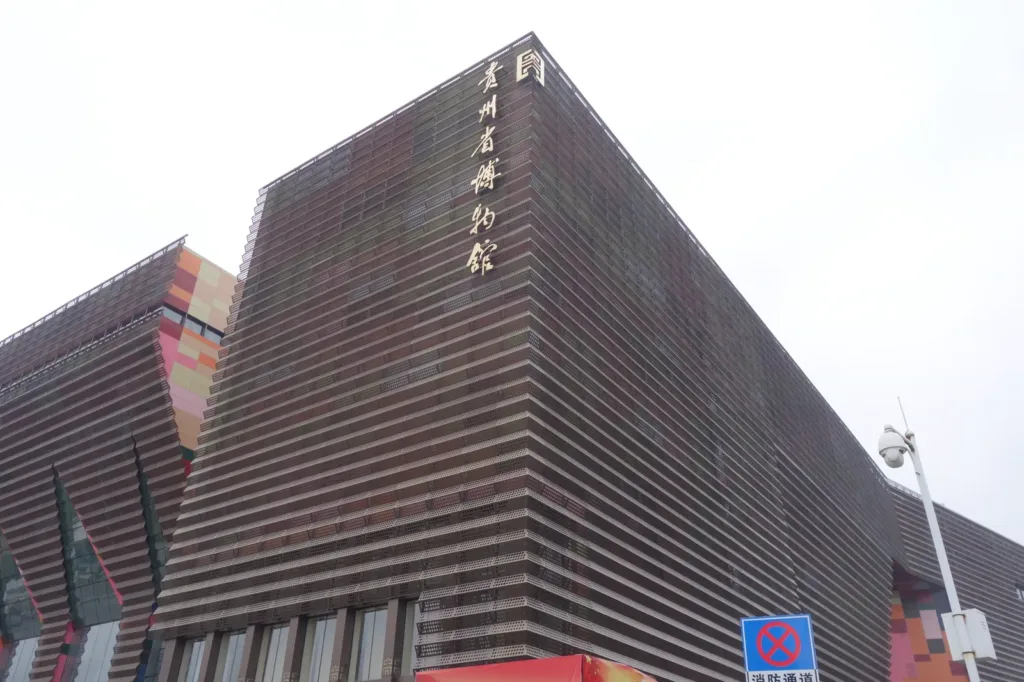 Guizhou Provincial Museum building photographed from below, with the museum name visible on the Guanshanhu building. Photo: Lkjidm · CC BY-SA 4.0
Guizhou Provincial Museum贵州省博物馆
Guizhou Provincial Museum is Guiyang’s clearest place to read the province through a chronological history exhibition, distinctive Miao material culture, and selected bronze and fossil collections in Guanshanhu District.
Read the place guide → A broad view across a lake in Guanshanhu Park, with wooded shorelines, a water-edge path and Guiyang high-rises beyond. Photo: 汗血 · CC BY 3.0
Guanshanhu Park观山湖公园
Guanshanhu Park is a large public green space in Guiyang’s Guanshanhu District, where lakes, forest, wetland and small gardens turn a former farm and reservoir site into an everyday city landscape.
Read the place guide →Plan your visit
Getting there
Guanshanhu District is about 5 km (straight-line distance) from central Guiyang City. Search for 观山湖区 in a map app to find stations and your accommodation.
Where to stay →Build your route
Guizhou Provincial Museum and Guanshanhu Park are about 1 km apart (straight-line distance). The linked place guides have entrance and visit details.
Continue with Guiyang City →More in Guiyang City
Sources & geographic information
Administrative names and parent areas: Official geographic directory (dmfw.mca.gov.cn) · Reference date 2026-09-06.
Background text adapted from Guanshanhu District — Wikipedia contributors, under CC BY-SA 4.0. Text has been shortened and reorganized; source revision 1370815180.
Map data © OpenStreetMap contributors. Pins mark approximate centres, not entrances or boundaries.
