

Explore the region
Tap any red Chinese text to hear it in Mandarin.
In brief
Guizhou Provincial Museum is Guiyang’s clearest place to read the province through a chronological history exhibition, distinctive Miao material culture, and selected bronze and fossil collections in Guanshanhu District.
Why make time for it
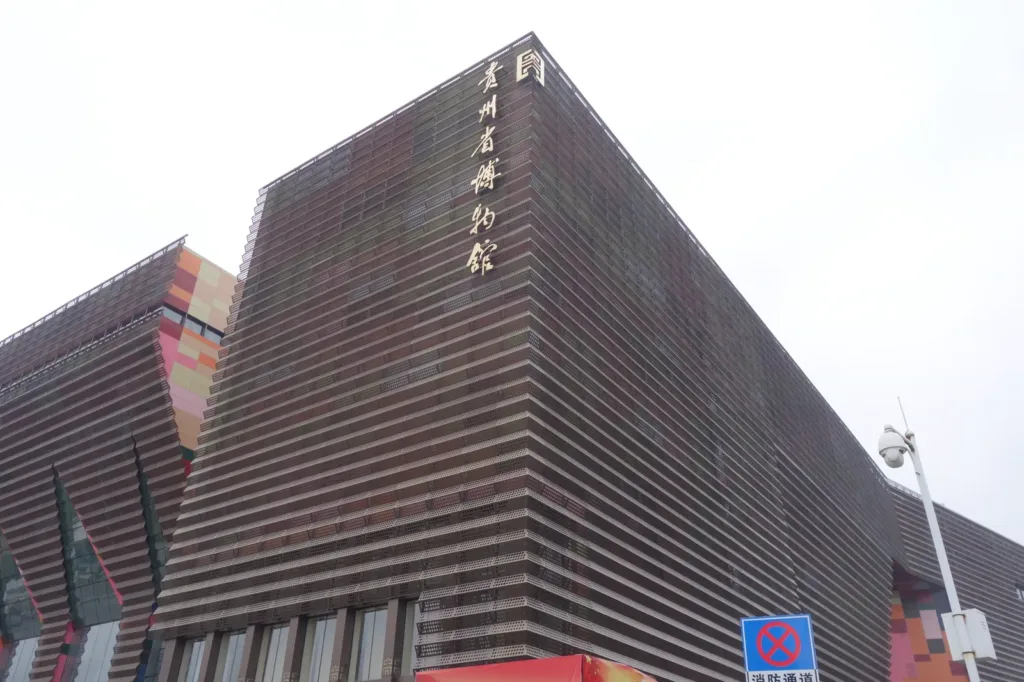
The museum began as a provincial institution planned in 1953 and opened in 1958. Its current building is the newer site in Guanshanhu, on Lincheng East Road, rather than the former museum on Beijing Road in Yunyan District. The building brings the public exhibition areas together with temporary exhibitions and education facilities, while the central galleries hold the main historical display.
Start with the permanent exhibition rather than treating the museum as a room of unrelated “treasures”. The official exhibition index lists six chronological sections, from prehistoric Guizhou and the Bronze Age through the Qin-Han and later periods to Ming and Qing Guizhou. They are arranged across Halls 1–3 and are listed as on display from 3 February 2024; the museum may change galleries or loans, so use the current exhibition notice when you arrive.
The collection rewards a slower second look. The museum’s English collection page highlights the Wanli-era Ming bronze bell inscribed “Ping Bao De”, Western Han Shizhai-type bronze drums, and a Ming Majiang bronze drum. The official overview also identifies Miao clothing and silver ornaments, Guizhou fossils, Paleolithic finds, and objects connected with the province’s local history and cultural diversity as collection strengths. These are collection signposts, not a promise that every named object will be in a gallery on your date.
A useful way to visit is to follow the six-part historical sequence, then compare the objects with the province’s mountains, archaeology, and many ethnic traditions that you will encounter elsewhere in Guizhou. Leave time for any temporary exhibition shown in the museum’s current programme; do not plan around a past exhibition title or a seasonal event that has not been announced for your dates.
Plan the visit
The current visitor guide published by the Guizhou provincial government lists free opening from Tuesday to Sunday, 09:00–17:00, with last entry at 16:00. Mondays are closed except for holiday exceptions. Basic galleries and most temporary exhibitions are free; the guide says that 4D films, cultural products, and some temporary exhibitions may charge separately.
The museum uses real-name reservations. The official guide directs visitors to reserve through the “贵州省博物馆” official WeChat account and says that, in principle, non-reserved visitors are not admitted; a successful reservation is checked by QR code or identity verification. The museum’s own service page describes the “票务预约” and “码上预约” steps and asks for the visitor’s name, identity-document number, and mobile number.
Those instructions do not explain the passport-specific booking or gate-verification process. If you are travelling with a passport rather than a Chinese identity card, contact the museum before relying on the reservation system; this is a point to confirm, not a claim that passport entry is refused. The published consultation numbers are 0851-84811809 and 0851-84811830.
The official guide lists free scheduled explanations at 10:00 and 14:30, as well as luggage storage. The service page also lists audio-guide service, free storage, and loan wheelchairs and baby strollers. Language availability and same-day capacity should be checked at the service desk.
Getting there and back
- Metro: Take Guiyang Metro Line 1 to International Eco-Conference Center Station (国际生态会议中心站) and use Exit B. This is the station and exit named in the museum visitor guide. The official page does not give a verified walking time or a precise museum-side entrance, so after exiting, check Amap using 贵州省博物馆 Guì Zhōu Shěng Bó Wù Guǎn and confirm the entrance rather than following a guessed distance.
- Bus: The same guide lists 贵阳警备区 Guì Yáng Jǐngbèiqū as served by routes 48, 58, 208, 209, 218, 246 and Night 8. It also lists 国际会议中心(北) for routes 29, 48, 58, 60, 111, 208, 209, 218, 246, 263, 280, 281, 290 and 702. Route patterns can change, so verify the direction and stop in Amap on the day.
- Taxi or ride-hailing: Give the driver the full Chinese destination 贵州省博物馆,贵阳市观山湖区林城东路107号. The official guide confirms this address but does not promise a fixed drop-off point; confirm the visitor entrance before getting out.
For the return, re-check the Line 1 platform direction or the live bus route at the station. Keep the Chinese name and address available on your phone: they are more useful for the final approach than an approximate map pin.
Combine your visit
Suggested order for the visit:
-
Permanent historical exhibition
Follow the province’s material history.
-
Bronze collection displays
Look for drums and the inscribed bell when on view.
-
Current temporary exhibition
Choose a subject from the programme for the day.
This is an editorial sequence of named spaces or places. It does not imply a verified walking connection or promise opening, ticket availability or a journey time.
Find Guizhou Provincial Museum
贵州省博物馆 · 贵阳
The pin marks the area, not the entrance.
More places nearby
Approximate straight-line distances between map pins, not travel distances.
Guizhou Geological Museum 贵州地质博物馆
4 km awayGuizhou Geology Museum explains the province through fossils, karst landscapes and mineral resources. The entrance hall’s Guanling crinoid fossil slab is a useful first stop: its branching sea-lily forms reveal a marine world…
View guide →Qianling Mountain 黔灵山
7 km awayQianling Mountain brings wooded hills and a lake into the edge of central Guiyang. The winding Nine Turns route leads towards Hongfu Temple, whose decorated halls form the principal cultural stop. Higher paths offer views over…
View guide →Qianling Park 黔灵山公园
7 km awayQianling Park rises through wooded hills within Guiyang. Hongfu Temple and the surrounding hilltop outlooks add architectural and scenic stops, while tea gardens provide a slower part of the visit. Wild monkeys also inhabit the…
View guide →Sources & visit information
Sources checked on 31 October 2026. Hours, tickets, reservations and transport can change; confirm with the operator before you go.
Image credits & notes (1)
- Guizhou Provincial Museum building photographed from below, with the museum name visible on the Guanshanhu building. Photo: LkjidmPhoto: CC BY-SA 4.0