

Explore the region
Tap any red Chinese text to hear it in Mandarin.
In brief: Tang’an is a lived-in Dong village and a China–Norway ecomuseum in Tang’an Village, Zhaoxing Town, Liping County. Its interest lies in the relationship between timber stilt houses, village paths, terraces and working infrastructure—not in a single museum hall.
Why visit
Tang’an occupies a mountainside above a broad fall of terraces. Houses follow the slope, while blue-flagstone lanes, water features and work buildings remain part of the settlement. The ecomuseum idea is important here: the village itself, its buildings, residents’ working environment and the surrounding landscape are treated as the subject, rather than being rearranged as a collection indoors. A provincial account records approval for the Liping Tang’an Dong Ecomuseum in December 1999 and its formal opening in May 2005.
This makes Tang’an a place for slow observation. Walk the public lanes, look down over the stone-built fields, and notice how the village’s shared buildings and water system fit around everyday homes. The setting feels different from a performance venue: it is a real community, so a quieter and more respectful visit is part of what the place is.
What to look for
Start with the drum tower in the village centre. The county describes it together with the opera stage and singing ground as a three-part expression of a Dong settlement. Follow the blue-stone lanes rather than looking only for a single viewpoint; the village also retains gates on the roads out, rice-drying racks, granaries, fish ponds and working equipment such as water mills and stone mortars.
The piao well is a particularly good detail to seek out. A spring fills a handled bluestone basin on a polygonal stone support, and the name refers to its resemblance to a wooden dipper. Below the village, the terraces were built with stacked stone and earth. Their structure is easier to understand from the paths and edges of the fields than from a distant photograph.
There is also a group of old graves within the settlement, many described as Qing-period tombs with carved dragons, phoenixes and scrolling foliage. Treat this as a heritage site, not a photo prop: do not climb on stonework or enter private compounds. The terraces are still an agricultural landscape, and the village’s ordinary activity matters as much as its buildings.
How to visit
Tang’an is a lived-in village. Stay on public paths, ask before entering a home or other residential space, and ask permission before photographing residents. Do not assume that a costume, song or daily task is a scheduled performance for visitors. The village should be observed without turning people’s routines into a show.
The Liping government’s scenic-spot page lists the village address as Tang’an Village, Zhaoxing Town, Liping County and lists no admission fee, but that page does not display a current publication date or establish today’s ticketing arrangement. The current opening hours of any separate ecomuseum information centre, current activities, and any requirement connected with the wider Zhaoxing scenic area were not confirmed by a current official notice. Check locally on the day. No current official passport-specific reservation procedure was found, so do not assume that a domestic ID-card booking route works for a passport.
For the terraces and the walk from Zhaoxing, the Ministry of Culture and Tourism lists May to December as the best travel period for its Liping route. That is a seasonal recommendation for the route, not a promise of a particular rice-growing stage, performance or shuttle service. For a walk, set out in daylight and check the day’s weather and footing before leaving Zhaoxing.
Getting there and back
The practical long-distance approach is to travel first to Congjiang Railway Station and then continue by road towards Zhaoxing and Tang’an. The Ministry of Culture and Tourism’s route page gives 7.5 km and about 17 minutes from Congjiang Station for this route area; a People’s Daily report gives about 5 km from the station to Zhaoxing. The different figures use different endpoints and should not be treated as a guaranteed transfer time.
At Zhaoxing, use the Chinese destination 堂安侗寨 Táng Ān Dòng Zhài and the administrative text 黎平县肇兴镇堂安村 Lí Píng Xiàn Zhào Xīng Zhèn Táng Ān Cūn when checking Amap (Gaode Maps). Amap confirms the Zhaoxing visitor location as 黔东南苗族侗族自治州黎平县肇兴村202省道; that is a useful approach reference, not the address of Tang’an itself.
From Zhaoxing, the Ministry of Culture and Tourism presents the route as Zhaoxing Village → Tang’an terraces → Tang’an Village. A Liping travel guide also describes the classic walk via Xiage and mentions a local bus from Zhaoxing towards Tang’an, but it gives no current operator or timetable. Treat the bus as a lead to verify at the local transport point, not as a guaranteed departure. Before going uphill, confirm the day’s drop-off and return options; otherwise plan to reverse the walk in daylight or arrange a return vehicle that will actually reach the village road.
There is no useful metro route for this mountain village. For a taxi or ride-hail, enter 堂安侗寨,黎平县肇兴镇堂安村 Táng Ān Dòng Zhài, Lí Píng Xiàn Zhào Xīng Zhèn Táng Ān Cūn in the map app, confirm that the driver accepts the mountain road and agree where and when a return pickup will happen. Do not rely on a fixed fare, journey time or late-day vehicle without a same-day confirmation.
Find Tang’an Dong Village
堂安侗寨 · 黎平县
The pin marks the area, not the entrance.
Sources & visit information
Sources checked on 31 October 2026. Hours, tickets, reservations and transport can change; confirm with the operator before you go.
Image credits & notes (1)
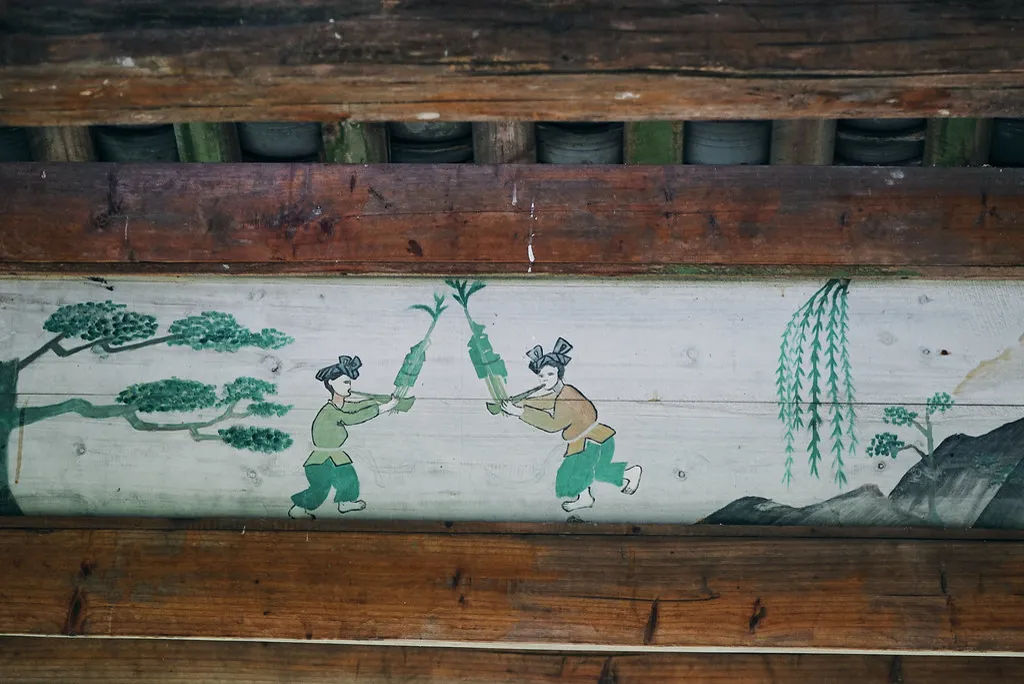
- A Dong mural on a timber building in Tang’an Dong Village, showing two painted figures carrying greenery against trees and mountain forms. Photo: J.L. CogburnPhoto: CC BY-SA 2.0