

Explore the region
Tap any red Chinese text to hear it in Mandarin.
Why this temple is distinctive
Putuo Zongcheng is one of Chengde’s outlying imperial temples, not a second entrance to the Mountain Resort and not the same place as nearby Xumi Fushou Temple. The municipal cultural-heritage description places the paired Potala & Palace of Panchen Lama Scenic Area north of the Mountain Resort, while UNESCO treats the Mountain Resort and its outlying temples as one larger 18th-century heritage property.
Construction began in 1767, during the Qianlong emperor’s reign, and the temple was completed in 1771. Its design follows the visual language of Lhasa’s Potala Palace; the complex served Buddhist ceremonies and imperial encounters with visitors from different ethnic communities. The completion of the temple coincided with celebrations for Qianlong’s mother, the Empress Dowager Chongqing, and the wider Chengde temple system also expressed the Qing court’s use of different Buddhist architectural traditions and religious institutions.
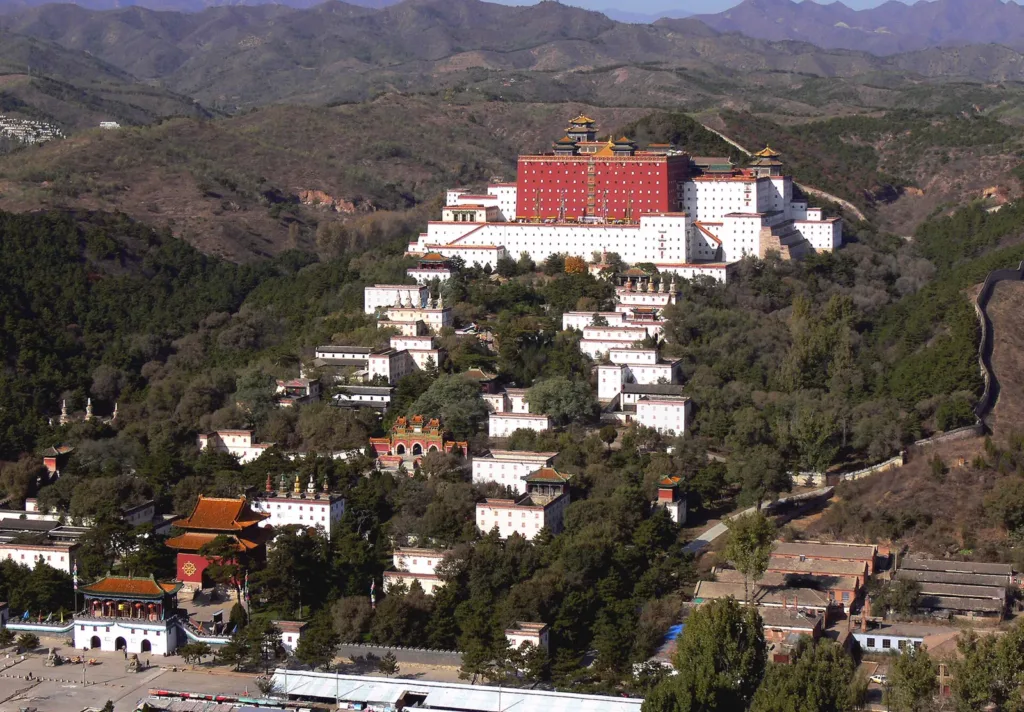
The interest is architectural and sequential. A five-hole stone bridge leads toward the entrance, followed by a stele pavilion, the Five Pagodas Gate and a glazed gateway. The stele pavilion’s inscriptions in Manchu, Chinese, Mongolian and Tibetan make the imperial and multilingual setting visible before the main ascent begins. After the smaller gateways and white terrace buildings, the route rises to the great red terrace. Wanfaguiyi Hall sits at its centre, its gilded roof projecting above the surrounding red structure.
The hillside layout is part of the experience: this is a climb through changing scales rather than a flat sequence of courtyards. Look back from higher ground to read how white, red and gold structures are set against Chengde’s northern hills. Individual halls or religious spaces may not all be open on a particular day, so treat the accessible route and current on-site notices as the final guide.
Plan the visit
Use the Chinese destination name 普陀宗乘之庙 Pǔtuó Zōngchéng Zhī Miào. The published address is on the north side of Shizigou, Beihuan Road, Shuangqiao District, Chengde: 河北省承德市双桥区狮子沟北侧北环路 Héběi Shěng Chéngdé Shì Shuāngqiáo Qū Shīzigōu Běi Cè Běihuán Lù. Give the Chinese name and address to a taxi or ride-hailing driver, and ask for the current visitor entrance rather than relying on an unnamed map pin.
The municipal cultural-heritage page available for this scenic area is dated 2018 and lists ¥80 from 1 April to 31 October and ¥60 from 1 November to 31 March. A separate tourism listing gives a different opening window, so neither should be treated as a guaranteed 2026 schedule. Confirm opening, admission, reservation, and whether the paired Xumi Fushou Temple is included with the operator before setting out. No reviewed source states a site-specific passport or foreign-visitor booking rule; do not infer one from domestic ID procedures.
The two temples are described together as the Potala & Palace of Panchen Lama Scenic Area, but they remain separate places. If you plan to see both, check the current ticket product and the operating route at the entrance rather than assuming that one gate or one ticket covers every building.
Getting there and back
- By city bus: Take 118路 to 普陀宗乘之庙站 Pǔtuó Zōngchéng Zhī Miào Zhàn. The municipal cultural-heritage page gives this route, and a city tourism listing also identifies the stop. A route record based on 2024 operator information lists 118路 in both directions through 普陀宗乘之庙; for the return, use the opposite-direction stop toward 小溪沟口(火神庙). Confirm the day’s stop display and last service locally.
- From high-speed rail: Arrive at 承德南站 (Chengde South Railway Station). The station plaza is documented as a transfer point for high-speed rail, city buses and taxis. A route database last updated 26 August 2024 records a 双层观光巴士 Shuāng Céng Guānguāng Bā Shì service between 承德南站 and 普陀宗乘之庙, but its current timetable was not independently confirmed; check the station’s live information before boarding. If it is not operating, take a taxi or ride-hailing car using the Chinese destination and address above. For the return to 承德南站, confirm a current direct service at the temple or station, or arrange a taxi back.
- No metro route is used here: the reviewed transport sources provide bus, rail and taxi connections, not a metro route. Do not substitute a similarly named temple or the Mountain Resort entrance when asking for directions.
Combine your visit
Suggested order within this visit:
-
Five Pagodas Gate
Read the lower ceremonial approach.
-
Glazed gateway and ascent
Follow the progression towards the main terrace.
-
Great red terrace and Wanfaguiyi Hall
See the architectural centre of the complex.
This sequence is an editorial suggestion based on the features described in the sources. Access to individual buildings or areas should be checked locally; no travel time or shared admission is implied.
Find Putuo Zongcheng Temple
普陀宗乘之庙 · 承德市
The pin marks the area, not the entrance.
More places nearby
Approximate straight-line distances between map pins, not travel distances.
Xumi Fushou Temple 须弥福寿之庙
1 km awayXumi Fushou Temple was built in 1780 for the Sixth Panchen Lama's visit to the Qianlong emperor, taking inspiration from Tashilhunpo Monastery. Its red terrace encloses Miaogao Zhuangyan Hall, whose gilded roof carries large…
View guide →Chengde Museum 承德博物馆
1 km awayChengde's museum beside Puning Road provides an indoor counterpart to the Mountain Resort and surrounding temples. Its displays explore imperial garden culture, Qing court life and Tibetan-Han Buddhist art, helping explain the…
View guide →Puning Temple (Chengde) 普宁寺
2 km awayPuning Temple combines two different spatial traditions on a single rising axis. The front courts follow a Chinese Buddhist hall arrangement; behind them, a Tibetan-inspired mandala composition surrounds the towering Dacheng…
View guide →Sources & visit information
Sources checked on 25 October 2026. Hours, tickets, reservations and transport can change; confirm with the operator before you go.
Image credits & notes (1)
- Aerial view of Putuo Zongcheng Temple's red central terrace and white hillside buildings in Chengde. Photo: GislingPhoto: CC BY-SA 4.0