

Explore the region
Tap any red Chinese text to hear it in Mandarin.
A forest with a human history
Saihanba sits on the northern side of Chengde’s Weichang County, near the southern edge of the Hunshandake Sandy Land. Forest, meadow, marsh and highland lakes meet here, and the landscape is also part of the wider Mulan Paddock story. The State Forestry and Grassland Administration describes the area as a former Qing imperial hunting ground with forests, grassland, plateau lakes and historical traces.
The present forest is not simply an untouched wilderness. The Qing government opened the land for farming in 1863, after which woodland and wetlands declined. In 1962, the Saihanba Mechanical Forest Farm was established to restore vegetation and reduce the effects of sandstorms. The national forest park was later built on that foundation. That long shift—from a degraded upland to a managed forest and ecological shield—is what makes the place different from a generic mountain park. Xinhua describes Saihanba as part of the landscape protecting northern China from sandstorms, while recent reporting records the continuing work of managing and improving the forest rather than treating it as a finished monument.
The name is often explained as meaning “beautiful highlands”, reflecting the area’s Mongolian and Chinese linguistic background. The place is also associated with the “Saihanba spirit”: the endurance, technical learning and long-term care required to grow trees in a cold, windy, high-elevation environment. The English-language Xinhua account records early planting failures, including survival below eight percent, before local workers adapted their methods and persisted.
What to see
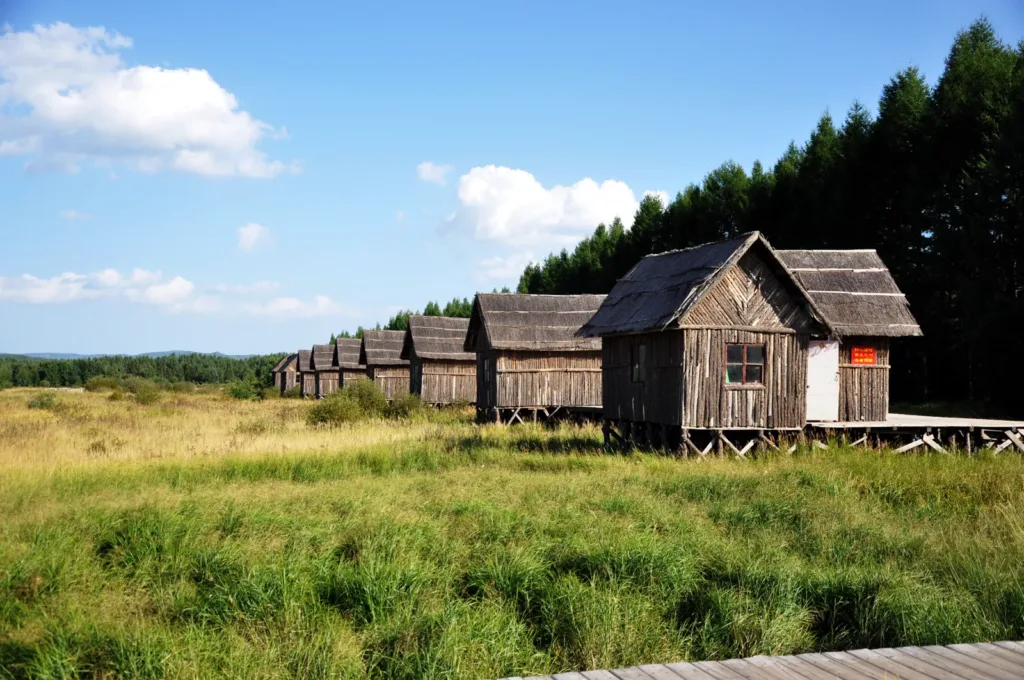
Qixing Lake(七星湖) is the clearest place to understand Saihanba as more than a forest. The wetland combines open water, marsh, meadow and surrounding trees; the name refers to the original arrangement of seven small lakes. It is a good first stop for looking across the water and vegetation rather than walking only beneath trees.
Shang Hai Memorial Forest(尚海纪念林) gives the forest story a more legible human scale. A boardwalk passes among established larches and younger growth. The memorial forest is connected with the 1964 “Mati Keng” planting campaign and with Wang Shang Hai, an early leader of the forest farm. Recent forestry reporting describes the site as both a visitor landscape and a place where mixed-forest management is being tested. Treat the boardwalk and nearby roads as managed facilities: do not enter closed stands or leave marked visitor areas.
If it is open on your date, the Saihanba Exhibition Hall(塞罕坝展览馆) is a useful companion to the outdoor stops. It presents the forest farm’s history through sections on arduous construction, reform and innovation, green development and ecological civilisation, with photographs, objects and film. It is in the central area of the forest park, but current opening arrangements should be confirmed locally rather than assumed from older descriptions. Other named viewpoints and lakes, including Saihan Tower(塞罕塔), Taifeng Lake(泰丰湖) and Liangbing Terrace(亮兵台), belong to the same wide landscape. Choose only the stops that fit the current road and fire-control notices; a list of names is not a promise that every site is open.
The character of the park changes with the year. The official forestry account describes cool summer conditions, autumn colour and winter snow, while the forest farm’s current notices emphasise fire prevention and resource protection. Weather at this elevation can change quickly. Bring layers, keep to signed roads and boardwalks, and follow temporary closures or no-entry signs.
Location and getting there
Use the Chinese destination 塞罕坝国家森林公园 Sàihǎnbà Guójiā Sēnlín Gōngyuán for the park area, or name a first stop such as 七星湖 Qī Xīng Hú or 尚海纪念林 Shàng Hǎi Jìniàn Lín. 塞罕坝机械林场 Sàihǎnbà Jīxiè Línchǎng is another useful Chinese destination name for the managed forest-farm area. The park covers a broad upland landscape, so a hired car or a pre-arranged private vehicle is more practical than expecting to walk between all the named sights. Confirm the day’s first stop, road access and the return pickup before setting out.
The rail option is a chain rather than a train to the gate. 四合永站(Siheyong Railway Station) is in Weichang County on the Jingtong Railway, not inside Saihanba. A regional route listing describes the onward pattern as road travel from the station to 围场县城 Wéichǎng Xiànchéng, followed by a county-to-机械林场 Jīxiè Línchǎng bus or other road transfer. The listing does not establish a current timetable, and it is not evidence of a guaranteed same-day connection. Check train availability on the official 12306 system, confirm the county-to-forest-farm service locally, and arrange the return leg before entering the forest area. Do not rely on a park pin as an entrance, and do not assume an internal shuttle between Qixing Lake, Shang Hai Memorial Forest and other stops.
Combine your visit
Suggested order within this visit:
-
Shang Hai Memorial Forest
See the planted forest and learn why this landscape changed.
-
Qixing Lake
Make a separately arranged transfer to the contrasting wetland scenery.
This sequence is an editorial suggestion based on the features described in the sources. Access to individual buildings or areas should be checked locally; no travel time or shared admission is implied.
Find Saihanba National Forest Park
塞罕坝国家森林公园 · 承德市
The pin marks the area, not the entrance.
More places nearby
Approximate straight-line distances between map pins, not travel distances.
Putuo Zongcheng Temple 普陀宗乘之庙
157 km awayPutuo Zongcheng translates the visual language of Lhasa's Potala Palace into Chengde's imperial setting. A sequence of gateways and stepped white buildings rises towards the great red terrace, enclosing Wanfaguiyi Hall and its…
View guide →Xumi Fushou Temple 须弥福寿之庙
157 km awayXumi Fushou Temple was built in 1780 for the Sixth Panchen Lama's visit to the Qianlong emperor, taking inspiration from Tashilhunpo Monastery. Its red terrace encloses Miaogao Zhuangyan Hall, whose gilded roof carries large…
View guide →Puning Temple (Chengde) 普宁寺
157 km awayPuning Temple combines two different spatial traditions on a single rising axis. The front courts follow a Chinese Buddhist hall arrangement; behind them, a Tibetan-inspired mandala composition surrounds the towering Dacheng…
View guide →Sources & visit information
Sources checked on 25 October 2026. Hours, tickets, reservations and transport can change; confirm with the operator before you go.
Image credits & notes (1)
- At the Qixing Lake shore in Saihanba National Forest Park, timber cabins and a boardwalk sit beside meadow and forest (photographed 20 August 2010). Photo: 中国郑开亮Photo: CC BY-SA 3.0