

Explore the region
Tap any red Chinese text to hear it in Mandarin.
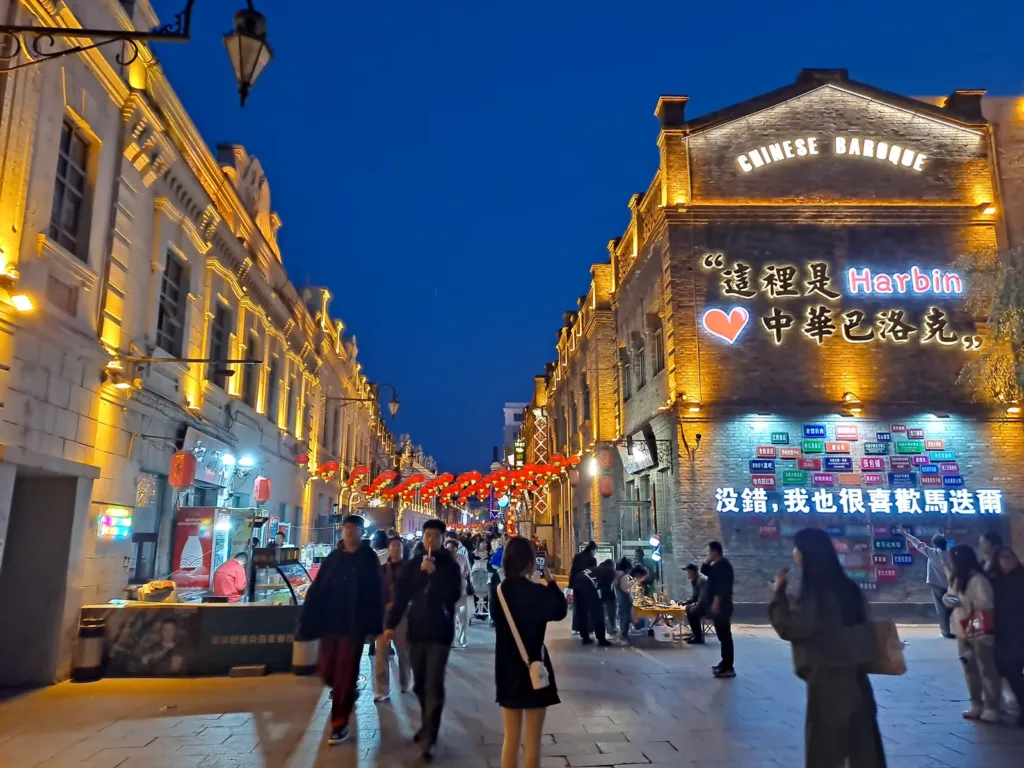
Harbin’s Chinese Baroque Historic Quarter is a neighborhood rather than a single enclosed monument. Its public streets show how Chinese merchants in historic Fujiadian (傅家甸), outside the former railway concession areas, adopted a fashionable European façade language without abandoning Chinese courtyard planning and decorative symbols. The result is not a copied European street: it is a record of how Harbin’s Chinese commercial community adapted outside influences to its own building traditions.
What to notice
Start from the street. The façades use Baroque-inspired curves, columns, arches and relief decoration, while details such as bats, peonies, pomegranates, auspicious clouds and other motifs draw on Chinese ideas of good fortune. Behind the public-facing frontage, the plans may turn into four-sided or three-sided courtyards, sometimes linked by gates, passageways or galleries. View a courtyard only when its entrance is clearly public; many yards remain homes, workplaces or parts of individual businesses.
The published conservation area is spread across several blocks, roughly from Jingyang Street east to Tenth Dao Street, with the southern edge around Nanxun Street–Fengrun Street and the northern edge around Tongfa Street–Shengping Street–Diling Street. A 2024 provincial culture-and-tourism report counted one protected cultural-relic unit, 40 immovable cultural relics, 61 historic buildings and 105 courtyards in the area. These figures describe the reported heritage inventory, not a list of buildings that can all be entered.
The quarter grew from the Chinese commercial settlement of Fujiadian. The railway and river trade helped Harbin expand from the late nineteenth century, while Daowai remained outside the railway concession areas and became a major Chinese residential and trading district. The street façades therefore tell two stories at once: the aspiration of prosperous shopkeepers and the practical courtyard-based life behind the shops.
A slow street walk and a bite to eat
Walk the public lanes slowly and look above eye level. Compare a decorated shop front with the simpler passages leading toward an entrance, and notice where a commercial façade gives way to an internal courtyard. The South Second Dao Street area is associated with established Daowai food businesses. Recent reporting describes baozi, smoked-and-sauced foods known as 熏酱, old-style pastries and other local dishes, but menus, queues and business names change; choose on the day and ask about meat, fillings or cooking methods if they matter to you.
The street’s living culture is part of the visit. Reports from 2023–2025 describe craft demonstrations and workshops involving paper cutting, sugar painting, clay, straw work and other traditional skills, as well as teahouse-style performances and crosstalk. Treat these as changing neighborhood activities rather than a guaranteed daily programme. Do not enter a private courtyard or photograph residents at close range without permission.
Entry and getting there
Use the public streets as the basic visit. A courtyard, museum, performance venue or restaurant is a separate interior destination, with its own opening, ticketing and reservation arrangements if any; do not assume that a street walk includes every building or activity. Redevelopment and restoration can also affect individual lanes, so follow barriers and local notices.
The clearest verified direct transit reference is Harbin Metro Line 3, Chinese Baroque Block station (中华巴洛克街区站). The station opened with the Old Daowai section in September 2023 and sits in the core historic area. No visitor-specific exit number or current street-level walking route was established in the sources used here, so follow the station’s signs after arriving. For the return, use the same station and check the live display for the direction and service status.
For a taxi or ride-hailing car, show the Chinese name 哈尔滨道外中华巴洛克历史文化街区 Hā’ěrbīn Dàowài Zhōnghuá Bāluòkè Lìshǐ Wénhuà Jiēqū. This is a broad, multi-block quarter rather than a single building with one dependable visitor entrance, so confirm a public drop-off point with the driver. Plan around the metro or a taxi rather than assuming that a particular bus or seasonal river service reaches the quarter; no current visitor-specific bus or water connection was verified for this guide.
Find Chinese Baroque Historic Quarter
中华巴洛克历史街区 · 道外区
The pin marks the area, not the entrance.
Sources & visit information
Sources checked on 23 October 2026. Hours, tickets, reservations and transport can change; confirm with the operator before you go.
Image credits & notes (1)
- Lantern-lit pedestrian street in Harbin’s Chinese Baroque Historic Quarter, showing continuous decorated façades on both sides (photographed 14 October 2023). Photo: EditQ (https://commons.wikimedia.org/wiki/User:EditQ)Photo: CC BY-SA 4.0