


Get to know Daowai District
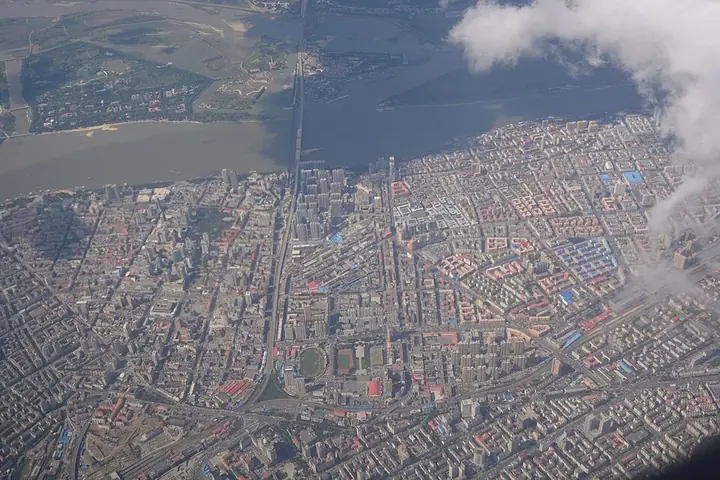
Photo adjustments
Full frame retained; proportionally resized and converted to WebP. No retouching or changes to the photographed subject. Card displays may crop the view.
- Administrative area
- District · 市辖区
- Part of
- Harbin
- Chinese name
- 道外区
- Local areas
- District guide
Area & population
- Area in the source
- 618.60 km²
- Population · 2019
- 644,894
- Administrative seat
- Daxing Subdistrict (大兴街道)
Source: cited geographic source, as of the dates shown.
History
The Heilongjiang culture and tourism department dates the name to 1890, when two brothers of the Fu family (傅宝善 and 傅宝山) from Shandong (山东) opened a carters' inn and a small pharmacy; the place became known as Fujiadian (傅家店, "Fu family inn"; later written 傅家甸). When Russia built the Chinese Eastern Railway (中东铁路), Fujiadian lay outside the railway zone and remained a Chinese settlement, and by the early twentieth century it was growing into a commercial centre.
In 1907 the Qing set up the Binjiang subprefecture (滨江厅) at Fujiadian. The area became Binjiang County (滨江县) in 1913 and Binjiang City (滨江市) in 1929, and was absorbed into Harbin after the Japanese occupation of 1932. The East and West Fujia districts were merged as Daowai District in 1956, and Taiping District (太平区) was merged into it in 2004.
What to see
The Chinese Baroque Historic Quarter (中华巴洛克历史文化街区) covers 47.23 hectares of old Daowai. Chinese businessmen built houses with Baroque street fronts decorated with Chinese auspicious motifs, and traditional courtyards behind them; the provincial culture and tourism department describes it as the largest and best-preserved group of such buildings in China, and it was named a national tourism and leisure block in 2023. Its South Second Street (南二道街) gathers old restaurants such as Zhangbaopu (张包铺) and Laorenyi (老仁义).
The Harbin Circuit yamen (哈尔滨关道), known as the Daotai Fu (道台府), stands between North 18th and North 19th streets. Begun in 1905, it was the first seat of civil government in Harbin, was restored in 2005 and is a provincial protected site; its halls show the circuit intendant's courtroom, offices and living quarters. The Wu Lien-teh Memorial Hall (伍连德纪念馆), at 140 Baozhang Street, occupies the old Northeast plague-prevention office and tells how Wu Lien-teh (伍连德) fought the pneumonic plague of 1910.
Setting and landscape
The Songhua runs for 41 kilometres through the district, which also has the Ashi River (阿什河) and the Majiagou River (马家沟河). Tianheng Mountain (天恒山), in Tuanjie town (团结镇), is described by the district as the only natural hill on the outskirts of Harbin; it rises to 120-215 metres and is more than 70 percent forested. The climate is continental monsoon, with a January mean of minus 20.3°C.
Food and local products
Laorenyi, founded in 1912, specialises in Hui-style steamed beef dumplings. Laodingfeng (老鼎丰), founded in 1911 on Zhengyang Third Street, makes pastries and is known for mid-autumn mooncakes; it carries the national "China Time-honoured Brand" (中华老字号) title.
Highlights
- Chinese Baroque Historic Quarter 中华巴洛克历史文化街区: Baroque street fronts with Chinese courtyards behind; national tourism and leisure block since 2023.
- Harbin Circuit yamen (Daotai Fu) 哈尔滨关道: Begun in 1905 as Harbin's first seat of civil government; provincial protected site.
- Wu Lien-teh Memorial Hall 伍连德纪念馆: In the former Northeast plague-prevention office on Baozhang Street.
- Tianheng Mountain 天恒山: Forested hill in Tuanjie town, called the only natural hill on Harbin's outskirts.
- Laodingfeng pastries 老鼎丰: Pastry maker founded in 1911, known for mooncakes.
Sources for this guide
哈尔滨市道外区人民政府 地理位置 · Daowai District People's Government, Harbin
哈尔滨市道外区人民政府 历史溯源 · Daowai District People's Government, Harbin
“中华巴洛克”街区中西合璧的建筑艺术殿堂 · Heilongjiang Provincial Department of Culture and Tourism (reprinting Heilongjiang Daily)
哈尔滨官道 · Daowai District People's Government, Harbin
道台府遗址文化公园 · Daowai District People's Government, Harbin
伍连德纪念馆 · Daowai District People's Government, Harbin
哈尔滨市道外区人民政府 自然资源 · Daowai District People's Government, Harbin
哈尔滨市道外区人民政府—自然简况 · Daowai District People's Government, Harbin
美食广场 · Daowai District People's Government, Harbin
Original English written from the listed sources and checked sentence by sentence against quoted extracts by a separate reviewer. Updated 2026-09-24.
Explore Daowai District
Core places to explore, with English and Chinese names.
Places to explore around Daowai District
 Chinese Baroque Historic Quarter (
Plan your visit
Getting there
Daowai District is about 4 km in a straight line from central Harbin. Search for 道外区 in a map app to find stations and your accommodation.
Where to stay →Build your route
Start with Chinese Baroque Historic Quarter. The linked place guides have entrance and visit details.
Continue with Harbin →More in Harbin
Sources & geographic information
Administrative names and parent areas: Official geographic directory · Reference date 2026-09-06.
Photo: Chinese Baroque Historic Quarter · JacobLyu · CC BY-SA 4.0. Full frame retained; EXIF orientation normalized, proportionally resized to at most 800 pixels and converted to WebP. No generated pixels or subject changes. Cards may crop the display.

Map data © OpenStreetMap contributors. Pins mark approximate centres, not entrances or boundaries.