

Explore the region
What this place is
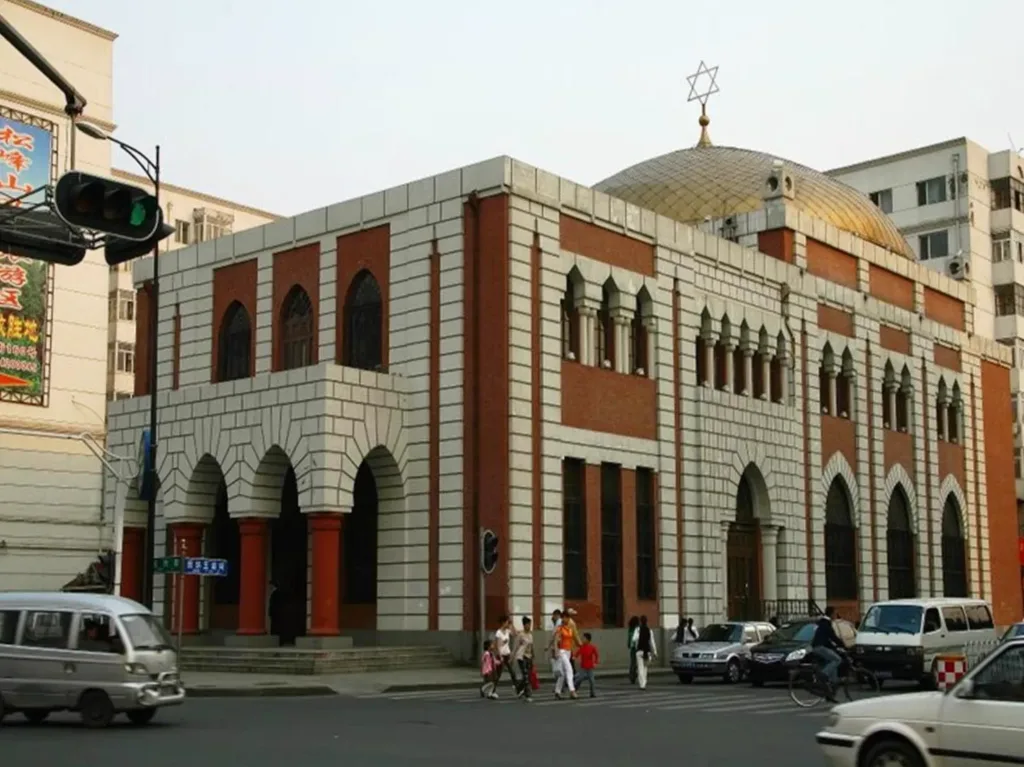
At 162 Jingwei Street (经纬街162号), the building is now presented by Harbin Museum as the Harbin Jewish History and Culture Memorial Hall (哈尔滨犹太历史文化纪念馆). The synagogue was founded on 21 September 1918 and completed on 25 September 1921. The museum describes a three-storey brick-and-stone building with a 2,163-square-metre floor area and space for about 800 worshippers. It was repaired in 2004 and opened to the public in 2006.
The building is part of the Harbin Jewish Activities Old Site Group, included in the seventh batch of China’s national-level key cultural relics protection units in 2013. Inside, the permanent exhibition is arranged in six parts, using objects and display panels to introduce Jewish life and institutions in railway-era Harbin.
What to look for
Start outside on Jingwei Street. The red-and-white masonry, square main form, pointed entrance arch, columned frontage and dome make the building easy to distinguish from the surrounding street buildings. Local architectural documentation also records six-pointed-star motifs in the windows and above the dome.
“New” is a historical distinction, not an alternative name for the older synagogue on Tongjiang Street. The two buildings belonged to the city’s Jewish community but are separate sites. The New Synagogue served the Hasidic congregation; its architect is identified in local historical accounts as Joseph Yurievich Levikin.
If the exhibition is open, look at the displays after reading the façade. The value of the visit is the connection between a surviving religious building and the people, charitable organisations and communal life that once occupied this part of Daoli. The museum’s six-part description is a useful guide to the exhibition’s intended scope, but it is not a promise that every room or display will be accessible on a particular day.
Planning a visit
The current Harbin Museum listing gives opening hours of 09:00–16:00 and says the hall is closed on Mondays; it says that it normally opens during public holidays. The same page does not publish a current admission price or a booking procedure. An older local guide listed different hours and a ¥25 ticket, but it was published in 2016 and should not be treated as the present rule.
The official listing does not explain passport acceptance, identity checks or advance registration for overseas visitors. If you are travelling on a foreign passport or making a special trip for the interior exhibition, confirm those details with the venue before setting out. When the hall is closed, the façade remains a useful stop on a Daoli architectural walk, but do not assume that an exterior view means the exhibition is open.
Getting there and returning
For a taxi or ride-hailing car, show the destination 哈尔滨犹太历史文化纪念馆(哈尔滨犹太新会堂), 黑龙江省哈尔滨市道里区经纬街162号. The address is confirmed by the museum. I found no reliable source naming a designated visitor gate or a fixed drop-off curb, so agree the exact stopping point locally rather than assuming that the nearest side street is an entrance.
Harbin Metro Line 2 serves Zhongyang Street (中央大街) and Shangzhi Street (尚志大街). Either is a reasonable rail starting point for this central Daoli site, but the sources reviewed do not establish a station exit, walking distance or final pedestrian entrance. Use a live Chinese map for the last leg, or take a short taxi ride from the station. For the return, reverse the same Line 2 journey after checking the current service status.
A nearby Jingwei Street listing identifies the stops Lao Huitang Concert Hall (老会堂音乐厅), Jingwei Third Street (经纬三道街) and Jingwei Sixth Street (经纬六道街), with local services including buses 2, 21, 75 and 105. These are area-level transport leads rather than a verified stop directly at No. 162. Check the live route, direction and stop name before boarding, then use the opposite-direction stop for the journey back.
Combine your visit
Suggested order within this visit:
-
Synagogue façade
Identify the religious symbols and contrasting masonry.
-
Community-history displays
Follow the people and institutions associated with the building.
-
Education and cultural-life material
Finish with the community's contribution to the city's arts and learning.
This sequence is an editorial suggestion based on the features described in the sources. Access to individual buildings or areas should be checked locally; no travel time or shared admission is implied.
Find Harbin Jewish New Synagogue
哈尔滨犹太新会堂 · 哈尔滨市
The pin marks the area, not the entrance.
More places nearby
Approximate straight-line distances between map pins, not travel distances.
Zhongyang Street 中央大街
Less than 1 km awayZhongyang Street is an architectural walk as well as a shopping street. Its rounded stone paving runs toward the Songhua River through façades associated with Harbin's early international trading community. At No. 89, the Modern…
View guide →Saint Sophia 圣索菲亚教堂
Less than 1 km awaySaint Sophia is a former Russian Orthodox cathedral whose red-brick walls and large green dome give Harbin one of its most recognisable silhouettes. The present church was completed in 1932, replacing an earlier wooden building…
View guide →Heilongjiang Art Museum 黑龙江省美术馆
Less than 1 km awayHeilongjiang Art Museum is especially useful for understanding the province's printmaking tradition. Artists associated with Beidahuang recorded agriculture, industrial work and northern landscapes, giving woodcuts a prominent…
View guide →Sources & visit information
Sources checked on 23 October 2026. Hours, tickets, reservations and transport can change; confirm with the operator before you go.
Image credits & notes (1)
- The exterior of Harbin's New Synagogue on Jingwei Street, with its red-and-white masonry, pointed arches and dome. Photo: JewbaskPhoto: Public domain