

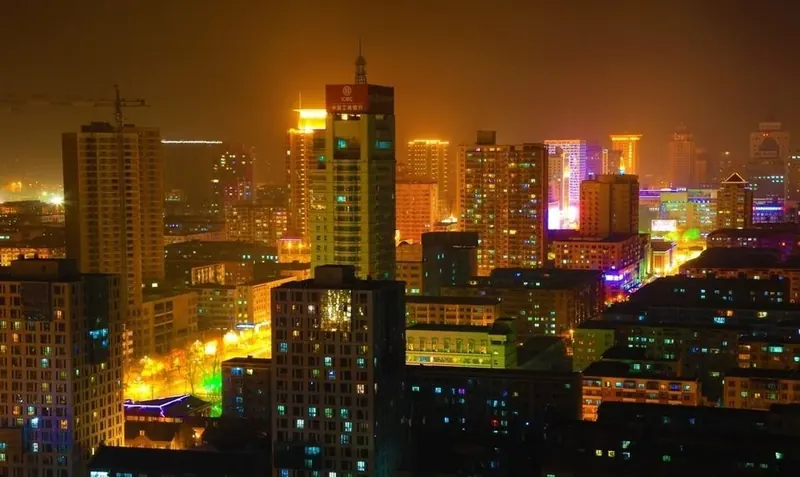
Photo adjustments
Full frame retained; proportionally resized and converted to WebP. No retouching or changes to the photographed subject. Card displays may crop the view.
Explore the region
About Mudanjiang
People's Park contains Yixin and Lianxin lakes, with planted banks and wetland vegetation set among everyday recreation spaces. These small-scale urban views are a useful contrast to Jingpo Lake's much larger landscape. Keep the city circuit compact, then plan Jingpo or Shangjing Longquanfu with a separate road transfer and enough time for the site itself.
The name Mudanjiang comes from the Manchu 'Mudan Ula', meaning a winding river. Ancestors of the Manchu people lived in the area for over two thousand years, and under the Tang dynasty it held Bohai's Upper Capital, Longquan Fu (上京龙泉府), one of the state's five capitals, modelled on Chang'an and enclosed by outer, inner and palace walls. Bohai fell to the Khitan in 926, and the region passed through Liao, Jin, Yuan, Ming and Qing administration, with the Qing long restricting land reclamation there.
Development began after Imperial Russia built the Chinese Eastern Railway and a station at Mudanjiang in 1898; the settlement remained small into the 1920s, overshadowed by the nearby town of Ning'an, though foreign merchants from France, Russia, Britain and Denmark opened trading agencies there. Japan occupied the area from 1931, developing it as a military and administrative center under the name Botankou, before Soviet forces captured the city in August 1945.
Mudanjiang lies at an average elevation of 230 meters amid mountains, hills and river valleys, with the Zhangguangcai and Laoye ranges to the east; its highest point, Baitu Mountain, reaches 1,686.9 meters, and its lowest, near the Russian border, is 86.5 meters. The local culture took shape mainly through Hebei and Shandong migrants, whose speech remains part of a local variant of Northeastern Mandarin.
What to look for
- Yixin Lake and the planted water landscape in People's Park.
- Lianxin Lake's retained wetland vegetation.
- Jingpo Lake and the Bohai capital remains as separate excursions from the city.
Location & getting there
Getting to Mudanjiang
Mudanjiang railway station is the main city rail arrival. People's Park is south of the station, between Dongsitiao Road and Huanhu Road.
- Confirm a dedicated onward transfer before visiting Jingpo Lake or Bohai Town; these are outside the central park area.
Combine your visit
Suggested order within this visit:
-
People's Park northern squares
Begin with the park's everyday community spaces.
-
Yixin Lake
Continue through the eastern water landscape.
-
Lianxin Lake
Finish with the smaller lake and wetland vegetation.
This sequence is an editorial suggestion based on the features described in the sources. Access to individual buildings or areas should be checked locally; no travel time or shared admission is implied.
Find Mudanjiang overview
牡丹江 · 牡丹江市
The pin marks the area, not the entrance.
More places nearby
Approximate straight-line distances between map pins, not travel distances.
People's Park 牡丹江人民公园
4 km awayMudanjiang's People's Park combines a social gathering place with two different lake landscapes. Yixin Lake occupies the eastern part, while the smaller Lianxin Lake lies nearer the western entrance and includes a retained…
View guide →Shangjing Longquanfu 渤海国上京龙泉府遗址
61 km awayShangjing Longquanfu was a capital of the Bohai, or Balhae, kingdom. Its plan followed the model of Tang Chang'an, organising an outer city, inner city and palace city around a north–south ceremonial axis. The surviving site is…
View guide →Jingpo Lake 镜泊湖
93 km awayJingpo Lake owes its long, winding shape to lava flows that blocked the Mudan River. The northern end gives a compact introduction to that volcanic landscape: Diaoshuilou Waterfall drops over dark rock, while the lakeside…
View guide →Sources & visit information
The linked encyclopedia sources support background and place descriptions. Current opening hours, ticket prices, booking rules and transport schedules have not been independently verified for this guide. Confirm them with the venue or operator before travelling.
- Wikipedia: 牡丹江市 ↗
- Chinese Wikipedia: 牡丹江市 (revision 94273130, 2026-09-10) ↗
- English Wikipedia: Mudanjiang (revision 1365277693, 2026-07-21) ↗
Visitor information adapted and edited from Wikipedia contributors · CC BY-SA 4.0. Source revision 92746425.
Background paragraphs translated and condensed from Wikipedia contributors, "牡丹江市", Chinese Wikipedia · CC BY-SA 4.0. Source revision 94273130.
Background paragraphs condensed from Wikipedia contributors, "Mudanjiang", English Wikipedia · CC BY-SA 4.0. Source revision 1365277693.