

Photo adjustments
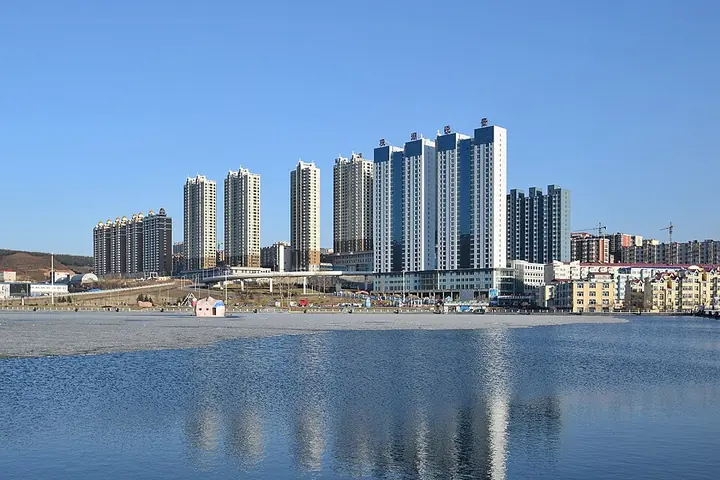
Full frame retained; proportionally resized and converted to WebP. No retouching or changes to the photographed subject. Card displays may crop the view.
Explore the region
About Suifenhe
Ren Tou Lou, the former tea-trading house later used as a Japanese consulate, is recognised by the face reliefs below its upper eaves. The Railway White Building has a different form: a two-storey courtyard block with elaborate entrance details. Its memorial displays connect the railway town with early twentieth-century political travel, making the two buildings a focused introduction to the border city.
Suifenhe lies in southeastern Heilongjiang, on the border with Pogranichny in Russia's Primorsky Krai, and is named after the Suifen River (绥芬河) that flows through the area. It has a monsoon-influenced continental climate, with a January average temperature of -16.6 degrees Celsius, a July average of 19.6 degrees Celsius and an annual average of 2.86 degrees Celsius.
As a county-level city under Mudanjiang, Suifenhe was designated in 2011 as one of the first two counties in Heilongjiang placed under direct provincial administration for economic and fiscal matters, while its judiciary and legislature remain under Mudanjiang. It is the terminus of the Binsui Railway (滨绥铁路) and, since January 2014, has been the only Chinese city where trading in Russian rubles is officially permitted.
What to look for
- Ren Tou Lou's face reliefs and red-and-white façade.
- The Railway White Building's courtyard form, entrance columns and historical displays.
Location & getting there
Getting to Suifenhe
Arrive at Suifenhe railway station, then transfer into the historic centre. Ren Tou Lou is at 88 Yingxin Street and the Railway White Building at 2 Lishu Street.
- Treat Ren Tou Lou principally as an exterior architectural stop unless its current occupants allow entry.
Combine your visit
Suggested order within this visit:
-
Ren Tou Lou, Yingxin Street
Start with the former commercial and consular building.
-
Railway White Building, Lishu Street
Compare the railway residence and its memorial narrative.
This sequence is an editorial suggestion based on the features described in the sources. Access to individual buildings or areas should be checked locally; no travel time or shared admission is implied.
Find Suifenhe overview
绥芬河 · 牡丹江市
The pin marks the area, not the entrance.
Sources & visit information
The sources below support the place-specific description and arrival information. Suggested combinations are editorial planning ideas; confirm current opening, entry arrangements and transport services for your date.
- Wikipedia: 绥芬河市 ↗
- Suifenhe Museum: former Japanese consulate / Ren Tou Lou ↗
- Suifenhe Museum: Railway White Building ↗
- CNR on-site visit: White Building memorial ↗
- English Wikipedia: Suifenhe (revision 1374269081, 2026-09-10) ↗
Visitor information adapted and edited from Wikipedia contributors · CC BY-SA 4.0. Source revision 93200220.
Background paragraphs translated and condensed from Wikipedia contributors, "绥芬河市", Chinese Wikipedia · CC BY-SA 4.0. Source revision 93200220.
Background paragraphs condensed from Wikipedia contributors, "Suifenhe", English Wikipedia · CC BY-SA 4.0. Source revision 1374269081.