

Explore the region
Tap any red Chinese text to hear it in Mandarin.
Why this place matters
Guanlin is not simply a tomb and not simply a temple. The municipal cultural-heritage authority describes it as a national-level protected site, a National 4A attraction and a place associated with the intangible cultural heritage of Guan Gong worship. It is also managed as a living cultural site connected with worship, festivals and exchanges among Guandi temples and communities overseas.
The burial story should be read as tradition: Guan Yu was killed in 220, and the story says Cao Cao buried his head here with rites for a prince. Earlier written records do not establish the location with the same precision, while Ming-period inscriptions show that the site was already being identified as Guan Yu’s burial place by the late sixteenth century. The surviving complex therefore lets you see both the historical architecture and the later making of a sacred memory.
What to look for
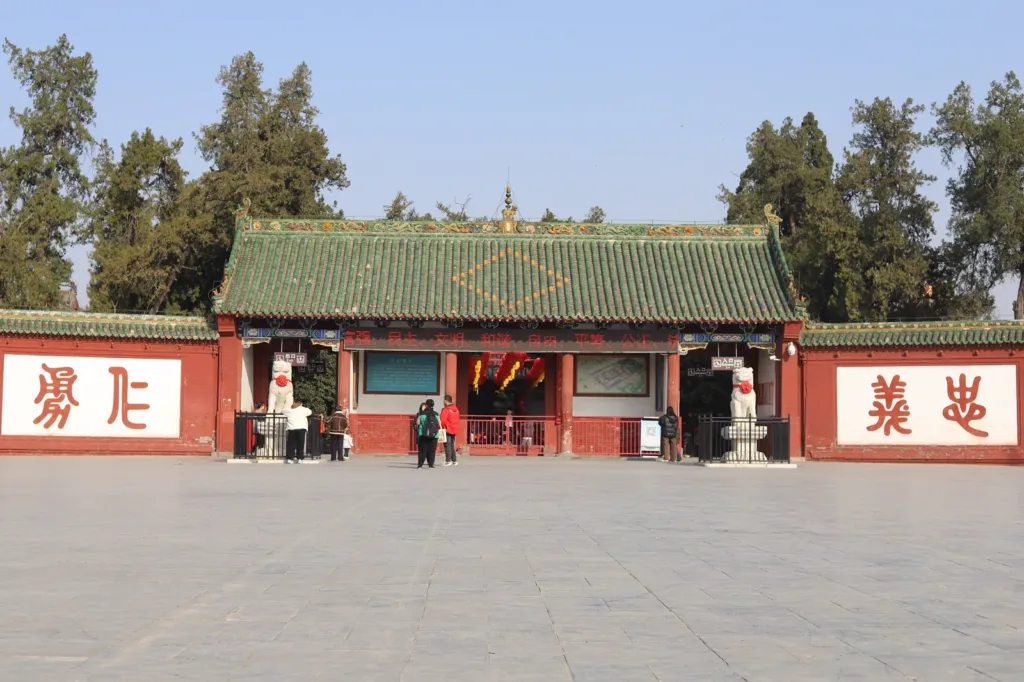
Enter with the north–south sequence in mind. The traditional route moves from the opera stage and gates through halls for Guan Yu and on toward the tomb mound. The core compound is organized around courtyards; Ming and Qing rebuilding gives the surviving architecture its present character. Look closely at the stone lions, memorial archways, steles and old cypresses rather than treating the complex as a single photo stop.
Published descriptions count more than 70 stone steles, four stone memorial archways, more than 110 stone and iron lions and about 800 old cypress trees. These figures are useful for knowing what to look for, but individual buildings, displays and access can change; follow on-site notices.
The tomb mound is reached after the temple precinct, not presented as an isolated archaeological find. Keep the distinction between traditional association and proven fact in your wording, and do not turn worship, offerings or visitors’ acts of remembrance into a performance. Ask before photographing ritual activity, avoid touching religious objects, and follow any restrictions inside halls.
Planning the visit
Guanlin is in Luolong District. A visitor listing gives the address as 关林南街2号, Luolong District, Luoyang. The same page, based on a visitor post published on 27 February 2025 and edited by Qunar on 27 September 2026, reports an adult ticket of CNY 40 and opening from 08:30 to 17:30. An English CITS guide instead lists 08:00–18:30, also with a CNY 40 ticket. These are not consistent enough to treat as a live official timetable: confirm the gate, ticket, discounts and any booking requirement with Guanlin management before you travel.
For public transport, the CITS guide lists bus 55 or 81 from Luoyang Railway Station and bus 58 from White Horse Temple. Use the Chinese destination 关林 Guānlín or 关林庙公交枢纽站 Guānlín Miào Gōngjiāo Shūniǔ Zhàn in Amap, verify the route and the return stop on the day, and do not rely on an old timetable. If using a taxi or ride-hailing car, show 关林(关林南街2号) and ask the driver to confirm the current visitor entrance. Luoyang’s metro operator currently lists Line 2’s Longmen High-Speed Railway Station (龙门高铁站) but no station named Guanlin; the metro is therefore not a verified direct entrance route for this visit.
Allow time to walk the whole axis and the cypress grounds. Guanlin works best as a focused heritage visit, paired by your own transport plan with Longmen or another Luoyang site rather than treated as a quick stop between unverified connections. Current entrance arrangements, photography rules and any event-day changes take priority over this guide.
Combine your visit
A suggested sequence through the named features described in the source.
-
Temple halls
Begin with the rebuilt halls dedicated to Guan Yu.
-
Commemorative grove and tomb precinct
Continue to the grove and the tomb traditionally associated with Guan Yu’s head.
The order is an editorial suggestion. Internal opening arrangements and transfers between sectors need checking; no walking duration or access entitlement is implied.
Find Guanlin
关林 · 洛阳市
The pin marks the area, not the entrance.
More places nearby
Approximate straight-line distances between map pins, not travel distances.
Luoyang Museum · Nietai Road 洛阳博物馆·聂泰路馆址
5 km awayLuoyang Museum presents objects from the successive cultures and capitals of the Luo River valley. Its bronze collection is especially distinctive: a three-wheeled dove cart turns an animal into a small vehicle, while ritual…
View guide →Longmen Grottoes 龙门石窟
6 km awayLongmen’s Buddhist figures occupy limestone cliffs on both sides of the Yi River, with the densest sequence on the west bank. Small niches and inscriptions lead to compositions on a very different scale, especially the great…
View guide →Yingtian Gate 应天门遗址
8 km awayYingtian Gate marked the southern entrance to the palace city of Sui and Tang Luoyang. Today, a large protective reconstruction gives the gateway’s scale and projecting towers a visible form above the archaeological remains. The…
View guide →Sources & visit information
Sources checked on 23 October 2026. Hours, tickets, reservations and transport can change; confirm with the operator before you go.
Image credits & notes (1)
- The main gate of Guanlin Temple (Guanlin), Luoyang, showing the green-tiled entrance hall, stone guardian lions and cypress trees behind the courtyard. Photo: BaomiPhoto: CC BY-SA 4.0