

Explore the region
Tap any red Chinese text to hear it in Mandarin.
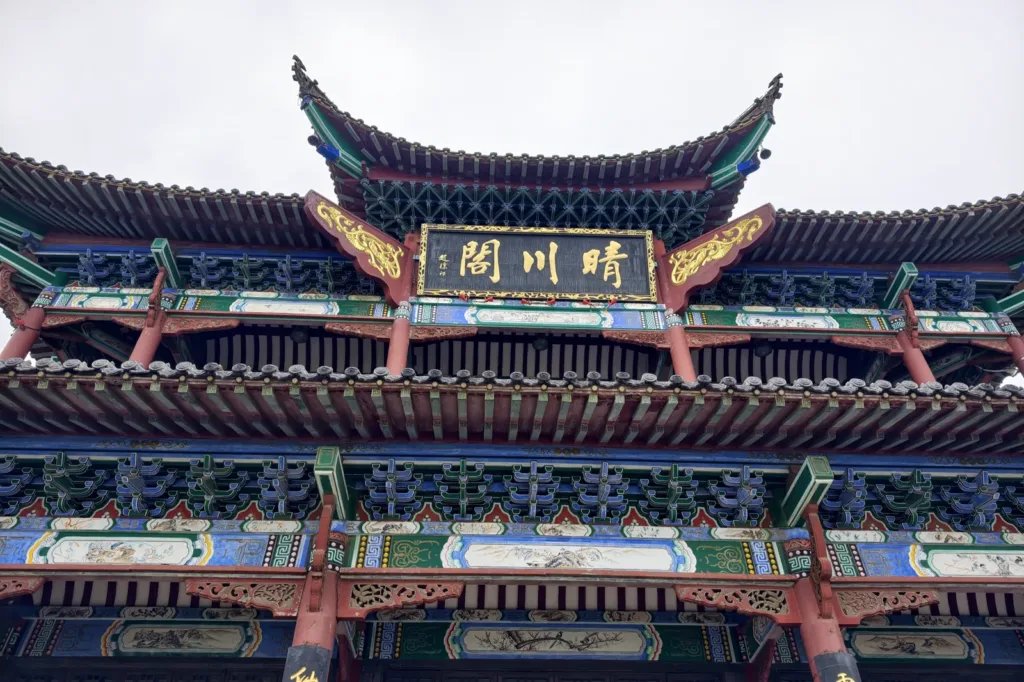
Qingchuan Pavilion sits on 禹功矶 at the eastern foot of Guishan in Hanyang. It faces the Yangtze and the mouth of the Han River, with Yellow Crane Tower on the opposite bank. The view is the point: the pavilion gives you a close look at a reconstructed historic roofline while the river, bridge and opposite hill make Wuhan’s geography legible.
The name comes from the image “晴川历历汉阳树” in Cui Hao’s Tang-dynasty poem about Yellow Crane Tower. The present buildings should not be read as one untouched Ming-era survival. The pavilion has been repeatedly rebuilt; the official account says the current version was reconstructed in the 1980s in the style of the Qing Guangxu period and opened in 1986, while the district government records a wider 1983–1991 reconstruction of the compound.
What to look for
The managed site is a small architectural group rather than only one tower. Start with the river-facing Qingchuan Pavilion, then look at Yuji Palace (禹稷行宫), whose history is tied to local worship of Yu the Great and whose surviving-style timber architecture is identified by the venue as an example of late-Qing construction in Wuhan. Tiemen Gate (铁门关) adds a different layer: the venue describes it as a strategic pass first established in the Three Kingdoms period and rebuilt in the 1990s.
Allow time for the courtyards, carved and inscribed stones, covered paths and river edge listed by the museum as part of the compound. The most rewarding visit is unhurried: compare the three main buildings, then pause for the view toward the bridge and Yellow Crane Tower. These are connected parts of the Qingchuan Pavilion site, not a promise that every nearby attraction or event uses the same access arrangement.
Practical visit
The visitor address is No. 86 Ximachang Street, Hanyang District, Wuhan (中国湖北武汉汉阳洗马长街86号). The official visitor notice says daytime entry is free. It lists opening hours of 09:00–17:00, with last entry at 16:30; the site is closed on Mondays, and its exhibition halls close at 15:00 on Thursdays for maintenance. The same notice says national public holidays are open all day and that the venue closes on Chinese New Year’s Eve.
Individual visitors register at the gate and pass a security check. Groups should arrange a reservation in advance through the venue at 027-84710887. The official notice does not state a passport-specific procedure, so international visitors should keep the Chinese name and address ready and confirm any current identification or reservation requirement before setting out.
The venue’s own transport page lists the 晴川大道晴川阁 Qíngchuān Dàdào Qíngchuān Gé bus stop, served by routes 30, 531, 532, 535, 553, 559, 561, 711 and 803. For metro travel, it advises taking Wuhan Metro Line 4 to Zhongjiacun Station (钟家村站), Exit E1, walking to the Zhongjiacun bus stop on Hanyang Avenue, and continuing by routes 535, 711, 803 or 553. This is a transfer rather than a metro stop at the pavilion; check the live service and the last return connection on your travel date.
For a taxi or ride-hailing car, show 晴川阁 / 武汉大禹文化博物馆,洗马长街86号 and follow the signed visitor approach. Do not use the nearby management-office address (晴川大道5号) as a substitute for the visitor address: the government listing identifies it as the administration office, while the venue’s visitor pages give 洗马长街86号.
Combine your visit
A suggested order for exploring this place and its immediate setting.
-
Qingchuan Pavilion晴川阁
Begin with the river-facing architecture.
-
Yuji Palace禹稷行宫
Explore the commemorative setting devoted to water control.
-
Tiemen Gate铁门关
Finish by comparing the gate structure with the pavilion.
Check access to the individual stops. A suggested sequence does not imply a combined ticket or guaranteed transfer.
Find Qingchuan Pavilion
晴川阁 · 武汉市
The pin marks the area, not the entrance.
More places nearby
Approximate straight-line distances between map pins, not travel distances.
Wuhan Yangtze River Bridge 武汉长江大桥
1 km awayWuhan’s first Yangtze bridge is a working piece of transport history. Opened in 1957, it put road traffic above a double railway track and replaced the cumbersome ferrying of trains across the river. Its steel spans link Snake…
View guide →Guqin Tai 古琴台
2 km awayGuqin Tai commemorates the story of the musician Boya and Zhong Ziqi, the listener who understood his playing. Its setting between Turtle Hill and Moon Lake gives the musical tradition a quiet landscape context. The memorial has…
View guide →Yellow Crane Tower 黄鹤楼
2 km awayYellow Crane Tower rises above Snake Hill with layered roofs and wide views towards the Yangtze. Its literary fame is much older than the building: the present tower was completed in 1985 after earlier versions repeatedly burned…
View guide →Sources & visit information
Sources checked on 23 October 2026. Hours, tickets, reservations and transport can change; confirm with the operator before you go.
- Wuhan Dayu Culture Museum / Qingchuan Pavilion Management Office home page ↗
- Hanyang District Government: Scenic attractions ↗
- Qingchuan Pavilion: venue history and introduction ↗
- Yuji Palace: venue introduction ↗
- Tiemen Gate: venue introduction ↗
- Visitor information: opening, entry and address ↗
- Official transport information ↗
- Wuhan Culture and Tourism Bureau: management office profile ↗
- Wuhan Transport Bureau: Gu De Temple–Qingchuan Pavilion D112 report ↗
- Trip.com Qingchuan Pavilion listing ↗
Image credits & notes (1)
- The ornate riverfront facade and roofline of Qingchuan Pavilion in Wuhan, photographed in 2026. Photo: HuangchinhsuPhoto: Creative Commons Attribution-ShareAlike