

Explore the region
Tap any red Chinese text to hear it in Mandarin.
Why go
武昌江滩 is not one compact viewpoint but a series of public riverside sections along Wuchang’s Yangtze shore. Its present form grew out of Wuhan’s shoreline clean-up: from 2016, the city removed more than 200 sand yards along the riverbanks, adjusted wharf frontage and returned about 70 hectares of riverside to green space. The wider Hundred-li Yangtze Ecological Corridor then combined flood protection, planting, slow paths and public recreation rather than treating the embankment as scenery alone.
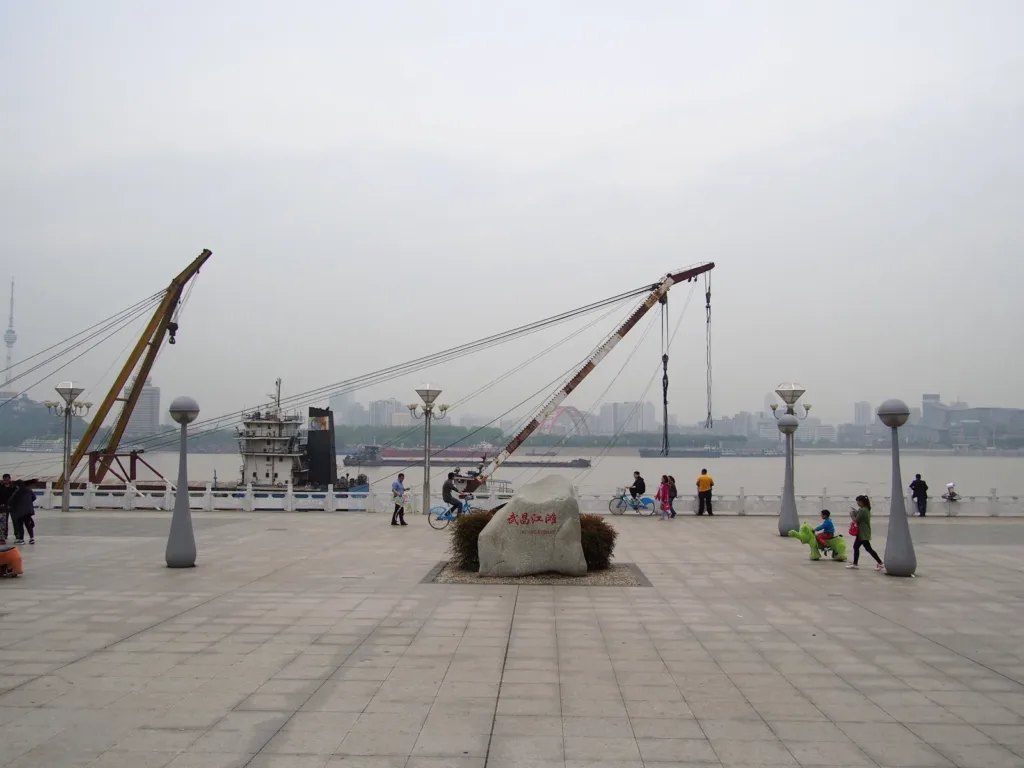
The most legible place to start is Wuchang Bay, on the former Wuchang Shipyard site. The project retained industrial traces such as gantry cranes and slipways while rebuilding the embankment and adding stepped river-viewing platforms. It is a useful contrast with the softer planting elsewhere on the waterfront: look for the relationship between working-river history, the reinforced flood edge and the Yangtze beyond. The Wuchang Bay section opened in 2025, completing the city’s connected ecological corridor.
Further along, Yujiatou Riverside Ecological Park occupies the waterfront by the Yujiatou waterworks, one of Wuhan’s drinking-water intakes. Before the shoreline renewal, this stretch contained eleven wharves and nine sand-and-gravel yards. Today the walk is about the river edge, planted open space and the changing view rather than a single monument. The city’s planting programme selected 156 tree and shrub species for conditions that include periodic inundation; spring brings displays such as magnolia and rape flowers when the season is right.
What to look for
- Industrial memory at Wuchang Bay: gantry cranes and slipways remain part of the landscape on the old shipyard site.
- The city across the water: the waterfront gives viewpoints towards the Yellow Crane Tower; use the river as your orientation rather than expecting every section to face the same landmark.
- A public park used by residents: in the Xujia-peng section, the 2,400-square-metre Wuchang Riverside Sports Park has children’s play equipment, fitness facilities and a skate area. A local government report says the wider riverside sports facilities are opened free of charge in time slots, but it does not publish a current timetable.
- Seasonal planting: spring colour is weather- and maintenance-dependent, so treat flowers as a timely bonus rather than a guaranteed display.
Plan your visit
Choose a section before setting out. Wuchang Bay, the Xujia-peng sports area and Yujiatou are not interchangeable entrances, and the whole riverside does not have one single visitor gate. Use the Chinese destination 武昌江滩 Wǔchāng Jiāngtān together with 武汉市 Wǔhàn Shì and 武昌区 Wǔchāng Qū in Amap or Apple Maps, then select the section you actually want.
For public transport, Xujiapeng Station 徐家棚站 is a useful Wuchang interchange on Metro Lines 5, 7 and 8. Official reporting confirms the three lines and the station’s large interchange layout, but does not establish one nearest exit for every part of the long riverside park. After choosing an entrance, check the live walking route; for a distant section, a taxi or ride-hailing car to the Chinese destination is less ambiguous than following directions to the station alone.
There is no reliable current source in the material reviewed for one park-wide admission rule or opening-hours schedule. The riverside is a public open-space system, but individual sports areas, gates and flood-management works can have their own arrangements. Check the current map listing and local notices on the day, stay on signed public paths, and obey temporary closures during high water or maintenance. The waterfront is built around flood protection as well as recreation.
Find Wuchang Riverside Park
武昌江滩 · 武昌区
The pin marks the area, not the entrance.
Sources & visit information
Sources checked on 23 October 2026. Hours, tickets, reservations and transport can change; confirm with the operator before you go.
Image credits & notes (1)
- A historical view of Wuchang Riverside Park’s riverside promenade in Wuhan, photographed in April 2016, with working cranes and the Yangtze beyond. Photo: Chen HuangPhoto: CC BY 3.0