

Explore the region
Tap any red Chinese text to hear it in Mandarin.
Why this place matters
The site at 356 Shuyuan Road in Tianxin District is the Chengnan-campus historic core of Hunan First Normal. The institution traces its lineage to Chengnan Academy, founded in 1161 by the scholar Zhang Shi; normal-school education began here in the early twentieth century. The present school site is recognised as a national key cultural relic and as one of the important settings for China’s modern teacher education and revolutionary history.
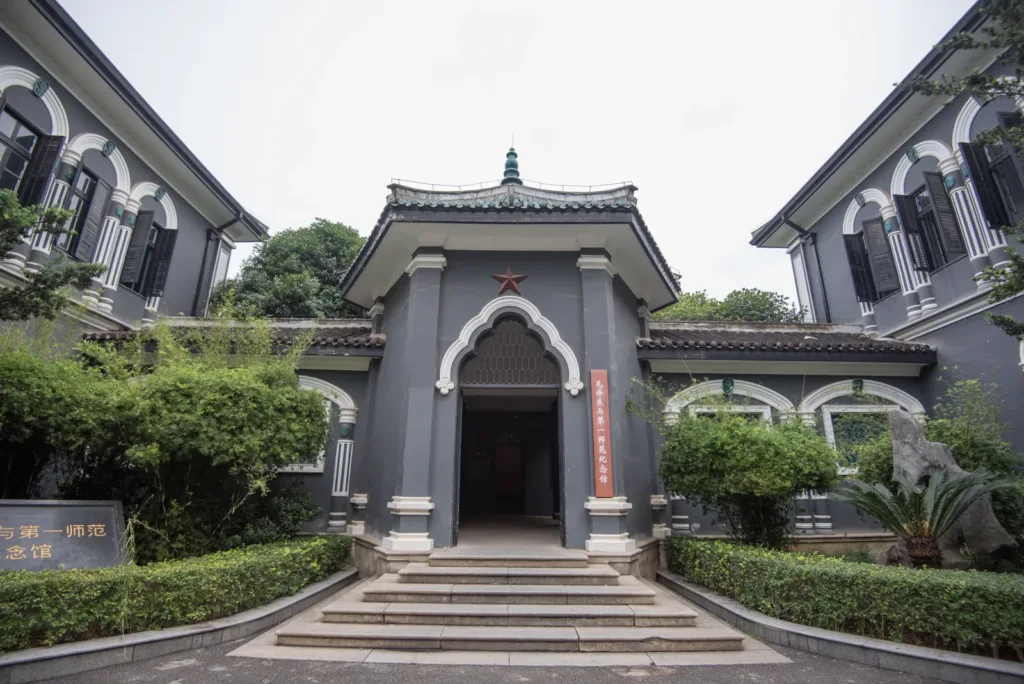
The strongest way to understand the place is spatial. The 1912-era complex combines brick-and-timber buildings with Chinese and Western architectural elements, linked by covered corridors and shaped around courtyards and practical teaching spaces. Look at how the corridors connect the classrooms, self-study rooms, reading spaces, dormitories and assembly hall rather than treating the entrance facade as the whole sight.
What to look for
Start with the Class Eight classroom and dormitory, then continue to the assembly hall and Chengnan well. These are among the 14 memorial points preserved within the old site; the official visitor description also identifies the reading room, Junzi Pavilion and the square with a young Mao Zedong statue. The rooms make the period legible in a way a biography alone cannot: desks, teaching settings, domestic routines and the well belong to an actual school environment.
The Mao Zedong and First Normal Memorial Museum adds ten themed exhibition halls to the historic-site route. Recent reporting describes the museum as using the 14 memorial points to explain Mao’s years as a student and teacher, as well as the friendships, study and early political activity of the wider student community. Read the displays alongside the buildings, and leave room for the architecture itself: the gray-and-white masonry, timber details, long verandas and changing courtyard views are part of the evidence.
Keep the scope precise. This is the Chengnan Shuyuan historic campus at 356 Shuyuan Road in Tianxin District, not Hunan First Normal’s modern campus in Yuelu District across the Xiang River. The two share an institutional name but are different visitor destinations.
Plan the visit
The site reopened to the public on 15 April 2026 after a protection-and-repair project. The reopening information available for this research states that the memorial museum is free, requires real-name reservation, and receives visitors Tuesday to Sunday from 09:00 to 17:00, with last admission at 16:30; it is normally closed on Mondays except public holidays. Enter through the historic site’s North Gate. Reserve through Alipay by searching 第一师范纪念馆 Dìyī Shīfàn Jìniànguǎn or through the museum’s WeChat public account. Groups, study visits and training activities should be booked at least three days ahead.
The published requirements confirm real-name booking, but they do not state whether a foreign passport is accepted in the current mini-program or at the gate. International visitors should ask the museum before relying on a same-day visit; the listed contact number is 0731-85157430. Bring the Chinese name and address: 湖南第一师范城南书院旧址,湖南省长沙市天心区书院路356号.
Getting there and back
The most straightforward public-transport option is Changsha Metro Line 3 to 灵官渡(第一师范)站. A current Hunan Daily city guide directs visitors to Exit 2 for the old site; from there, follow signs and local directions to the museum’s North Gate rather than assuming the university’s old west gate is the visitor entrance. The Hunan government visitor page also lists buses 1, 160, 225 and 311 from Changsha South Railway Station, Changsha Railway Station and the East Coach Station to 第一师范 Dìyī Shīfàn; bus services and directions can change, so check the live route using the Chinese stop name before setting out.
For a taxi or ride-hailing car, show 毛泽东与第一师范纪念馆北门 Máo Zédōng yǔ Dìyī Shīfàn Jìniànguǎn Běimén or the full address above. No dedicated return shuttle is identified in the sources. Leave through the North Gate and use the same metro station or the current bus network for the return leg, checking the last connection before entering the museum.
Combine your visit
A suggested order for exploring this place and its immediate setting.
-
Memorial introduction毛泽东与第一师范纪念展示
Begin with the educational and biographical context.
-
Class Eight classroom第八班教室
Read the specific classroom setting and its interpretation.
-
Assembly hall and old well大礼堂与城南古井
Continue through the designated historic-campus route.
Check access to the individual stops. A suggested sequence does not imply a combined ticket or guaranteed transfer.
Find Hunan First Normal Historic Campus
湖南第一师范城南书院旧址 · 湖南省长沙市天心区书院路356号湖南第一师范城南书院校区
The pin marks the area, not the entrance.
More places nearby
Approximate straight-line distances between map pins, not travel distances.
Orange Isle 橘子洲
Less than 1 km awayOrange Isle is a long island within the Xiang River, offering views towards both central Changsha and Yuelu Mountain. The monumental sculpture of the young Mao Zedong near its southern end gives the riverside walk a clear…
View guide →Changsha Bamboo Slips Museum 长沙简牍博物馆
1 km awayChangsha Bamboo Slips Museum turns ancient administration into something unusually tangible. The Zoumalou discoveries include wooden and bamboo documents recording land, people and official business in the Three Kingdoms period…
View guide →Tianxin Pavilion 天心阁
2 km awayTianxin Pavilion stands on a surviving section of Changsha’s old city defences, with a central tower and connected side pavilions overlooking the modern streets. The present pavilion was rebuilt in the 1980s after the earlier…
View guide →Sources & visit information
Sources checked on 24 October 2026. Hours, tickets, reservations and transport can change; confirm with the operator before you go.
Image credits & notes (1)
- The entrance pavilion of the Mao Zedong and First Normal Memorial Museum within the historic Hunan First Normal site in Changsha, photographed in 2018. Photo: Siyuwj (Wikimedia Commons)Photo: CC BY-SA 4.0