

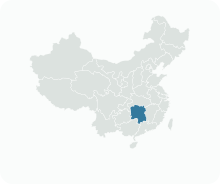
Get to know Shigu District
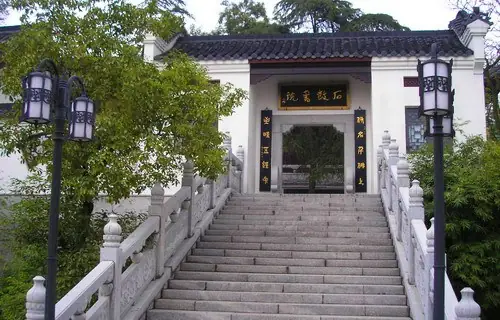
Photo adjustments
The exact downloaded source bytes are separately retained and hashed. Prepared JPEG is proportionally reduced to a maximum 720-pixel long edge; full frame retained, no subject alteration. Final website rendition: full frame retained, proportionally resized to at most 720 pixels and converted to WebP. No additional retouching or subject alteration. Card displays may crop the view.
- Administrative area
- District · 市辖区
- Part of
- Hengyang
- Chinese name
- 石鼓区
- Local areas
- District guide
Setting and landscape
Hengyang County (衡阳县) lies to the northwest, Jiefang Road (解放路) marks the southern boundary with Yanfeng District (雁峰区), and Zhengxiang North Road (蒸湘北路) the western boundary with Zhengxiang District (蒸湘区). The district government sits on Siqian Street (司前街). Hunan Daily's Xinhunan service notes that four of the eight traditional views of old Hengyang fall within Shigu.
History
The district dates from 4 April 2001, when the State Council approved a reorganisation that abolished Hengyang's four old districts and formed Shigu from five subdistricts of the former Chengbei District (城北区), parts of the former suburban district and Jiaoshan Township (角山乡), previously in Hengyang County.
Shigu Academy is far older. In the Yuanhe reign of the Tang (806–820) the scholar Li Kuan (李宽) built a hut on Stone Drum Hill to study; China.com.cn dates the founding to 810. Li Shizhen (李士真) enlarged it in 997, and in 1035 the Song court granted its name board, after which it was counted with Yingtian (应天书院), White Deer Grotto (白鹿洞书院) and Yuelu (岳麓书院) academies as one of the four great academies. Zhu Xi (朱熹) wrote a record of the academy in 1187. It was destroyed by Japanese shelling during the defence of Hengyang in July 1944, and the city government rebuilt it on its Qing-dynasty plan in 2006.
What to see
The rebuilt Shigu Academy's buildings include the Temple of the Marquis Wu (武侯祠) for Zhuge Liang (诸葛亮) and the Li Zhongjie Shrine (李忠节公祠) for Li Fu (李芾), the late Southern Song general sent in 1275 to govern Tanzhou (潭州, now Changsha) and organise its resistance to the Yuan army, who died for the Song cause. Daguan Tower (大观楼), first built at the end of the Wanli reign of the Ming, held books upstairs and lectures downstairs; carved portraits of the academy's Seven Worthies, among them Han Yu (韩愈) and Zhou Dunyi (周敦颐), hang in its ground floor. Hejiang Pavilion (合江亭) recalls the essay Han Yu wrote about it. The Shigu Academy Square (石鼓书院广场), laid out with the 2006 rebuilding, gained a new "Shigu Jiangshan" (石鼓江山, "the rivers and hills of Shigu") memorial arch in a later renovation.
In Western Lake Park (西湖公园), the district has laid out a garden themed on Zhou Dunyi, drawing on the story of Zhou Dunyi visiting the park's Lotus-Loving Pavilion (爱莲亭). Hengyang Xiang opera (衡阳湘剧), listed as national intangible heritage in 2008, has been staged in the academy.
Highlights
- Shigu Academy 石鼓书院: Grew from Li Kuan's Tang-era study hut on Stone Drum Hill; counted among the four great academies after the 1035 name grant; rebuilt in 2006.
- Daguan Tower 大观楼: Late-Wanli library and lecture hall of the academy, hung with carved portraits of the Seven Worthies.
- Li Zhongjie Shrine 李忠节公祠: Honours Li Fu, sent in 1275 to govern Tanzhou and organise its resistance to the Yuan army; first built on Stone Drum Hill in his home town of Hengyang in the Chenghua reign of the Ming.
- Hejiang Pavilion 合江亭: Academy pavilion for which Han Yu wrote his essay on Hejiang Pavilion.
- Western Lake Park 西湖公园: Home of a garden themed on Zhou Dunyi and his Lotus-Loving Pavilion story.
Sources for this guide
石鼓区 · Chinese Wikipedia · CC BY-SA 4.0
石鼓区:书香廉韵润古今 · Xinhunan (Hunan Daily new media)
石鼓書院:涵養湖湘文化的精神家園 · People's Daily Online
石鼓书院 · China.com.cn
Original English written from the listed sources and checked sentence by sentence against quoted extracts by a separate reviewer. Updated 2026-09-24.
Explore Shigu District
Core places to explore, with English and Chinese names.
Places to explore around Shigu District
Plan your visit
Getting there
Shigu District is about 6 km in a straight line from central Hengyang. Search for 石鼓区 in a map app to find stations and your accommodation.
Where to stay →Build your route
Start with Shigu Academy. The linked place guides have entrance and visit details.
Continue with Hengyang →More in Hengyang
Sources & geographic information
Administrative names and parent areas: Official geographic directory · Reference date 2026-09-06.
Some facts checked against 石鼓区 — Wikipedia contributors, CC BY-SA 4.0.
Photo: Shigu Academy · 人間正道 · 人間正道 — 石鼓书院正门.jpg — CC BY-SA 3.0 · CC BY-SA 3.0. The exact downloaded source bytes are separately retained and hashed. Prepared JPEG is proportionally reduced to a maximum 720-pixel long edge; full frame retained, no subject alteration. Final website rendition: full frame retained, proportionally resized to at most 720 pixels and converted to WebP. No additional retouching or subject alteration. Card displays may crop the view.

Map data © OpenStreetMap contributors. Pins mark approximate centres, not entrances or boundaries.