

Explore the region
At a glance
Manzhouli is a compact China–Russia border city shaped by railway trade, where a working frontier, Russian-influenced streets, the Matryoshka complex and a quieter lakeside city can be experienced in one visit.
A border city built around the railway
Manzhouli’s modern identity began with the railway. A station was established here during the construction of the Chinese Eastern Railway in 1901, and the settlement grew into a customs and trading town at the western end of the line. Its position opposite Russia still matters: the city is not a decorative “Russian-style” stop detached from the border, but a working port city whose visitor landmarks make the railway, trade and frontier visible.
That history is legible in the city’s everyday scale. The central streets are compact, with Russian-influenced rooflines, bilingual shop signs and a commercial rhythm that continues after dark. Shops, restaurants and imported-goods businesses sit alongside ordinary residential streets rather than behind a single museum gate. A walk through the centre, followed by time around Beihu Park, gives a more useful sense of present-day Manzhouli than a quick circuit of monumental attractions alone.
Three ways to read the city
The National Gate: border and railway landscape
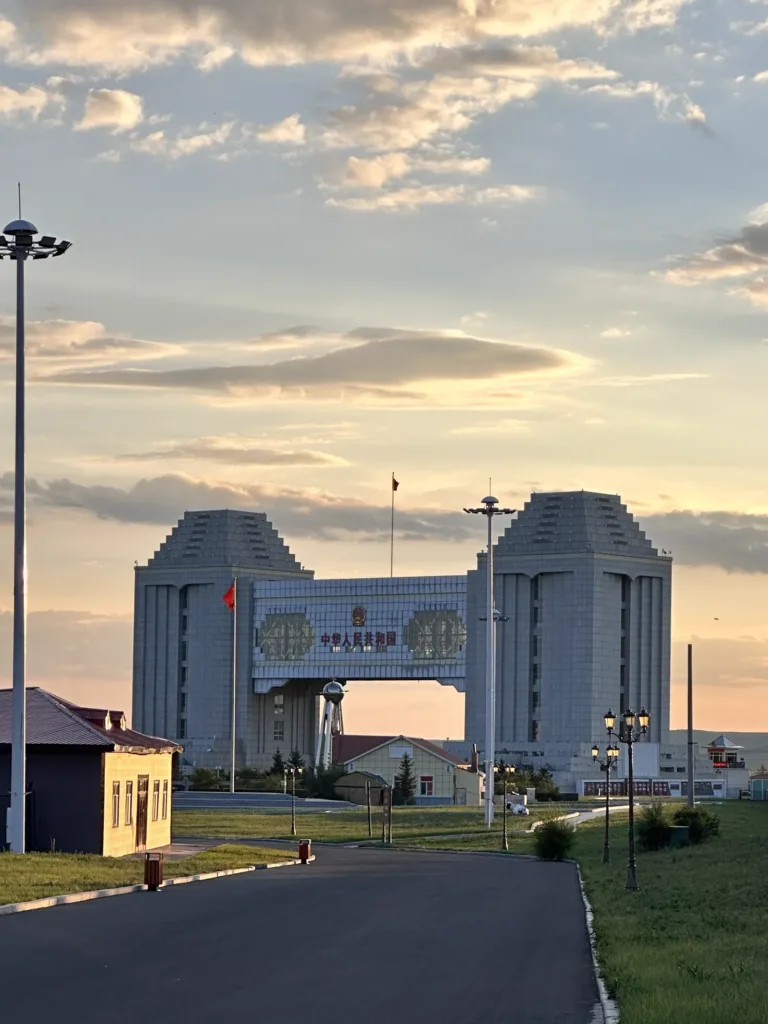
The National Gate Scenic Area (满洲里国门景区) is the clearest place to see Manzhouli as a border railway city. The municipal government lists the gate together with Boundary Monument No. 41, Peace Gate Square, Aircraft Square, Locomotive Square, the former “red secret transport line” site, the Exhibition Hall of the Sixth National Congress of the Communist Party of China and a red-history exhibition.
Treat the area as a group of viewpoints and historical displays, not as permission to approach the frontier freely. The public visitor listing describes the scenic area as being in a military-management zone and says that visitors must bring an identity document for ticketing and entry checks. It does not explain how foreign passports are handled. Visitors travelling on a passport should confirm the current document and admission procedure with the venue before setting out. Do not cross barriers or treat the boundary marker as a casual photo prop.
Matryoshka Square: a themed architectural district
The Matryoshka complex (满洲里套娃广场) expresses the city’s Russian-facing commercial culture through architecture and entertainment. The city government describes a large themed resort combining a park, performances and a hotel. Its buildings use Russian architectural motifs, while the programme includes a Matryoshka world, a Matryoshka experience hall, performance theatres, a Russian folk-culture museum and indoor and outdoor attractions.
The complex works best when you look beyond the giant doll-shaped landmark. Notice how the repeated doll form becomes a way of organising entrances, façades, plazas and staged entertainment. This is a designed visitor district rather than an old Russian quarter, so pair it with a walk through the central streets if you want to compare the city’s everyday commercial life with its purpose-built tourist image.
Beihu Park and the central streets: the quieter counterpoint
After the two western visitor complexes, return to the city centre for a slower urban view. Beihu Park and the linked lakeside green spaces are useful for observing how a border-trade city makes room for ordinary recreation. The point is not a long checklist of sights: follow the water and planted edges, then continue through nearby streets where signs, shops and evening food places show the city operating at its own pace.
Planning a visit
A practical sequence is the National Gate first, Matryoshka Square second, and the central streets or Beihu Park last. This order moves from the working border and railway setting to the city’s deliberately theatrical architecture, then back to everyday Manzhouli. It is an editorial sequence, not a promise of a shared ticket, fixed transfer time or guaranteed opening of every sub-attraction.
For rail travel, use the exact destination name 满洲里站 (Manzhouli Railway Station). The station is a railway and border-transport facility, not the entrance to either western visitor complex. After arrival, put the full Chinese name of the venue into Amap or another current local map and arrange the final ride to the named entrance.
For air travel, the airport’s current official name is 满洲里西郊国际机场 (Manzhouli Xijiao International Airport). The Civil Aviation News report on the renaming places it southwest of the city and describes it as the city’s air gateway. From either arrival hub, use the exact Chinese destination 满洲里国门景区 or 满洲里套娃广场 rather than asking for “the border” or “the Russian area.”
A public visitor listing gives Line 6 as a route from 北方市场 towards 国门景区, with 国门景区 as the destination stop, but labels the bus information as reference-only. Check the route and stop on the day. If you use a taxi or ride-hailing service for the western district, save the Chinese venue names and agree the return plan before entering; do not assume a late bus or an available car at the gate.
The same listing gives a winter-period schedule of 09:00–17:30 for the National Gate area, with last entry at 17:00, while noting that the day’s on-site information controls. Opening, performances, ticketing, and any combined arrangements at both major complexes can change by season. Recheck the venue notice for your date, and allow enough daylight to leave the western district and return to the city or your departure hub.
Combine your visit
Suggested order within this visit:
-
National Gate visitor complex满洲里国门景区游客中心
Begin with the border and railway setting.
-
Matryoshka complex满洲里套娃广场
Continue with the city's distinctive themed architecture.
-
Beihu Park满洲里北湖公园
Return to the centre for a quieter lakeside finish.
This sequence is an editorial suggestion based on the features described in the sources. Access to individual buildings or areas should be checked locally; no travel time or shared admission is implied.
Find Manzhouli overview
满洲里 · 呼伦贝尔
The pin marks the area, not the entrance.
More places nearby
Approximate straight-line distances between map pins, not travel distances.
Manzhouli Matryoshka Square 满洲里套娃广场
2 km awayManzhouli's Matryoshka complex turns the Russian nesting doll into architecture, scenery and entertainment. The giant doll-shaped hotel anchors a theme park whose buildings borrow Russian decorative forms. Inside, the Matryoshka…
View guide →Manzhouli National Gate Visitor Center 满洲里国门景区游客中心
4 km awayThe National Gate visitor complex presents Manzhouli's border and railway history around the monumental gate above the rail corridor. Boundary Monument No. 41 marks the frontier, while Locomotive Square makes the railway…
View guide →Manzhouli Beihu Park 满洲里北湖公园
5 km awayBeihu Park is a small urban-lake retreat in northwestern Manzhouli. Its appeal comes from the water, planted edges and views back toward the surrounding city, rather than a long sightseeing checklist. A circuit along the…
View guide →Sources & visit information
Sources checked on 1 November 2026. Hours, tickets, reservations and transport can change; confirm with the operator before you go.
Image credits & notes (1)
- Manzhouli National Gate Scenic Area, photographed on 13 December 2025. Photo: SUN JIAYI'sPhoto: CC BY-SA 4.0