

Explore the region
What it is
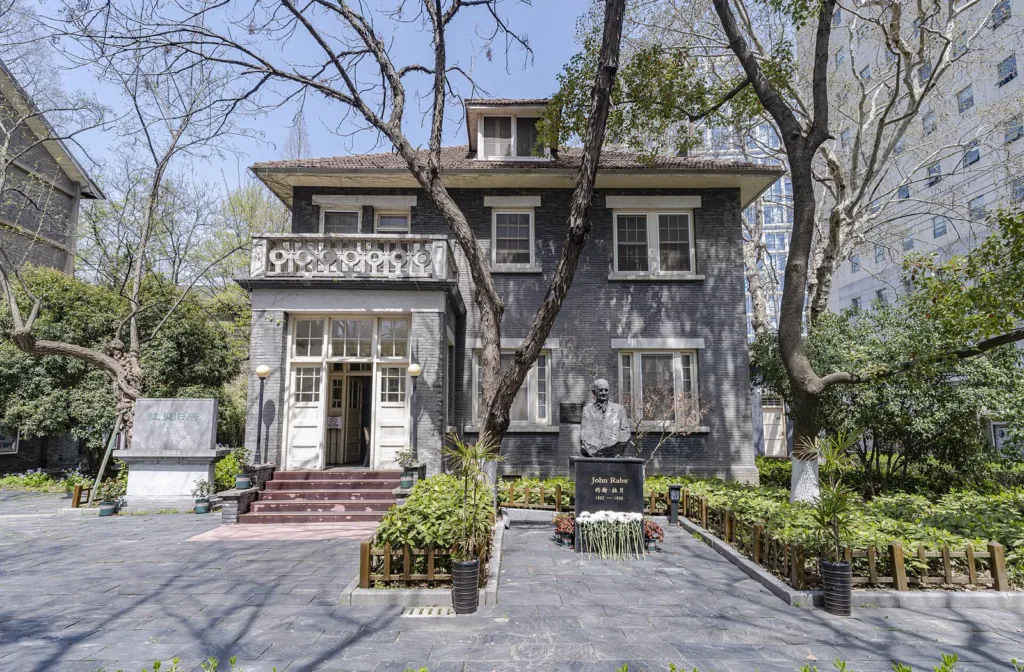
The address is No. 1 Xiaofenqiao (小粉桥1号), where Xiaofenqiao meets Guangzhou Road in Gulou District, on the southeast corner of Nanjing University’s Gulou campus south campus (南园). The building is the villa John Rabe rented under an agreement he signed with the University of Nanking’s agronomy dean, Xie Jiasheng, in 1932; it was finished in 1934 and served as both his home and the Siemens Nanjing office until he left China in 1938.
It is genuine 1930s fabric: a two-storey brick-and-timber western-style house with an attic, grey brick walls, a red tile roof, dormer windows and a small terrace above the entrance porch; five steps lead up to the door, and the compound gate faces east onto Xiaofenqiao.
Rabe chaired the International Committee for the Nanjing Safety Zone, a 3.86-square-kilometre area with 25 refugee camps that sheltered about 250,000 people; his own compound was one of those camps, holding more than 600 people at its peak. He wrote daily wartime notes here from September 1937 to February 1938; published worldwide in December 1996 as the Diaries of John Rabe, they became one of the most detailed records of the massacre. The house was identified as No. 1 Xiaofenqiao in 1997 and opened as the John Rabe and International Safety Zone Memorial Hall on 31 October 2006.
Do not confuse it with the Memorial Hall of the Victims in Nanjing Massacre by Japanese Invaders (侵华日军南京大屠杀遇难同胞纪念馆), the city’s much larger museum of the same history. This is a university-run house museum at one specific address.
What to look at
A renovation completed on 7 December 2025 rehung the exhibition in five linked parts — Rabe’s life, the evidence, humanitarian partners, the Safety Zone’s protection of people, and the residence’s own past — and split it deliberately across the building.
The ground floor follows Rabe as a person: Hamburg, his years in Africa, his move to China in 1908 and his work for Siemens in Beijing, Tianjin and Nanjing, then family life at Xiaofenqiao.
The upper floor explains how protection actually worked: the committee’s meetings, protests and relief operations, and the people who carried them out. Look for the reconstructed office, with his desk items and files and photographs shown through simulated windows, and the committee meeting room next door, where projections of wartime scenes are set against the real windows of today. A section on “humanitarian partners” draws on recent research that identified more than 1,500 Chinese staff who ran security, porridge kitchens, medical care and burials inside the Safety Zone.
In the courtyard, the element visitors linger over is the refugee register wall added in 2025: reproduced pages recording 302 men and 300 women, with names, ages, native places and occupations, which also show how the camps screened arrivals and recruited people with needed skills. Panels beside the remains of the air-raid shelter — which Rabe designed and then had reinforced, with women and children given priority — explain its construction and quote diary anecdotes about him and his neighbours. Two one-storey buildings complete the compound: the German school Rabe set up in 1934 for the children of Siemens’ German staff, and the rear building that housed the Siemens Nanjing office.
One caution on authenticity: the villa, courtyard and outbuildings are the historic structures, but the office and the committee room are described by the museum itself as reconstructions built from documents, photographs and film. Read them as interpretation rather than as untouched 1937 interiors.
The memorial covers 1,628 square metres, holds more than 300 photographs and over 50 objects, and carries status as a national key cultural relic protection unit, a national War of Resistance memorial site, and — since 2010 — a member of the International Network of Museums for Peace. Nanjing University also uses the house for teaching and runs a peace and reconciliation research centre here.
Visiting: hours, entry, tickets
Open Tuesday to Sunday, 9:00–17:00, with last entry at 16:40; Mondays are closed for internal maintenance. Holiday dates are announced separately — during the 2026 Mid-Autumn and National Day holidays, for example, the hall opened only on 26–27 September and 6–7 October, and it stayed shut on 1–2 January 2026.
There is no ticket to buy. Visitors register on arrival with an identity document, so bring your passport; the university’s visitor guide states that, as a teaching and research institution, it does not charge visit fees, and no admission price is published for the memorial. Groups that want a guided tour must book in advance through the university’s reservation system. The same guide says individual visitors must complete campus-entry formalities before entering its venues, so ask about the current procedure when you arrive — the hall sits on the campus edge with its own street address. Food and drinks are not allowed in the exhibition rooms.
The 1934 villa is entered by five steps and the exhibition continues on the upper floor; no lift appears in the museum’s own descriptions. For questions, the hall lists 025-83597217 and 025-83686306.
Some English-language listings, including the Wikipedia article, still give Monday–Friday 8:30–16:30 hours. Those predate the renovation that closed the hall for most of November 2025 and reopened it that December, so check the hall’s own page before travelling.
Getting there
Metro. Nanjing Metro Line 1, Zhujiang Road station (珠江路站), the station under the Zhongshan Road and Zhujiang Road junction, whose exit signage points toward Guangzhou Road on the north side, Xiaofenqiao and Nanjing University. The memorial’s own access note gives Line 1 to Zhujiang Road as its metro option.
Bus. The hall’s page names two nearby stops: 珠江路·中山路 (Zhujiang Road–Zhongshan Road) for routes 6, 48, 65, 91, 532 and night route Y6, and 中山路·珠江路南 (Zhongshan Road South–Zhujiang Road) for routes 1, 16, 25, 33 and night routes Y1 and Y16. The station’s own listings show the same corridor, with routes 6, 48, 65, 91, 160, 532 and Y6 at the Guangzhou Road–Zhongshan Road stop. Route numbers change over time, so read the stop sign.
Rail. Both Nanjing Railway Station (南京站) and Nanjing South Railway Station (南京南站) sit on Line 1, which stops at Zhujiang Road, so no change of line is needed from either; Nanjing South is the main high-speed hub.
Airport. Nanjing Lukou International Airport is served by metro line S1, the Airport Line, which runs between the airport and Nanjing South Railway Station; change there to Line 1 for Zhujiang Road. Since 29 September 2026, S1 trains run through with Line 6 toward Qixiashan, so check the train’s destination before boarding.
Taxi or ride-hailing. Give the driver 广州路小粉桥1号 or 南京大学拉贝与国际安全区纪念馆. The compound gate is on Xiaofenqiao lane at the Guangzhou Road end, not at the campus main gates.
Nearby places from the same history
These are separate sites at city scale, not a waymarked circuit. No. 5 Ninghai Road (宁海路5号) was the Safety Zone International Committee’s headquarters from 2 December 1937. Drum Tower Hospital (鼓楼医院), then the University of Nanking Hospital, kept treating the wounded through the occupation. Ginling College (金陵女子文理学院), now Nanjing Normal University’s Suiyuan campus, was the camp that sheltered mainly women and children. Inside the same Nanjing University campus, the Pearl S. Buck Memorial Hall (赛珍珠纪念馆) opens on weekdays, 9:00–12:00 and 13:30–17:00. Each December, a commemorative walk of 8.8 kilometres links several of these addresses; it is an annual event rather than a permanent marked trail.
Combine your visit
A suggested sequence linking the specific features of this visit.
-
Rabe’s life and reconstructed office
Begin with the person, household and documents behind the memorial.
-
Nanjing Safety Zone exhibition
Follow the organization and operation of the protection effort.
-
Refugee-registration wall and reproduced shelter
Finish with individual refugees and the interpreted spaces used to explain their protection.
This order is editorial. Confirm access and any transfers between stops; it does not establish a walking route, same-day connection or common admission ticket.
Find John Rabe's former residence
拉贝与国际安全区纪念馆 · 南京市
The pin marks the area, not the entrance.
More places nearby
Approximate straight-line distances between map pins, not travel distances.
Presidential Palace (Nanjing) 南京总统府
2 km awayNanjing’s Presidential Palace is a layered political complex on Changjiang Road. It housed the office of the Republic of China’s president during the period when the government was based in Nanjing.
View guide →Jiming Temple 鸡鸣寺
2 km awayJiming Temple rises on Jilong Hill beside the southern shore of Xuanwu Lake. Its present ensemble includes substantial modern reconstruction, including the seven-storey, eight-sided Medicine Buddha Pagoda. The Guanyin Hall is…
View guide →Nanjing Municipal Museum 南京市博物馆朝天宫
2 km awayNanjing Municipal Museum occupies Chaotian Palace, a compound transformed from a Daoist institution into Jiangning’s Confucian temple and school. The surviving main ensemble largely reflects reconstruction after the Taiping-era…
View guide →Sources & visit information
Sources checked on 22 October 2026. Hours, tickets, reservations and transport can change; confirm with the operator before you go.
- 南京大学拉贝与国际安全区纪念馆 故居导览 ↗
- 南京大学档案馆 场馆简况 ↗
- 南京大学档案馆 场馆参观及预约指南 ↗
- 拉贝旧居焕新升级 开放时间调整(南京日报) ↗
- 关于南京大学拉贝与国际安全区纪念馆2026年元旦前后开放时间安排的通知 ↗
- 关于中秋、国庆假期各校区校史馆名人馆开放安排的通告(2026年9月24日) ↗
- 校馆弦歌 南京大学拉贝与国际安全区纪念馆(新华社) ↗
- 南京大学拉贝与国际安全区纪念馆 让和平的种子生根发芽(光明日报) ↗
- 筑言·鼓楼 南京大学鼓楼校区拉贝故居 ↗
- 拉贝故居(南京大学资产管理处) ↗
- John Rabe House(英文维基百科) ↗
- 珠江路站 南京市(中文维基百科) ↗
- 南京地铁1号线线路简介(南京地铁集团) ↗
- Reciprocating Kindness and Generosity(中国外交部英文网) ↗
- 200余名中外人士徒步8.8公里 寻访南京安全区(侵华日军南京大屠杀遇难同胞纪念馆) ↗
- 地铁里程611公里 南京南站五线换乘(中国江苏网) ↗
- 校园里的拉贝故居 纪念约翰·拉贝诞辰140周年(南京大学) ↗
Image credits & notes (1)
- John Rabe's former residence at No. 1 Xiaofenqiao: the 1934 two-storey villa with the Rabe bust and the stone marker 拉贝旧居 in the courtyard. Photo: ScareCriterion12Photo: CC BY-SA 4.0