

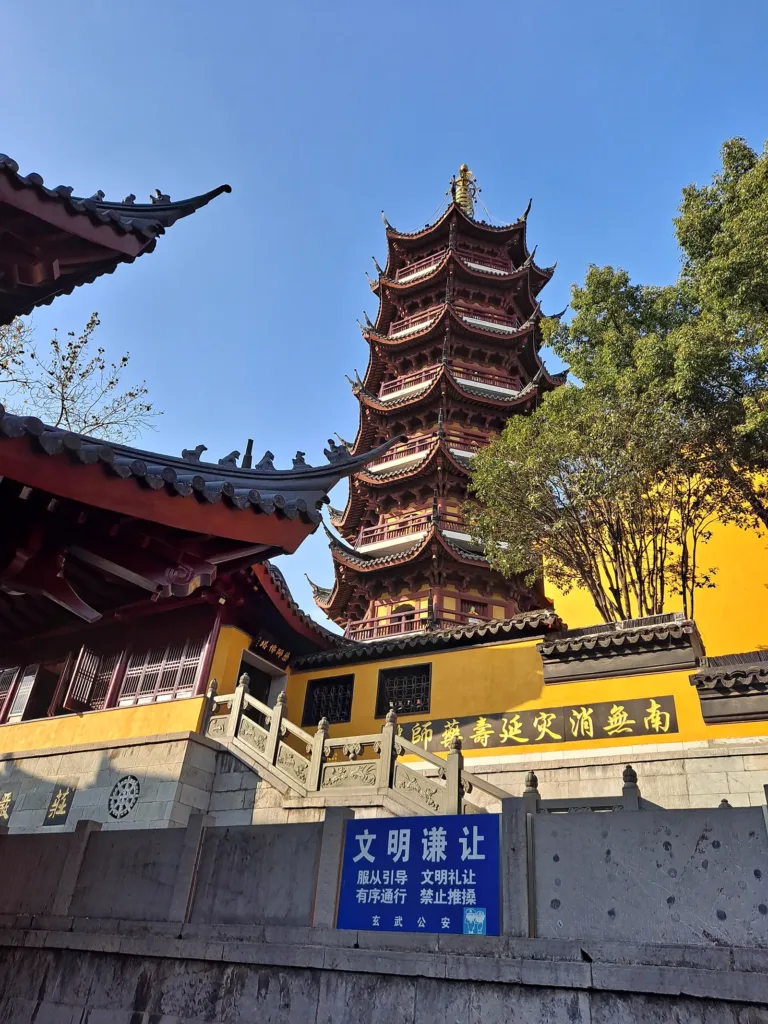
Explore the region
Jiming Temple stands on the east slope of Jilong Hill (鸡笼山), on the southern shore of Xuanwu Lake, with the Ming city wall running along the ridge directly behind it. The halls climb the slope in stages and a seven-storey pagoda marks the top, which is why the temple reads from the lake, from the wall and from the road below as one shape: yellow walls, dark roofs, a gold finial above them. A Buddhist shrine was first built on this ground in 300 AD, and since 1958 the community here has been nuns rather than monks.
The reputation of the place rests on the Liang dynasty. Emperor Wu built Tongtai Temple (同泰寺) here in 527, gave himself to it as a servant four times over, and issued the 《断酒肉文》 from it — the text that fixed vegetarianism as the rule for Chinese Buddhist clergy. That is the basis of the claim, still made for the site, that this was the first of the “480 temples of the Southern Dynasties”. Whether Tongtai Temple stood on exactly this spot is not settled: some accounts put it on a different alignment near Zhujiang Road, while a Nanjing Buddhist Association figure quoted in the press argues the imperial temple’s precinct was large enough to cover today’s site.
What you walk through now is largely a 20th-century reconstruction. Zhu Yuanzhang rebuilt the temple on the old ground in 1387, the twentieth year of the Hongwu era, and gave it the name it still carries — 鸡鸣寺, the temple of the crowing cock, after the phrase 闻鸡起舞, “rise at cockcrow and get to work”. Under the Xuande, Chenghua and Hongzhi emperors the complex grew past thirty halls with more than a hundred resident monks, and the Kangxi and Qianlong emperors left inscriptions on their southern tours. It was destroyed in the Taiping fighting of the 1850s and rebuilt on a smaller scale under the Tongzhi emperor. The Cultural Revolution damaged it, a fire in 1973 destroyed most of what remained, the municipality funded a reconstruction from 1981, and the temple reopened in 1985; the present buildings follow the Ming and Qing layout. In 1982 it was listed as a Nanjing municipal protected site, dated to the Liang.
The Medicine Buddha Pagoda (药师佛塔)
The present pagoda is the fifth great pagoda on this site. It was completed in April 1990 (some accounts say 1991): seven storeys on an octagonal plan, 44.8 m to the tip of the finial, with bracket sets under double eaves, a copper finial and tubular roof tiles. The eaves step back as they rise, so the silhouette reads as more tiers than there are; the temple’s own description calls it “nine faces in appearance, seven storeys and eight sides in fact”.
Inside, the object of the visit is a Ming bronze Medicine Buddha (药师琉璃光如来) that came from the Yonghe Palace (雍和宫) in Beijing. It was moved to Nanjing in 1972 on an application by Zhao Puchu that Zhou Enlai approved; the temple’s account has it sent first to Linggu Temple and stored before being carried into the new pagoda. From the second storey upward each floor holds four niches carved in Ming golden nanmu wood, with a nanmu Medicine Buddha in each — twenty-four in all. The niches were formerly kept at Zhongnanhai in Beijing. Zhao Puchu wrote the 药师佛塔 plaque above the south door; the north door carries 国泰民安.
The pagoda was built with internal stairs and an outer gallery. The municipal records office describes climbing it for the view straight down the cherry-blossom road to Xuanwu Lake, with the Zifeng Tower rising behind the temple roofs. Access to the upper floors varies, so ask at the pagoda rather than assuming you can go up. The pagoda has a second life on screen: in 1992 the television series 《新白娘子传奇》 used it for the Leifeng Pagoda, because the real Leifeng Pagoda at Hangzhou was down and its replacement had not yet been built.
The north-facing Guanyin
The Guanyin Hall holds the temple’s most discussed image. It faces north, looking away from the people coming in, and the couplet over the niche explains why: 问菩萨为何倒坐,叹众生不肯回头 — “why does the bodhisattva sit facing backwards? Because people will not turn back.” The hall was built in 1867 as the Guanyin Tower, and for a period the temple was known as the Guanyin Pavilion or Guanyin Tower after it.
Walking up through the halls
The entrance is on the left-hand side of 鸡鸣寺路: stone steps climb to a yellow-plastered moon gate carrying 古鸡鸣寺 in gold characters. That is the mountain gate (山门). Just inside, the 施食台 — also called 志公台 — stands to the left, the terrace linked to the monk Baozhi. From there the route steps upward: 弥勒殿 first, with 大雄宝殿 and 观音楼 above it. The main hall holds two gilded bronze seated figures of Shakyamuni and Guanyin given by Thailand, along with thirty-two newly made transformation images of Guanyin. East of the main hall is the site of 凭虚阁; west of it is the pagoda court, paved in carved bluestone.
Higher up are the two buildings meant for looking out. 豁蒙楼 takes its name from a line of Du Fu; the late-Qing viceroy Zhang Zhidong built it in memory of Yang Rui, one of the six reformers executed after 1898. East of it stands 景阳楼, whose couplet names what you see from the balcony: Jilong Hill, the imperial Taicheng below it, and the old Rouge Well beside Xuanwu Lake. Both buildings now hold a tea room and a vegetarian restaurant (百味斋). The temple’s noodle bowls, 素面, are part of the visit for many people — they are well enough established to have been turned into a line of plush souvenirs at the shop by the gate.
East of the temple is the 胭脂井, an octagonal well traditionally identified with the one where the last Chen emperor hid with his consort Zhang Lihua and Consort Kong when Sui troops entered Taicheng in 589. In the story the rouge on the women’s faces stained the stone rim of the well and could not be wiped off, which gives it the name Rouge Well; it is also called 辱井, the well of shame. Behind the temple run 台城 and the city wall, and the wall’s Taicheng stretch above the temple is walked from 解放门.
Tickets, hours and how entry works
- Admission is 10 CNY. The ticket is a 香花券 — an incense-and-flower voucher — and comes with three incense sticks.
- The municipal tourism information service lists opening as 7:30–17:30, while several current listings give 7:30–17:00, so treat the closing time as a range and check at the gate on the day.
- Tickets are sold at the gate, and the same voucher can be bought in advance online; entry then works by scanning either your ID or the voucher’s QR code.
- The temple does not appear on the city’s 2026 list of government-guided-price attractions with free-admission days, so there is no free day to plan around.
- Rates for special periods are not published on an official page, so confirm the price at the gate if you are visiting over the Lunar New Year.
- These are working religious spaces and photography rules are posted hall by hall; follow the signs rather than assuming.
When to go
The road in front of the temple, 鸡鸣寺路, is Nanjing’s best-known cherry-blossom avenue: about 500 m of late-blooming cherries running from the 古鸡鸣寺 archway north to 解放门, at their best in the middle and later part of March and lit at night. In a normal peak-bloom year roughly 25,000 people a day pass through the blossom-road area, with the crush between 10:00 and 15:00; the police suggest 8:00–9:00 or after 15:00, and point out that Xuanwu Lake, Zhenzhu River, Ming Xiaoling and other sites also have cherries if the avenue is too crowded.
The temple has its own peak days. The 19th day of the 2nd, 6th and 9th lunar months — Guanyin’s birthday, enlightenment and renunciation — bring tens of thousands of pilgrims, and the Lunar New Year period is the busiest of the year. On an ordinary morning the halls are quiet enough to look at properly. The compound is compact: most visitors are through it in about an hour, longer if they stop for tea or noodles.
Getting there
Metro. Line 3 or Line 4 to 鸡鸣寺 (Jimingsi). It is an interchange station with four exits, and exit 5 comes out on 北京东路 at the head of 鸡鸣寺路 — the exit signed for 鸡鸣寺, 和平公园 and the Xuanwu Lake entrance at 解放门. Local guidance pairs the temple with exit 5 and a walk of about 600 m; the metro’s own exit notes also place the temple roughly 400 m from exit 4.
During the blossom peak the exits are used differently: on busy weekends in 2024 exit 5 ran entry-only and exit 6 exit-only, while exits 1 and 4 stayed open in both directions.
Bus. Three stops serve the temple, all on or beside 北京东路: 太平北路·鸡鸣寺 by exit 1 (routes 2, 3, 31, 44, 52, 70, 304), 北京东路·兰园 by exit 4 (2, 11, 20, 48, 70) and 北京东路·鸡鸣寺 by exit 6 (11, 20, 48). The city’s tourism information service also lists routes 201 (the former sightseeing line 游1), 24, 67 and 140 among those reaching 鸡鸣寺.
Rail. Line 3 links both of Nanjing’s main railway stations to the temple with no change of train: 鸡鸣寺 is two stops from 南京站 (Nanjing Railway Station) and about ten from 南京南站 (Nanjing South Railway Station).
Taxi or ride-hailing. Give the driver 鸡鸣寺 or 古鸡鸣寺; the address is 玄武区鸡鸣寺路 (the religious affairs bureau gives 鸡鸣寺路1号). At blossom peak 鸡鸣寺路 is closed to motor vehicles on weekends between 8:30 and 15:30, with traffic control on weekdays as needed, so a car may have to set you down on 北京东路 instead. Parking is scarce: the nearest commercial car parks are 凯瑟琳广场 (407 spaces) and 荔枝广场 (513 spaces), about 10–15 minutes on foot from the temple archway, and they are busy at weekends.
Combining the visit. The temple sits between three things worth the same trip. 解放门 and the Taicheng stretch of the city wall are five minutes north along 鸡鸣寺路, on the 30 CNY Shence Gate–Taiping Gate section (8:30–17:00, tickets stop at 17:00, with evening opening at 解放门 in the warmer months). Xuanwu Lake, beyond the wall, is free. The palaeontology museum on 北京东路 is next door, and its second-floor café looks out over the blossom road. The tourism information service lists a 鸡鸣寺 entrance to the wall as part of the ticketed section, and the English-language reference material also notes a wall entrance at the rear of the temple — but wall entrances open and close with maintenance work, so check the wall’s own WeChat account before planning to climb from the temple side.
Practical notes
Everything here is uphill. The gate is reached by stone steps from 鸡鸣寺路 and the halls and pagoda are stacked above it, so allow time and wear shoes that grip. On blossom weekends and Guanyin festival days expect queueing at the gate, one-way crowd control on 鸡鸣寺路 and temporary restrictions on which metro exits you may use. The temple’s telephone, as listed by the city’s tourism information service, is 57715595 (Nanjing area code 025).
Combine your visit
A suggested sequence linking the specific features of this visit.
-
Main worship halls
Begin with the arrangement of the temple’s active religious spaces.
-
Guanyin Hall
Look for the unusual orientation of the bodhisattva image and its explanation.
-
Medicine Buddha Pagoda
Finish with the octagonal tower and its hillside setting from permitted public areas.
This order is editorial. Confirm access and any transfers between stops; it does not establish a walking route, same-day connection or common admission ticket.
Find Jiming Temple
鸡鸣寺 · 南京市
The pin marks the area, not the entrance.
More places nearby
Approximate straight-line distances between map pins, not travel distances.
Xuanwu Lake 玄武湖
1 km awayXuanwu Lake lies beside the northeastern part of Nanjing’s historic centre. Its island-and-causeway landscape brings pavilions, planted gardens and open water together within the city.
View guide →John Rabe's former residence 拉贝与国际安全区纪念馆
2 km awayJohn Rabe’s former home in Nanjing interprets his life in China and the work of the Nanjing Safety Zone during the 1937 atrocities. The renewed exhibition places Rabe’s biography on the first floor and the Safety Zone’s…
View guide →Presidential Palace (Nanjing) 南京总统府
2 km awayNanjing’s Presidential Palace is a layered political complex on Changjiang Road. It housed the office of the Republic of China’s president during the period when the government was based in Nanjing.
View guide →Sources & visit information
Sources checked on 22 October 2026. Hours, tickets, reservations and transport can change; confirm with the operator before you go.
- 鸡鸣寺简介 — 南京市民族宗教事务局 ↗
- 鸡鸣寺 — 南京市文化和旅游信息服务中心 ↗
- 鸡鸣寺 — 中文维基百科 ↗
- 南京市文物保护单位名录(397处404点)— 南京市文化和旅游局 ↗
- 南京鸡鸣寺药师塔:曾在电视剧中“扮演”雷峰塔 — 中国新闻网转扬子晚报, 2012-05-30 ↗
- 南京警方发布鸡鸣寺赏樱攻略 — 南京市人民政府, 2024-03-22 ↗
- 南京明城墙 — 南京市文化和旅游信息服务中心 ↗
- 跟着方志游南京|春天打卡鸡笼山 — 南京市地方志办公室, 2025-03-28 ↗
- Jiming Temple — English Wikipedia ↗
- 鸡鸣寺站 — 中文维基百科 ↗
- 鸡鸣寺站 — 百度百科(据南京地铁官网2023年8月数据) ↗
- 市发展改革委关于公布2026年度南京市实行政府指导价管理景区免费开放日的通知 — 南京市发展和改革委员会, 2026-01-05 ↗
- 鸡鸣寺(寺院展示)— 江苏省佛教协会 ↗
- 南京鸡鸣寺地铁几号线能到达 — 南京本地宝, 2023-03-22 ↗
- 南京鸡鸣寺香花券是门票吗 — 南京本地宝, 2023-12-25 ↗
- 鸡鸣寺文创上新“毛茸茸的素面”现场“出锅” — 新华网江苏转扬子晚报, 2024-12-19 ↗
- 南京地铁3号线 — 中文维基百科 ↗
- 南京买票攻略:哪些景点能现场买?哪些必须预约? — 新浪, 2026-10-05 ↗
Image credits & notes (1)
- The Medicine Buddha Pagoda rising behind the temple's yellow-plastered walls and stone stair, with the 消灾延寿药师 inscription on the wall below. Photo: 钉钉 (uploaded by 호고호)Photo: CC BY-SA 4.0