

Explore the region
Qixia Temple stands at the western foot of Qixia Mountain (栖霞山) in the northeast of Nanjing, about 22 km from the city centre. It is a working monastery with an unusually continuous record: founded in 489 under the Southern Qi, cradle of the Three Treatise school (三论宗) of East Asian Buddhism, repeatedly destroyed and rebuilt, and reconstructed in its present layout from 1919.
Three monuments here are protected at national level. The Sui-era relic foundation and the stone sarira pagoda that stands on it (舍利塔) were listed in 1988; the Thousand Buddha Cliff grottoes (千佛崖石窟) and the Tang Ming Zhengjun Stele (明征君碑) in front of the temple gate were listed together in 2001. The temple itself was designated a National Key Buddhist Temple in the Han Chinese area in 1983 and a Jiangsu provincial heritage site in 2002.
A temple destroyed and rebuilt
The site began as the private residence of Ming Sengshao (明僧绍), a Southern Qi recluse who refused repeated summons to office and gave his house and land to Buddhism in 489; the temple takes its name from his courtesy name, Qixia, and the monk Zhidu, a friend of his, ran the first foundation. In the Liang dynasty the monk Senglang taught the Three Treatises here, which is why the temple is called the school’s ancestral court. When Emperor Wen of Sui distributed relics to 83 prefectures in 601, the edict named Qixia Temple of Jiangzhou first; the wooden relic pagoda of that programme is gone, but its stone successor survives.
Under the Tang the monastery was known as Gongde Temple and was counted with Lingyan in Shandong, Yuquan in Hubei and Guoqing in Zhejiang as one of the “four great groves under heaven”. It was destroyed in the wars of 1130, rebuilt in 1392 by the Ming founder, who granted it more than 1,300 mu of farmland and hillside, and rose again under a succession of Ming and Qing abbots. The Qianlong emperor stayed here five times during his six southern tours, with a temporary palace built on the mountain by the governor-general of Liangjiang; temple and palace were both burnt in 1853 during the Taiping fighting.
The present buildings date from the reconstruction begun in 1919 by the monk Zongyang, who came from Jinshan, and continued by his successor Ruoshun; the Nanjing municipal government repaired the compound again in 1979. In the winter of 1937–38 the temple opened its gates to civilians fleeing the Japanese capture of Nanjing, sheltering them for about four months; published accounts put the number of refugees between roughly 20,000 and 24,000. A Buddhist academy was set up on the site in the 1980s and is now the Qixia Mountain branch of the Chinese Buddhist Academy.
What to look at, and in what order
Approach from the west gate of the scenic area. The temple forecourt opens with a memorial archway and a bell tower, with the Mingjing Lake — laid out in the Qianlong period with a zigzag bridge to an island pavilion — on the western side, and a lotus pond just before the temple gate.
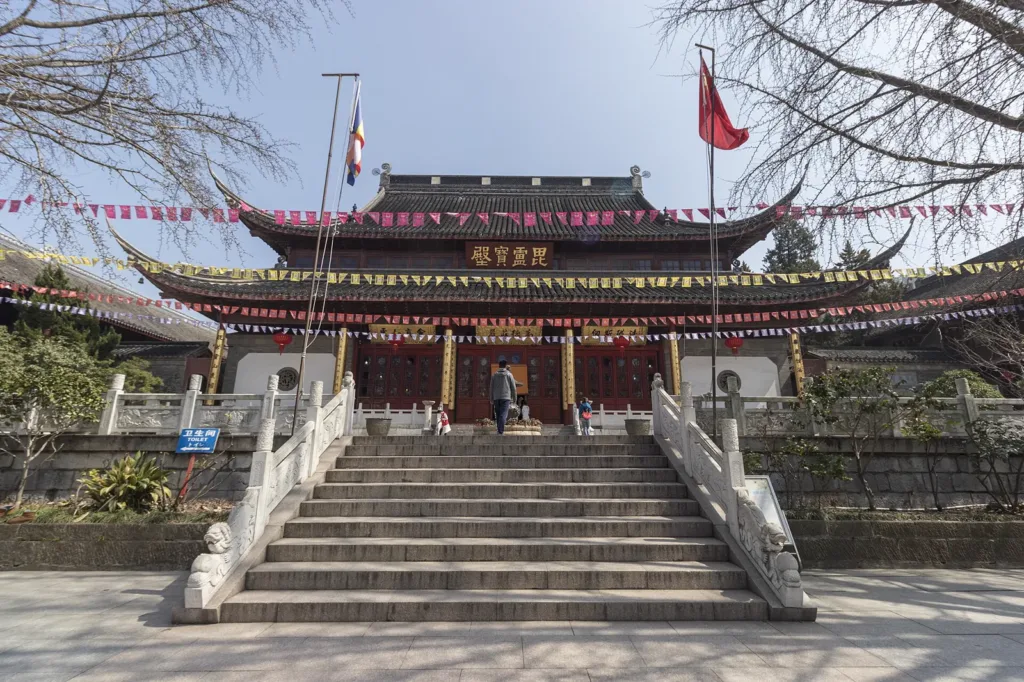
The first building inside is the Maitreya hall, with a laughing, bare-bellied Maitreya and Weituo standing behind him. The main hall above it is the Pilu Hall (毗卢宝殿), where the seated Vairocana is flanked by Brahma and Indra and the twenty guardian deities line the sides; behind the group is an island tableau of Guanyin. Beyond, built into the slope, come the Dharma hall, the recitation hall and the sutra library, with the Jade Buddha Hall and the memorial hall to the monk Jianzhen at the side.
Two things are easy to miss. First, the halls climb the hill in stepped terraces, so look back downhill from each level — the sequence of roofs and the lake below read differently from above. Second, the sutra library and the side halls hold objects that document the temple’s foreign links: the memorial hall keeps a dry-lacquer figure of Jianzhen, the Tang monk who tried six times to reach Japan, and material presented by Japanese Buddhists in 1963 for the 1,200th anniversary of his death, while the Jade Buddha Hall holds a jade Buddha donated from Taiwan.
The stone pagoda
The sarira pagoda stands beside the temple, close to the cliff, and is the single most important object on the site. Its predecessor was a five-storey wooden pagoda built in 601 under Emperor Wen of Sui; the present octagonal, five-eaved stone pagoda is a Southern Tang reconstruction, generally dated between 945 and 965 and supervised by the statesmen Gao Yue and Lin Renzhao.
Walk a full circle of it rather than photographing the front only. The base is a sumeru pedestal whose eight faces carry scenes from the Buddha’s life — the eight phases, from the white elephant entering the womb to the cremation — with standing dragons and four guardian kings alternating at the corners. Above it, the tall first storey is carved with Manjushri on a lion, Samantabhadra on an elephant and guardian figures, and the four storeys above have two niches per face, sixty-four small Buddhas in all. Liang Sicheng devoted several pages of his History of Chinese Architecture to the pagoda after visiting it in 1934, and judged it among the finest surviving stone towers of its kind.
Published heights vary: the Jiangsu feature gives 18.04 m, while the Chinese reference entry for the pagoda gives about 15 m. The pagoda was restored in 1930 under the architects Liu Dunzhen and Lu Shusen, who dug out the buried base and reinstated its balustrade, and eight fallen stones were re-set in a 1993 repair.
The cliff carvings and the Tang stele
Behind the temple, the rock face rises into the Thousand Buddha Cliff. Cutting began in 489, when Ming Sengshao’s son and the monk Zhidu commissioned a trinity of Amitabha with Guanyin and Mahasthamaprapta to commemorate him; the Great Buddha Pavilion (大佛阁) holds that seated Amitabha, roughly 12 m high, with the two attendant figures beside it. Later dynasties kept carving, and the cliff now holds roughly 294 to 297 niches and 515 figures from the Southern Dynasties period, with more than 700 carvings in total; because it predates most of the great northern grottoes, it is often called the “Yungang of the south”.
Look for the mural in niche 中102, found in 2000 and identified as a “Qixia flying apsara” — the only painted mural so far found in the whole cliff, and the easternmost such find in China.
The Ming Zhengjun Stele stands in a pavilion outside the gate. It was erected in 676 after Ming Chongyan, a favourite of Emperor Gaozong, asked the throne to honour his ancestor Ming Sengshao; the emperor supplied the text, the calligrapher Gao Zhengchen wrote it in running script, and Wang Zhijing incised the seal-script heading on the top. Two things make it worth the detour: it is one of the very few surviving Tang running-script steles in China, and the slab itself is cut from local Qixia limestone packed with crinoid-stem fossils — more than 22,000 of the lentil-shaped white marks, giving the stone a mottled pattern before a single character was carved. The reverse carries the two characters 栖霞, traditionally attributed to the emperor’s own hand.
Tickets and opening hours
The temple, the pagoda, the cliff carvings and the stele all stand inside the Qixia Mountain scenic area, so what visitors buy is the scenic-area gate ticket, not a temple ticket.
The district government lists the gate ticket at ¥50 on ordinary days and ¥80 during the red-maple festival, the autumn peak. During the 2026 festival (18 October to 18 December) the scenic area priced entry at ¥80 and sold a ¥99 autumn pass valid to 31 December for unlimited daytime entry between 07:00 and 17:00, excluding night sessions, plus half-price entry for students; the ¥80 “maple cat” set bundled a ticket with a cup of yogurt. Prices and promotions here have moved more than once in recent years — the ticket was raised from ¥25/¥40 to ¥50/¥80 in 2023 — so check the scenic area’s own WeChat account, 南京栖霞山, before travelling.
The scenic area keeps a daytime window of roughly 07:00–17:00. It does not publish a separate timetable for the temple halls, which close earlier in the afternoon than the hill paths; treat the temple and the pagoda as the first stops of the day rather than a late-afternoon add-on. On 8 March the scenic area is on the Nanjing list of officially free open days, and on 18 October 2026 over-60s entered free as a one-off festival promotion.
Getting there and back
Metro. Line 6 opened on 29 September 2026 and now runs straight to the mountain. The line starts at Nanjing South Railway Station and ends at 栖霞山站 (Qixiashan), 32.4 km with 19 stations, and it runs through-services with the S1 airport line, so from Lukou Airport or Nanjing South you can stay on the same train to Qixiashan rather than changing. First train leaves Qixiashan at 06:00; the last train back towards Nanjing South leaves at 23:00. Useful interchanges: 明故宫 for Line 2 and the old city, 岗子村 for Line 4, 万寿 for Line 7, 光华门 for Line 5, and 机场跑道旧址 for Line 10.
The station sits on Qixia Avenue at the junction with Hongfeng Road, with two exits; the exit is signed for the scenic area, and the district government describes the walk from the metro to the mountain gate as a few hundred metres. Local guides published alongside the 2026 autumn notices point to Exit 2.
Bus. Routes 138, 194, 195, 196, 206, 326 and 327 serve the foot of the mountain, though the stop names differ — 栖霞寺, 栖霞山, 栖霞山风景区 and the 栖霞山总站 bus terminal all appear on maps. Bus 206 ends at 南京站·北广场东, the north square of Nanjing Railway Station, which makes it the direct option if you arrive there by train. The district government’s older transport note also suggests changing from Line 2 at 学则路 onto bus 138, or from Line 3 at 新庄 onto bus 206; that note dates from 2022, so treat it as a fallback rather than the main plan.
Taxi and ride-hailing. Give the driver 栖霞山风景区西门 (the west gate) or 栖霞山风景区南门 (the south gate). The scenic area asks drivers to distinguish the two, so the gate name matters.
On foot and on the hill. From the gate you walk the forecourt to the temple, then up to the pagoda and the cliff; the mountain above adds stair flights and sloping paths to points such as 纱帽峰, 碧云亭, the 乾隆行宫 ruins, 白乳泉, 天开岩 and 始皇临江处. The temple courts themselves rise on stepped terraces. In the maple season — mid-October to mid-December — weekends carry heavy crowds, and the scenic area pushes weekday visits and public transport.
Around the temple
Give the visit half a day at least: temple and stele in the morning, pagoda and cliff carvings next, then one hillside circuit suited to your legs, and the Qixia Old Town (栖霞古镇) at the bottom, which is free and where the festival food and performance programme concentrates. This order is editorial, not an official route, and the temple, the cliff and the hill paths are separate areas rather than one guided circuit.
Combine your visit
A suggested sequence linking the specific features of this visit.
-
Bell and drum towers
Begin with the paired structures at the temple approach.
-
Principal Buddhist hall
Continue into the main religious space.
-
Selected hillside path
Add the mountain setting through a managed route suited to your visit.
This order is editorial. Confirm access and any transfers between stops; it does not establish a walking route, same-day connection or common admission ticket.
Find Qixia Temple
栖霞寺 · 南京市
The pin marks the area, not the entrance.
More places nearby
Approximate straight-line distances between map pins, not travel distances.
Dr. Sun Yat-sen's Mausoleum 中山陵
14 km awaySun Yat-sen’s Mausoleum occupies a slope of Purple Mountain east of central Nanjing. Completed in 1929 to a design by Lü Yanzhi, it combines a modern national memorial with elements of traditional Chinese tomb architecture.
View guide →Ming Xiaoling 明孝陵
15 km awayMing Xiaoling is the mausoleum of the Hongwu emperor, founder of the Ming dynasty. It lies at the southern foot of Purple Mountain, where its processional route and burial precinct form a major imperial landscape.
View guide →Xuanwu Lake 玄武湖
17 km awayXuanwu Lake lies beside the northeastern part of Nanjing’s historic centre. Its island-and-causeway landscape brings pavilions, planted gardens and open water together within the city.
View guide →Sources & visit information
Sources checked on 22 October 2026. Hours, tickets, reservations and transport can change; confirm with the operator before you go.
- 栖霞山 (Qixia Mountain), Qixia District People's Government ↗
- 栖霞寺, Chinese Wikipedia ↗
- 栖霞山风景区 official site (scenic area description) ↗
- 江苏读城·阅读建筑: 这座南京最早的古塔, 新华日报·交汇点 (Jiangsu Read-the-City series) ↗
- Qixia Temple, English Wikipedia ↗
- 走进大美栖霞山, 群众 (Qunzhong), by the Qixia District Government Office ↗
- 明征君碑, Chinese Wikipedia ↗
- 棲霞石碑, 大公报 (Ta Kung Pao) ↗
- 南京栖霞山石刻之谜与千佛岩秘境, 中国侨网 (China Qiaowang, from Xinhua) ↗
- 江苏南京栖霞寺·历史, 凤凰网 (Ifeng, history feature) ↗
- 学院简介, 中国佛学院栖霞山分院 (Qixia Mountain branch, Chinese Buddhist Academy) ↗
- 南京地铁6号线今日开通初期运营, 南京市人民政府 (Nanjing Municipal Government) ↗
- 南京地铁6号线, Chinese Wikipedia (station list and interchanges) ↗
- 栖霞山站, Chinese Wikipedia (Qixiashan metro station) ↗
- 走!坐6号线去栖霞山看枫叶, 扬子晚报 via Sohu (opening-day report) ↗
- 南京栖霞山2026年红枫系列活动10月18日正式启幕, 交汇点 (Jiangsu news) ↗
- 秋栖霞, 好戏刚刚开场, Qixia District People's Government ↗
- 本周末, 南京栖霞山对部分人群免费! 门票价格即将调整, 南京本地宝 via Ifeng ↗
- 市发展改革委关于公布2026年度南京市实行政府指导价管理景区免费开放日的通知, 南京市发展和改革委员会 ↗
- 栖霞寺舍利塔, Chinese Wikipedia (the pagoda entry) ↗
Image credits & notes (1)
- The Pilu Hall (毗卢宝殿), the main hall of Qixia Temple, above its flight of stone steps Photo: ScareCriterion12Photo: CC BY-SA 4.0