

Explore the region
Sun Yat-sen’s Mausoleum covers the south slope of Zhongmao Peak on Purple Mountain (紫金山), east of central Nanjing. Sun died in Beijing in March 1925 and had asked to be buried in Nanjing; the Nationalist government and the Kuomintang ran an open design competition, began building in January 1926, interred him at a state funeral — the 奉安大典 — on 1 June 1929, and finished the whole complex in 1931. The competition was won by a then little-known architect, Lü Yanzhi (吕彦直), who died in 1929 before the work was finished; seen in plan, his layout reads as a bell, an image meant to echo Sun’s own call to “rouse the masses”.
The site carries three layers of official recognition: first batch of Major Historical and Cultural Sites Protected at the National Level (1961), one of the first national 5A-level scenic areas, and — since 2024 — a place on China’s Tentative List for World Heritage as a representative work of the pioneers of modern Chinese architecture.
The axis, from the archway to the burial chamber
Everything sits on one south-to-north line. Between the granite archway at the bottom and the chamber behind the sacrificial hall, the axis runs about 700 m and climbs roughly 70 m, with 392 stone steps and 10 platforms in between; the buildings are white granite, reinforced concrete and blue glazed tile.
The sequence is fixed by the design. You begin at the three-bay 博爱坊 memorial archway — 11 m high, 17.3 m wide, with Sun’s own calligraphy for 博爱 (“universal love”) on the centre lintel — and walk a tomb passage about 480 m long. The passage is the first thing to look at closely: instead of the stone officials and animals of an imperial spirit way, it is lined with cedars and cypresses, planted in ordered rows; the two rows of cedars on the central passage date from 1935.
At the top of the passage, the 陵门 tomb gate (roughly 27 m wide and 16.5 m high) opens in three arches under a double-eaved blue roof, with 天下为公 — “what is under heaven is for all” — over the centre door in Sun’s hand. Behind it stands the stele pavilion, a square granite structure holding a 9 m stele incised with 24 characters and no epitaph: in 1928 the burial committee decided that no text could sum up Sun, so the stone carries only the dedication to the Kuomintang’s “Premier Sun”.
Then the stairs. Of the 392 steps, 290 run in eight flights from the gate and stele pavilion up to the platform in front of the sacrificial hall; ten platforms break the climb across the whole axis. On the sixth platform stands a bronze tripod donated for the 1929 funeral; its western side still shows two bullet holes from the fighting around Nanjing in December 1937.
The 祭堂 sacrificial hall is the highest and largest building on the axis, a granite hall with a double-eaved blue roof. The three doorways are inscribed, left to right, with the characters of the Three Principles of the People — 民族, 民权, 民生 — and the lintel above carries 天地正气. Inside, at the centre, is the seated marble figure of Sun: 4.6 m tall, in a long gown, a book open on his knees, carved from Italian white marble in Paris by the sculptor Paul Landowski and unveiled in November 1930. Reliefs around the pedestal show scenes from his life. Behind the hall, through bronze doors, is the hemispherical burial chamber; on the marble sarcophagus inside rests a reclining figure of Sun carved by the Czech sculptor known in Chinese sources as Gao Qi (高崎), and the coffin lies about 5 m below it.
How to look at it
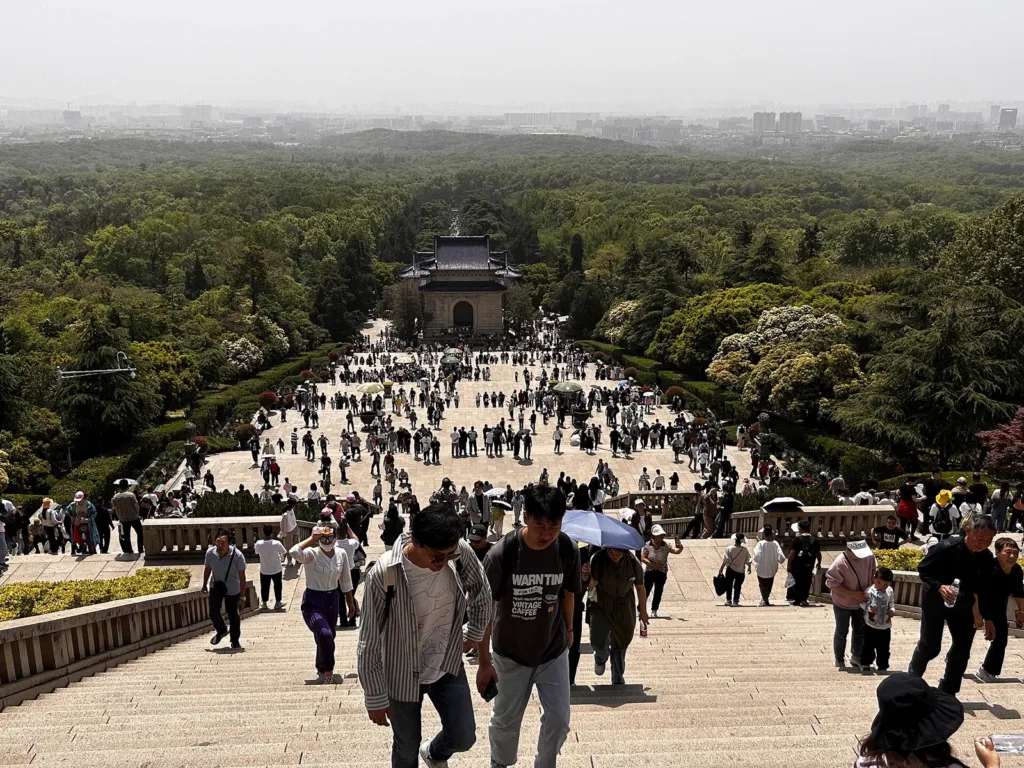
The climbing is part of the composition. Because the flights and landings alternate, the view changes as you go: looking up, the landings disappear and the stairway reads as one continuous slope; standing on the top platform and turning round, the steps disappear and only the platforms show.
Look back at the whole route from the hall platform — the tomb gate below, the cedar alleys, the plane trees on the approach, and the forested mountain running out to the city skyline. On the way, the details worth stopping for are the 12.6 m huabiao columns flanking the hall forecourt, the lotus and cloud carving on the archway, the mosaic ceiling inside the hall, and the scarred tripod on the sixth platform.
Planting is as deliberate as the stone. The cedars on the tomb passage were set out in 1935, and 79 trees in the mausoleum grounds are now on Nanjing’s register of ancient and famous trees. The avenue that brings you here, 陵园路, was built in 1929 for the funeral procession and is lined with London plane trees — 1,034 of them donated by the Shanghai French Concession’s municipal council; it is often described as China’s first modern tree-lined road.
Tickets, opening hours and reservations
Admission to the mausoleum is free, but you cannot simply walk in: a real-name, timed reservation is compulsory for the area above the “天下为公” gate — the tomb gate, stele pavilion and sacrificial hall. Book through the park’s WeChat account 南京钟山风景区 or 中山陵园票务中心, through the Meituan app, or at the self-service machines at the site with your passport or Chinese ID card; tour groups use the 久柏易游 platform. Slots are released seven days ahead at 16:00 each day, and cancelled or unclaimed slots are put back on the day; local listings describe the day as two-hour blocks from 08:30, with check-in allowed from 30 minutes before to 60 minutes after the booked time. Booking arrangements for this site are adjusted often, so check the official booking page again shortly before you travel.
Opening hours are 08:30–17:00. The mausoleum closes every Monday for maintenance, except on public holidays and the anniversaries of Sun’s death (12 March) and birth (12 November). The park’s own bilingual guide of 2025 and its 2026 holiday notices state that the burial chamber behind the hall is not open to visitors; earlier schedules had it open Tuesday to Friday, so plan on seeing the hall rather than the chamber, and ask on the day if the chamber matters to you.
Visiting is quiet by rule: the mausoleum operates “no noise” management, which means no loud conversation and no amplification equipment.
The rest of the mountain is ticketed, and tickets are sold under real-name registration with a passport accepted: Ming Xiaoling ¥70, Linggu ¥35, Meiling Palace ¥30, the Open-Air Music Hall ¥10, or ¥100 for all four.
Getting there and back
There is no metro station at the gate. The standard approach is Metro Line 2 and then a park shuttle, and the park’s registered address is No. 7 Shixiang Road, Xuanwu District (玄武区石象路7号).
Metro. Line 2 runs east past the mountain. Park guidance is to get off at 苜蓿园 (Muxuyuan) or 孝陵卫 (Xiaolingwei) and change to a shuttle, or at 下马坊 (Xiamafang), where you can take bus 34, a shuttle, or walk in on footpaths via 博爱路 (Bo’ai Lu). If you are coming from elsewhere in the city, Line 2 interchanges with Line 1 at 新街口 (Xinjiekou) and with Line 3 at 大行宫 (Daxinggong).
Park shuttles (观光车). ¥10 for a single ride, ¥30 for unlimited rides in a day. Lines run from the metro stations above to 中山陵南站, the mausoleum’s south shuttle stop, and from 中山陵停车场; a long loop links 下马坊, 美龄宫, 明孝陵7号门, 中山陵, 流徽榭, 灵谷景区 and 钟灵街. On controlled weekends and holidays the shuttle departure point at 苜蓿园 metro is moved to 美龄宫, which means walking the plane-tree stretch of 陵园路 to board.
Bus. Route 34 (中山码头—中山陵停车场) is the line that reaches the mausoleum, stopping at 中山陵停车场, 博爱园 and 下马坊. Bus 20 and bus 315 serve the Ming Xiaoling side of the park, and bus 202 runs to Linggu via 孝陵卫; extra holiday routes such as G25 and G29 appear only during long holidays.
Taxi and ride-hailing. Give the driver 中山陵博爱广场 (the south entrance plaza) or 中山陵停车场. On weekends, public holidays and peak seasons, though, the park’s roads close to private cars, taxis and ride-hailing cars between 08:30 and 17:30 — 陵园路, 博爱路, 紫金山路 and others — so expect to be dropped outside the control area and to continue by shuttle; the practical drop-off points then are the Line 2 stations or the two visitor hubs, 金陵style and 紫金·钟爱里.
By car. Park at 金陵style or 紫金·钟爱里 and take a shuttle in, or pre-book a space a day ahead through the park’s WeChat accounts, with each car limited to two pre-bookings per calendar month. Coaches face their own access restrictions on these roads.
Bags and mobility. Lockers are available at 苜蓿园, 下马坊 and 孝陵卫 metro stations and at 博爱广场 and the mausoleum’s east and west reservation gates; the visitor centre stores bags manually for ¥10 per piece per day (08:30–16:30) and lends umbrellas, wheelchairs, strollers and walking sticks against a deposit. The last stretch to the hall is a stairway of 392 steps in all; if stairs are a problem, ask at the visitor centre what is possible that day.
Around the mausoleum
The mausoleum belongs to the wider Zhongshan Mountain park, which holds several separate scenic areas, so give it half a day instead of treating it as a stop beside the road.
A workable order — editorial, not an official route and not a single ticket: arrive by metro at 下马坊 or 苜蓿园, take a shuttle to 中山陵南站, walk the axis up to the sacrificial hall, then come down to 博爱广场. From the plaza, the Open-Air Music Hall (音乐台, ¥10, ticketing 06:30–18:30 from February to November, 07:00–17:30 in December and January) is a short walk down the slope — a semicircular stage built in 1933, where white pigeons gather on the lawn. The Sun Yat-sen Memorial Hall in the 藏经楼 (free, 09:00–17:00, closed Mondays) keeps his papers and material from the 1929 funeral. With more time, Ming Xiaoling — the tomb of the Ming founder and a UNESCO World Heritage site — and Linggu lie on the same shuttle loop.
Combine your visit
A suggested sequence linking the specific features of this visit.
-
Entrance axis and stele pavilion
Read the approach as a sequence of memorial spaces.
-
Main stairway
Notice how the slope frames the view back over the approach.
-
Sacrificial hall
Finish at the hall and seated marble figure.
This order is editorial. Confirm access and any transfers between stops; it does not establish a walking route, same-day connection or common admission ticket.
Find Dr. Sun Yat-sen's Mausoleum
中山陵 · 南京市
The pin marks the area, not the entrance.
More places nearby
Approximate straight-line distances between map pins, not travel distances.
Ming Xiaoling 明孝陵
1 km awayMing Xiaoling is the mausoleum of the Hongwu emperor, founder of the Ming dynasty. It lies at the southern foot of Purple Mountain, where its processional route and burial precinct form a major imperial landscape.
View guide →Nanjing Museum 南京博物院
4 km awayNanjing Museum combines a historic museum building with several major exhibition sections. Its architecture brings a traditional roofed front together with a more modern building arrangement.
View guide →Xuanwu Lake 玄武湖
5 km awayXuanwu Lake lies beside the northeastern part of Nanjing’s historic centre. Its island-and-causeway landscape brings pavilions, planted gardens and open water together within the city.
View guide →Sources & visit information
Sources checked on 22 October 2026. Hours, tickets, reservations and transport can change; confirm with the operator before you go.
- Ticketing, mausoleum reservation and parking reservation notice, Zhongshan Mountain National Park ↗
- Zhongshan Mountain National Park Tour Guide (bilingual), Zhongshan Mausoleum Administration ↗
- Spring and Qingming holiday visitor service guide, Zhongshan Mausoleum Administration ↗
- 2025 shuttle lines and operating hours, Zhongshan Mausoleum Administration ↗
- Metro access, Zhongshan Mountain National Park service guide ↗
- Bus access, Zhongshan Mountain National Park service guide ↗
- Dr. Sun Yat-sen's Mausoleum scenic area introduction, Zhongshan Mausoleum Administration ↗
- More than architecture: the mausoleum in my eyes, Zhongshan Mausoleum Administration ↗
- 中山陵, Chinese Wikipedia ↗
- Sun Yat-sen Mausoleum, English Wikipedia ↗
- 中山陵营造记, Tsinghua University School of Architecture (reprint from Beijing Evening News) ↗
- Dr. Sun Yat-sen's Mausoleum, TravelChinaGuide ↗
- Scenic Spots, Nanjing Municipal Bureau of Culture and Tourism ↗
- National Day holiday visitor service guide 2026, Zhongshan Mountain National Park ↗
- Does the mausoleum need advance booking? Nanjing Bendibao ↗
- Nanjing Metro Line 2, TravelChinaGuide ↗
Image credits & notes (1)
- Looking back down the stairway from the sacrificial hall, with the tomb gate, the plaza and the city beyond. Photo: Scott Edmunds (Flickr)Photo: CC BY 2.0