

Photo adjustments
Proportionally resized and converted to WebP without cropping, retouching or changing the photographed subject.
Explore the region
About Ming Xiaoling
It lies at the southern foot of Purple Mountain, where its processional route and burial precinct form a major imperial landscape.
The Sacred Way is lined with stone animals and officials. The Square Pavilion and its great turtle-supported stele introduce the commemorative language of the complex, while the burial mound belongs to a separate later stage of the route. The sequence is more important than rushing directly to the final monument.
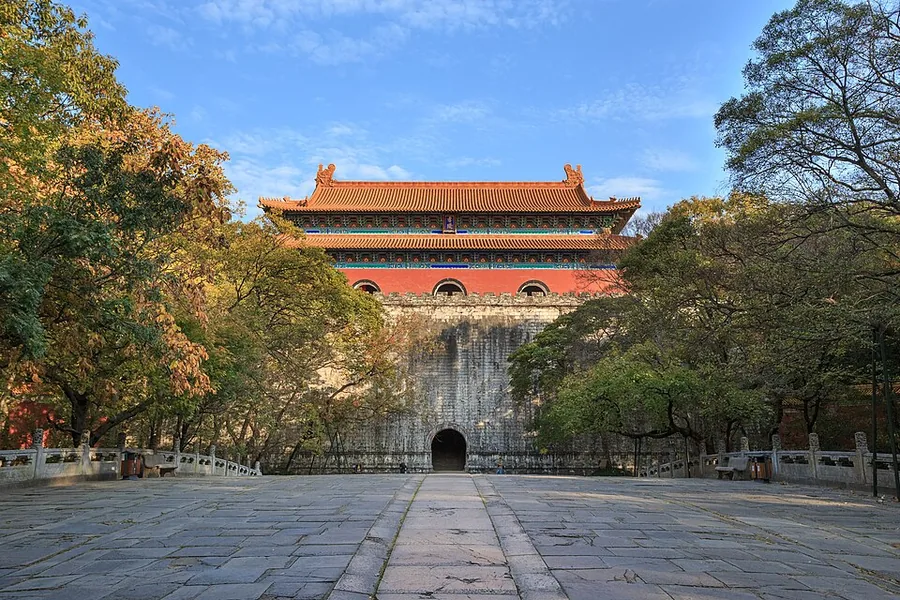
Construction began in the 14th year of the Hongwu era (1381); the main hall and other principal structures were finished by 1383, and the whole complex was completed in the third year of the Yongle era (1405), using a total of 100,000 laborers. Most of the site's timber-frame buildings were destroyed during fighting between Qing forces and the Taiping Kingdom in 1853, leaving mainly brick and stone structures such as the Great Gold Gate (大金门), stone figures (石像生), and the Square City and Ming Tower (方城明楼) standing today.
The tomb precinct extends 2.62 kilometers, enclosed originally by a red wall about 45 li (里) around. Past the Lingxing Gate (棂星门), the main axis runs through the Golden Water Bridge (金水桥), the Gate of Civil and Military Officials (文武方门) and the Xiaoling Hall (孝陵殿) to the Square City and Ming Tower. This layout influenced imperial tomb design in Beijing, Hubei, Liaoning and Hebei for the next 500 years.
Ming Xiaoling is the largest imperial mausoleum in Nanjing and one of the largest in China. It was inscribed on the World Heritage List in 2003, together with six nearby tombs of early Ming meritorious officials: Chang Yuchun (常遇春), Qiu Cheng (仇成), Wu Liang (吴良), Wu Zhen (吴祯), Xu Da (徐达) and Li Wenzhong (李文忠).
What to look for
- Stone animals and officials line the Sacred Way.
- The turtle-supported stele and the burial mound represent different stages of imperial commemoration.
The surrounding area
The provincial capital suits museums and major historical sites; reserve time for different districts instead of treating it as one walking circuit.
Location & getting there
Getting to Ming Xiaoling
Approach the Ming Xiaoling sector at the southern foot of Purple Mountain. Choose the entrance that serves the Sacred Way or burial precinct you intend to see first.
Combine your visit
A suggested sequence linking the specific features of this visit.
-
Square Pavilion and stele
Begin with the monumental account of the emperor’s memory.
-
Sacred Way
Follow the sequence of stone animals and officials.
-
Burial precinct
Complete the transition from the processional landscape toward the tomb mound.
This order is editorial. Confirm access and any transfers between stops; it does not establish a walking route, same-day connection or common admission ticket.
Find Ming Xiaoling
明孝陵 · 南京市
The pin marks the area, not the entrance.
More places nearby
Approximate straight-line distances between map pins, not travel distances.
Dr. Sun Yat-sen's Mausoleum 中山陵
1 km awaySun Yat-sen’s Mausoleum occupies a slope of Purple Mountain east of central Nanjing. Completed in 1929 to a design by Lü Yanzhi, it combines a modern national memorial with elements of traditional Chinese tomb architecture.
View guide →Nanjing Museum 南京博物院
3 km awayNanjing Museum combines a historic museum building with several major exhibition sections. Its architecture brings a traditional roofed front together with a more modern building arrangement.
View guide →Xuanwu Lake 玄武湖
4 km awayXuanwu Lake lies beside the northeastern part of Nanjing’s historic centre. Its island-and-causeway landscape brings pavilions, planted gardens and open water together within the city.
View guide →Sources & visit information
The sources below support the place-specific description and arrival information. Suggested combinations are editorial planning ideas; confirm current opening, entry arrangements and transport services for your date.
Visitor information adapted and edited from Wikipedia contributors, “Xiao Mausoleum” · CC BY-SA 4.0. Source revision 1365742078.
Visitor information adapted and edited from Wikivoyage contributors, listing “Ming Xiaoling Mausoleum” · CC BY-SA 4.0.
Background paragraphs translated and condensed from Wikipedia contributors, "明孝陵", Chinese Wikipedia · CC BY-SA 4.0. Source revision 93634070.