

Explore the region
On Dongguan Street, Geyuan feels less like a palace complex than a carefully composed residence garden. Bamboo is the constant green thread; the artificial hills change character as you move through them. Spring uses bamboo with pointed shoot-like stones, summer is built around porous grey Taihu stone, autumn uses warmer Huangshi, and winter uses pale Xuanshi. The interest is not simply naming the four seasons, but noticing how stone colour, texture, shadow and planting alter the scale of each small scene.
The garden was rebuilt in 1818 by the Lianghuai salt merchant Huang Zhiyun on the site of the earlier Ming-era Shouzhi Garden. Its name refers to the shape of bamboo leaves and their shadows suggesting the character 个. Geyuan was added to the national list of Major Historical and Cultural Sites Protected at the National Level in 1988. The garden is the ticketed enclosure; the adjacent Dongguan Street is a separate open historic street, so a walk through the street does not replace a garden ticket.
What to look for
- Spring Hill: look for the relationship between bamboo, narrow shoot-like stones and the lighter, more upright composition. It is a good place to see why the garden’s name is inseparable from bamboo.
- Summer Hill: the grey, perforated Taihu stone makes a denser and more water-linked scene. Look through openings in the rock rather than treating the hill as a single mass.
- Autumn Hill: Huangshi gives the rockery warmer ochre and yellow tones and a more emphatic vertical profile. The upper pavilion provides a higher view over the garden when that section is open.
- Winter Hill: pale Xuanshi catches sunlight and shadow differently from the darker summer and autumn stones. The quieter colour range is the point of the composition.
- The residence and bamboo areas: the garden also includes a southern residential section and a northern bamboo-planting area. Nanmu Hall and Xilu Residence are named parts of the historic complex; access to individual interiors can change, so follow the route and notices in force on the day.
Allow about 1.5–3 hours if you want to compare the rockeries rather than pass through quickly. Dongguan Street and the surrounding old-city lanes make a natural after-visit extension, with local shops and food stalls outside the garden enclosure.
Tickets and opening
The currently published local ticket guide lists a standard daytime price of CNY 48 from February to October and CNY 30 in January, November and December. It also describes real-name reservation through the Geyuan WeChat account and daytime hours of 07:15–17:45, with last entry at 17:30. These are a planning reference rather than a permanent tariff: check the garden’s latest operator notice or ticket channel before travelling. The guide does not establish a passport-specific booking or inspection procedure, so overseas visitors should confirm that point directly when booking.
The listed address is No. 10 East Yanfu Road, Guangling District, Yangzhou (扬州市广陵区盐阜东路10号). The south gate leads directly to Dongguan Street.
Getting there
There is no metro instruction for this visit in the checked Yangzhou transport sources. The practical public-transport option is a bus to Geyuan stop (个园站): local guidance lists routes 61, You 1 (游1), You 2 (游2), 8 and 27. A government travel guide identifies Geyuan as stop 27 on You 1 and stop 16 on You 3 (游3), the latter serving visitors arriving from the eastern railway and coach-terminal area.
If you arrive at Yangzhou Railway Station (扬州站), local guidance lists K1, 88 or 26 to Qionghuaguan (琼花观), followed by a walk of about 600 metres to Dongguan Street; continue along the street to the garden’s south gate. From Yangzhou East Railway Station (扬州东站), it lists bus 71 to Qionghuaguan and the same Dongguan Street approach. These directions identify the railway-to-old-city connection, not a measured distance to the garden gate.
For a taxi or ride-hailing car, show “扬州市广陵区盐阜东路10号,个园南门(东关街入口)”. The garden is in an old-city pedestrian environment, so ask to be set down at an accessible road point rather than assuming a car can stop at the gate. For the return, leave through the south gate onto Dongguan Street and order the next taxi or bus from the road access available that day; confirm any local traffic controls on site. No Geyuan-specific seasonal boat landing or return boat service is included in the checked sources.
Combine your visit
A suggested sequence linking the specific features of this visit.
-
Spring bamboo composition
Begin with the planting that gives the garden its identity.
-
Summer and autumn rockeries
Compare Taihu stone with the Huangshan-stone landscape.
-
Winter rockery
Finish with the pale stone used to suggest a different season.
This order is editorial. Confirm access and any transfers between stops; it does not establish a walking route, same-day connection or common admission ticket.
Find Geyuan Garden
个园 · 扬州市
The pin marks the area, not the entrance.
More places nearby
Approximate straight-line distances between map pins, not travel distances.
He Garden 何园
2 km awayHe Garden combines a late-Qing residence with eastern and western gardens in a connected sequence. Its architecture incorporates both Chinese garden traditions and Western influences.
View guide →Slender West Lake 瘦西湖
2 km awaySlender West Lake winds through a restored garden landscape northwest of Yangzhou’s old city. Its narrow waterway developed from earlier moats and canals, later bordered by wealthy merchants’ estates.
View guide →Daming Temple 大明寺
4 km awayDaming Temple occupies the middle peak of Shugang in Yangzhou. It is closely associated with Jianzhen, the monk who later carried Buddhist teachings to Japan.
View guide →Sources & visit information
Sources checked on 24 October 2026. Hours, tickets, reservations and transport can change; confirm with the operator before you go.
Image credits & notes (1)
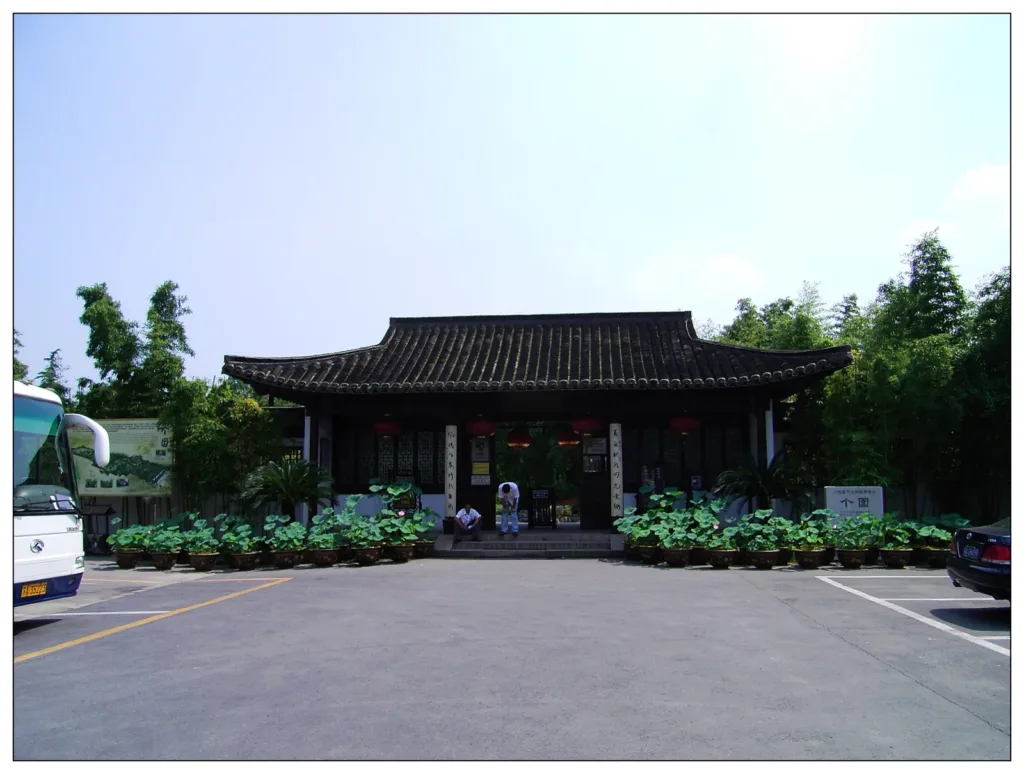
- Geyuan Garden's main gate in Yangzhou, photographed on 8 August 2006. Photo: gdczjkkPhoto: CC BY 3.0