

Explore the region
Why visit
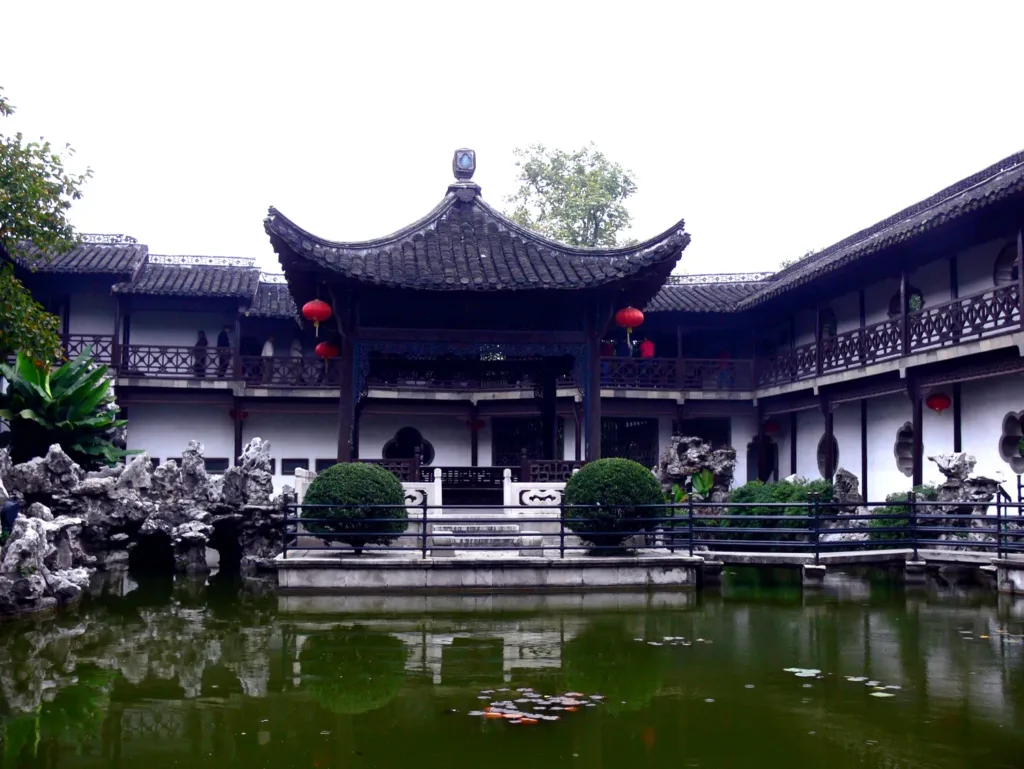
He Garden is less a collection of isolated pretty views than a designed way of moving through a home. A raised, double-path corridor joins halls and living quarters, turns through framed openings, and changes the height and direction of the view. The result is practical as well as picturesque: residents could move between spaces under cover, while visitors see the residence and garden as one composition.
The garden began in 1862 for He Zhidao, also known as He Weijian, and took thirteen years to build. He called it Jixiao Shanzhuang, a name drawn from Tao Yuanming’s “The Return”. In 1883, the Wu family’s Pianshi Shanfang was incorporated into the property. That layered history explains why the visit moves between a late-Qing family residence, garden courtyards and an older rockery tradition.
What to look for
Start with the residential section and Yuxiu Building. Its surviving details include Chinese residential planning alongside features described by a People’s Daily account as French louvred doors and windows, Japanese sliding doors, a French fireplace and iron beds. These are not decorative add-ons to ignore: they show how a wealthy late-Qing household adapted a traditional courtyard residence to new ideas of comfort and contact with the outside world.
Then follow the corridor into the eastern and western gardens. The Boat Hall uses a boat-like form and a pebble-and-tile ground pattern that evokes water; the family’s salt-trading background gives that image a plausible social association, though it should be read as an architectural allusion rather than a literal boat. In the west garden, the pond, Butterfly Hall and Water-Centered Pavilion create different relationships between rooms, water and sound.
Leave time for Pianshi Shanfang, the garden-within-the-garden linked to the Wu family site and to the rockery tradition associated with the painter Shi Tao. Look closely at the rockwork and water rather than rushing through it as an appendix. The official cultural account identifies it as one of He Garden’s defining features and describes the garden as a meeting of Chinese garden craft and Western architectural elements.
How to visit
Address and entry. The operator gives the address as 66 Xuningmen Street, Yangzhou (扬州市徐凝门大街66号). Its April 2025 entrance notice described the East Gate and East Side Gate as regular channels, the North Gate as a flexible weekend and holiday high-flow entrance, and the South Gate as the exit. Use 何园,扬州市广陵区徐凝门大街66号 as the Chinese taxi or ride-hailing destination, then follow the gate signs on arrival. Policies can change with crowd control, so confirm the open gate with the venue before setting out.
Opening and tickets. This is a ticketed attraction. The operator’s official booking notice directs visitors to the “何园” WeChat account and its “门票预约” menu; the same notice describes the ticket office at the address for that specific promotion. The official ticket shop also exposes He Garden ticket products, but seasonal prices and eligibility should be checked in the current booking screen rather than copied from an old promotion. The venue’s 9 April 2025 entrance notice gave 07:30–18:00 in the busy season with last entry at 17:30, while a Yangzhou government cultural page published on 6 November 2025 lists 07:30–17:00. Treat the day’s official notice as controlling and leave time for the residential rooms, corridor and Pianshi Shanfang.
Bus and onward travel. The venue lists bus routes 6, 19, the tourist line and 209 to the He Garden stop. Yangzhou’s government route list also shows Tour 1 linking the West Coach Hub and Yangzhou Railway Station with Kangshan Culture Park (He Garden), and a sightseeing bus between Daming Temple and He Garden. For a return, use the opposite-bound stop or the current live route information; do not assume a seasonal tourist service runs late. The practical last mile is the He Garden stop or a taxi to Xuningmen Street; plan around the confirmed stop and entrance rather than a metro interchange. A taxi driver can use the Chinese destination above; on foot, leave through the signed South Gate if that day’s one-way arrangement is in force.
Combine your visit
A suggested sequence linking the specific features of this visit.
-
Residential section
Begin with the domestic setting of the late-Qing garden.
-
Double-Path Cloister
Follow the changing views connecting the garden areas.
-
Boat Hall and pond pavilion
Compare two different waterside architectural forms.
This order is editorial. Confirm access and any transfers between stops; it does not establish a walking route, same-day connection or common admission ticket.
Find He Garden
何园 · 扬州市
The pin marks the area, not the entrance.
More places nearby
Approximate straight-line distances between map pins, not travel distances.
Geyuan Garden 个园
2 km awayGeyuan in Yangzhou uses different rocks and planting to represent the four seasons. Bamboo provides the recurring green setting, while the seasonal rockeries create contrasting textures and colours.
View guide →China Grand Canal Museum 中国大运河博物馆
3 km awayChina Grand Canal Museum stands in Yangzhou’s Sanwan wetland park and examines the canal as a connected cultural landscape. Its permanent exhibitions move between the whole waterway, boats and the cities that grew beside it.
View guide →Slender West Lake 瘦西湖
4 km awaySlender West Lake winds through a restored garden landscape northwest of Yangzhou’s old city. Its narrow waterway developed from earlier moats and canals, later bordered by wealthy merchants’ estates.
View guide →Sources & visit information
Sources checked on 24 October 2026. Hours, tickets, reservations and transport can change; confirm with the operator before you go.
- He Garden introduction · He Garden Management Office ↗
- The Charm of the First Garden of the Late Qing Dynasty · People's Daily Overseas ↗
- He Family Academy and He Garden · Yangzhou Commission for Discipline Inspection ↗
- Three entrance channels at He Garden · He Garden Management Office ↗
- Transport · He Garden Management Office ↗
- Yangzhou public bus routes · Yangzhou Municipal Government ↗
- Reservation guide for He Garden · He Garden Management Office ↗
- He Garden official ticket shop ↗
- He Garden official English site ↗
Image credits & notes (1)
- He Garden's central water court and covered two-level corridor in Yangzhou, photographed in October 2007. Photo: GislingPhoto: CC BY 3.0