

Explore the region
Tap any red Chinese text to hear it in Mandarin.
Yangzhou is at its most legible here as a city of layered routes: an uphill temple, a literary viewpoint and a garden with water and old trees occupy one slope rather than being separated into unrelated museums. The climb from the road is gentle but real; allow time for steps, courtyards and the eastern and western sections instead of treating the temple as a quick gate photograph.
Daming Temple is also a place where Yangzhou’s links with Japan can be read in architecture. Jianzhen, the Tang monk associated with the temple and his journey to Japan, is commemorated in a complex designed in the architectural spirit of Tōshōdai-ji in Nara. Pingshan Hall offers a different lens: Ouyang Xiu built it in 1048, and its name refers to distant hills appearing level with the sightline from the hall.
What to see
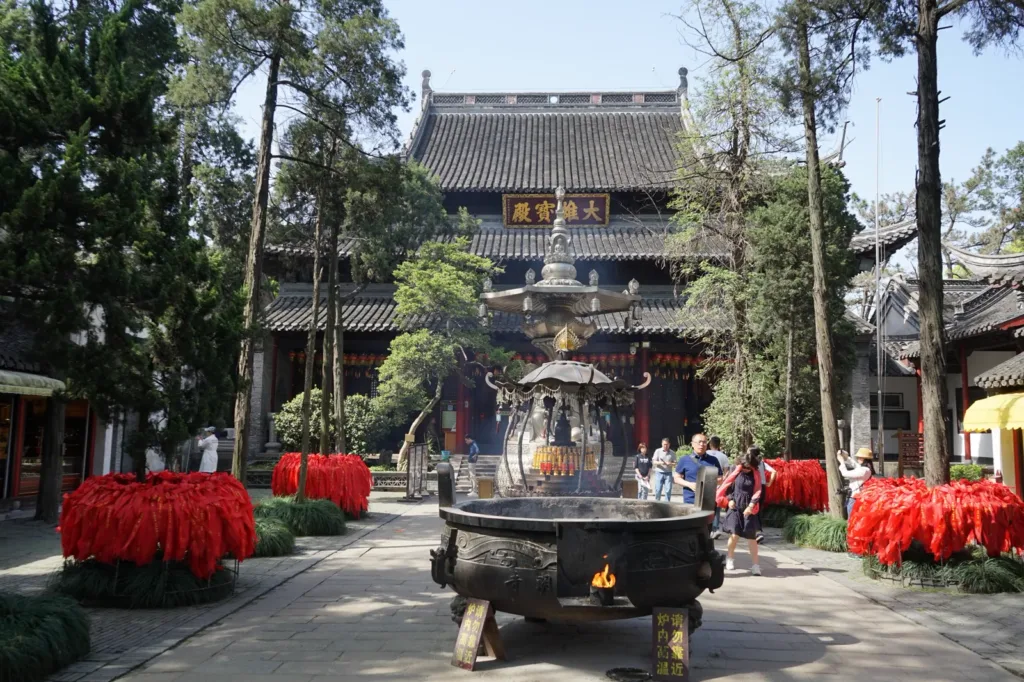
Read the site as three connected areas, not as one undifferentiated temple. The central section is the active worship core: pass the memorial archway and mountain gate, then continue to the Hall of the Heavenly Kings and the Mahavira Hall. Keep voices low, follow signs about photography, and give worshippers priority in the courtyards.
The eastern section holds the Jianzhen Memorial Hall and Qiling Pagoda. The memorial complex includes a display room, gate hall, stele pavilion and main hall. Its Tang-style design was created to honour Jianzhen, the Yangzhou monk whose journey to Japan became a major link between Chinese and Japanese Buddhist history. The displays and memorial architecture are the point here; do not confuse this local memorial with the original Jianzhen statue preserved at Tōshōdai-ji in Nara.
Qiling Pagoda is a nine-storey pagoda associated with the temple’s Sui-dynasty history. The present tower is a modern reconstruction based on historical forms, rather than the surviving original tower. Its height and position make it a useful landmark when reading the temple’s eastern side, but tower access and any supplementary ticket should be confirmed at the site on the day.
The western section is the literary and garden side. Pingshan Hall, built by Ouyang Xiu in 1048, is joined in the same historic group by Gulin Hall and the Ouyang Memorial Hall. Continue into Xiyuan, also known as the West Garden or Imperial Garden in local descriptions, for rockeries, pavilions, a release pond, the Qianlong stele pavilion and the spring known as the “Fifth Spring Under Heaven.”
A workable order
A practical first visit is central halls → Jianzhen Memorial Hall → Qiling Pagoda → Pingshan Hall and Xiyuan. This follows the compound’s central, eastern and western logic, but it is an editorial sequence, not a promise that every hall is open or that every part shares one separately priced admission product. Allow about half a day if you want to read the memorial displays and garden rather than only see the main gate.
When to go in and how to arrive
The current visitor listing checked on 24 October 2026 gives public opening hours of 08:00–17:00, with admission ending at 16:30. It identifies the site as No. 8, Pingshantang East Road, Hanjiang District, Yangzhou. The temple’s own visitor guide confirms the same road address but does not show a current ticket table. Admission is paid; current adult prices, discounts, reservation rules, passport acceptance and whether Qiling Pagoda access is included can change, so confirm the date-specific arrangement through the official temple channel or the notice at the entrance before paying.
For a bus, use route 5 or 25 and get off at Daming Temple (大明寺). From the stop, follow Pingshantang East Road towards the temple and take the uphill approach to the public entrance. For the return, come back to 大明寺 Dàmíng Sì bus stop and check the reverse-direction display before boarding; live departure times and stop-side information are not fixed in this guide.
Yangzhou’s relevant rail arrivals are Yangzhou Railway Station (扬州站) and Yangzhou East Railway Station (扬州东站). Neither station is at the temple. Continue from the station by a currently routed bus or taxi, using the verified 大明寺 Dàmíng Sì stop as the destination landmark, and reverse that transfer for the return journey. There is no verified operating metro route or metro station for this visit, and no water shuttle serves the hilltop entrance.
For a taxi or ride-hailing car, show “大明寺,扬州市邗江区平山堂东路8号” and ask for the 大明寺游客入口 Dàmíng Sì yóukè rùkǒu or 大明寺正门 Dàmíng Sì zhèngmén. The public approach is uphill from the road; keep the Chinese address for the return pickup rather than relying on an English place label.
Combine your visit
A suggested sequence linking the specific features of this visit.
-
Central worship halls
Begin with the temple’s main Buddhist arrangement.
-
Jianzhen Memorial Hall
Explore the connection with the monk’s journey to Japan.
-
Pingshan Hall
Finish with the literary and landscape viewpoint.
This order is editorial. Confirm access and any transfers between stops; it does not establish a walking route, same-day connection or common admission ticket.
Find Daming Temple
大明寺 · 扬州市
The pin marks the area, not the entrance.
More places nearby
Approximate straight-line distances between map pins, not travel distances.
Slender West Lake 瘦西湖
2 km awaySlender West Lake winds through a restored garden landscape northwest of Yangzhou’s old city. Its narrow waterway developed from earlier moats and canals, later bordered by wealthy merchants’ estates.
View guide →Geyuan Garden 个园
4 km awayGeyuan in Yangzhou uses different rocks and planting to represent the four seasons. Bamboo provides the recurring green setting, while the seasonal rockeries create contrasting textures and colours.
View guide →Yangzhou Museum 扬州博物馆
5 km awayYangzhou Museum shares the western-city Double Museum building with the China Block Printing Museum. Its collection connects the canal city with archaeology and decorative arts, including the celebrated Yuan blue-glazed vase…
View guide →Sources & visit information
Sources checked on 24 October 2026. Hours, tickets, reservations and transport can change; confirm with the operator before you go.
Image credits & notes (1)
- The Mahavira Hall (Great Hall) at Daming Temple, Yangzhou, with a foreground incense burner and red prayer ribbons. Photo: HuangchenhaiPhoto: CC BY-SA 4.0