

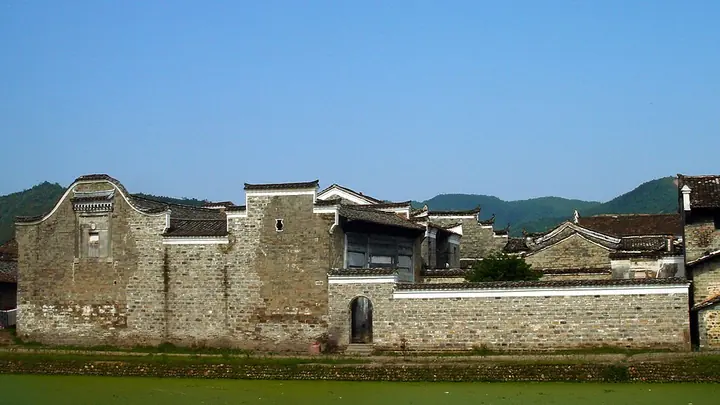
Photo adjustments
Full frame retained; proportionally resized and converted to WebP. No retouching or changes to the photographed subject. Card displays may crop the view.
Explore the region
About Liukeng
The settlement is associated with the Dong lineage and preserves substantial Ming- and Qing-period architecture.
Hills surround the village, while the Niutian River runs beside it. Old camphor trees along the river contribute to a landscape that extends beyond the built village.
Villagers are mostly surnamed Dong (董) and claim descent from Dong Zhongshu (董仲舒), though the earliest traceable founding ancestor is Dong He (董合). The village was founded during the Southern Tang Shengyuan era (昇元) and originally belonged to Yongfeng County (永丰县) in Ji Prefecture (吉州) before coming under Le'an County in the Southern Song. After visiting, the traveller Xu Xiake (徐霞客) described it as crisscrossed by market streets and home to thousands of families, with the Dong clan its most prominent lineage and its Five Cassia archway (五桂坊); the village has since been called the 'thousand-year first village' (千古第一村).
The village today has 19 surviving Ming-dynasty structures, including sites, and more than 250 from the Qing dynasty. Hills enclose it on four sides, and the Niutian River (牛田河), also called the Enjiang (恩江), flows past its edge from southeast to northwest. More than ten thousand old camphor trees line the riverbank downstream to Xiazhen village (峡圳村), including 346 specimens over 1,000 years old.
In 1997 the Jiangxi provincial government designated Liukeng a Jiangxi Province Historical and Cultural Protection Zone (江西省历史文化保护区). In June 2001 it was listed as a Major Historical and Cultural Site Protected at the National Level (全国重点文物保护单位), and in October 2003 it was named one of China's first Historical and Cultural Famous Villages (中国历史文化名村).
What to look for
- Ming- and Qing-period buildings preserve the Dong lineage’s settlement history.
- The riverbank and old camphor trees extend the village landscape beyond its streets.
Location & getting there
Getting to Liukeng
Travel to Liukeng village in Niutian town, Le’an County. Keep the village and its adjoining Niutian River corridor as the focus of the visit.
- Confirm the visitor entrance and access to the named areas before departure.
Combine your visit
A suggested sequence through the named features described in the source.
-
Historic village streets
Begin with the street pattern and surviving Ming- and Qing-period buildings.
-
Dong-lineage architecture
Read the buildings in relation to the Dong family’s settlement history.
-
Niutian River setting
Finish with the riverbank and old camphor trees outside the built core.
The order is an editorial suggestion. Internal opening arrangements and transfers between sectors need checking; no walking duration or access entitlement is implied.

Find Liukeng
流坑 · 抚州市
The pin marks the area, not the entrance.
More places nearby
Approximate straight-line distances between map pins, not travel distances.
Bailuzhou Academy 白鹭洲书院
78 km awayBailuzhou Academy stands on a sandy island in the Gan River at Ji’an. Repeated floods and rebuilding shaped its history, making the raised grounds and river edge especially meaningful. Fengyue Tower and Yunzhang Pavilion…
View guide →Xiannü Lake 仙女湖
109 km awayXiannü Lake is the visitor name for Jiangkou Reservoir southwest of Xinyu. Flooded valleys create a varied shoreline: Wulong Lake contains many bays and islands, while Zhongshan Gorge narrows the water between hills. A…
View guide →Mount Dajue 大觉山
143 km awayDajue Mountain in Zixi combines forested hills with a temple set in a large rock cave. The cave shrine is the clearest cultural feature, while the canyon below supports the scenic area’s rafting activities. These offer quite…
View guide →Sources & visit information
The linked encyclopedia sources support background and place descriptions. Current opening hours, ticket prices, booking rules and transport schedules have not been independently verified for this guide. Confirm them with the venue or operator before travelling.
Visitor information adapted and edited from Wikipedia contributors, “流坑村” · CC BY-SA 4.0. Source revision 92186719.
Background paragraphs translated and condensed from Wikipedia contributors, "流坑村", Chinese Wikipedia · CC BY-SA 4.0. Source revision 92186719.