

Explore the region
Why come
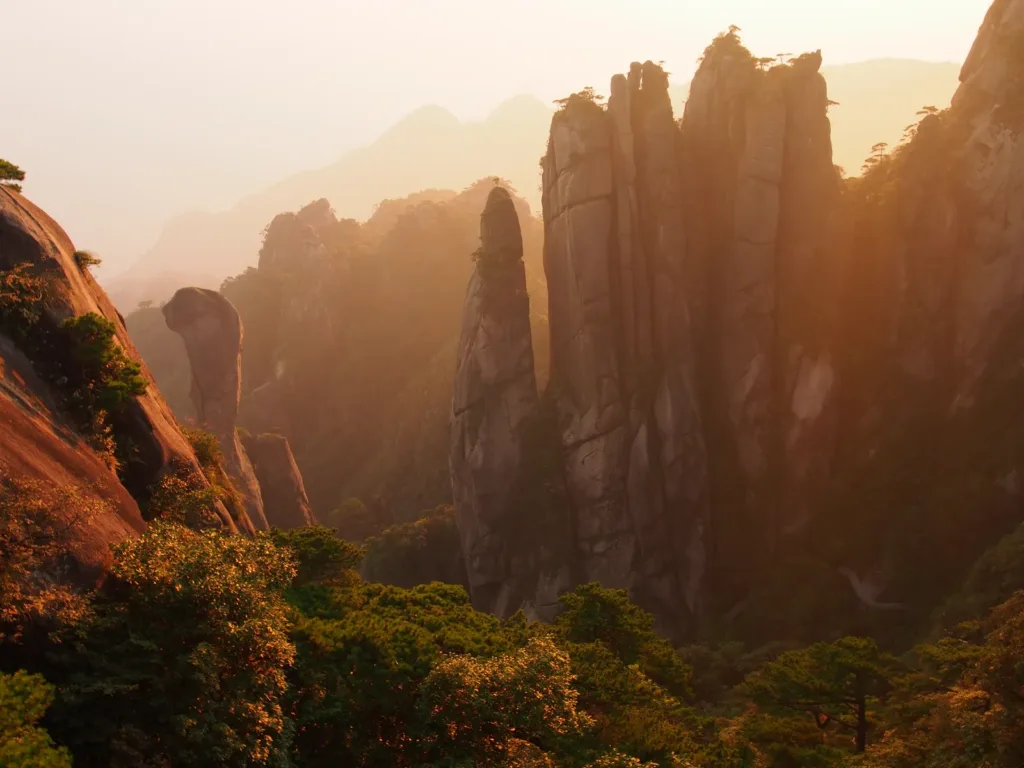
Sanqingshan is a mountain landscape in northeast Shangrao rather than a single summit with one universal trailhead. UNESCO inscribed Mount Sanqingshan National Park in 2008 for the concentration of 48 granite peaks and 89 granite pillars, many read as human or animal silhouettes. The 1,817-metre mountain is also shaped by forests, waterfalls, springs and changing weather, so the view is not just a collection of isolated rocks.
The geology is part of the experience. UNESCO describes a granite peak forest formed through the uplift and erosion of a fault block over hundreds of millions of years. The Oriental Goddess and the 128-metre Python Slithers out of Mountain are useful places to compare how one material can become two very different silhouettes.
What to look at
Begin with Nanqing Park if you have one main outing. The official English visitor site lists the Oriental Goddess, Gigantic Python Rising in the Mountain and other named formations there. Rather than photographing each name as a separate attraction, pause at more than one viewpoint and notice the contrast between the seated-profile shape of the Goddess and the narrow vertical column of the Python.
The West Seashore is a different kind of visit: its plank footpath is built around cliff-edge views, sea of clouds, sunsets and layered valleys. The official description calls the scenic area mostly flat, but a cliff path is still weather-dependent; walk only on the route open that day and leave enough time for the return. UNESCO identifies suspended walking trails as part of how visitors experience the park’s scenery, not as permission to leave the managed paths.
Sanqingshan is also a Taoist mountain. Its name refers to the three summits Yujing, Yuxu and Yuhua, associated with the Three Purities. Around Sanqing Temple, UNESCO’s geopark profile records 238 Taoist cultural remains, including temples, palaces, carvings and cliff inscriptions, along a roughly two-kilometre cultural axis. Treat these as religious and heritage sites: look closely at the setting and inscriptions, keep clear of restricted areas, and do not turn active or protected spaces into a backdrop for careless climbing.
Entrances, tickets and safety
Sanqingshan is operated through more than one mountain gateway. A 29 August 2026 operator notice listed the Jinsha, Waishuangxi and Gangshou cableways, as well as the Waishuangxi walking trail, and reported normal operation from 30 August after a weather closure. The same notice recorded a Waishuangxi cableway inspection from 1 to 15 September, which is a reminder that ropeway operation is date-specific rather than a permanent promise.
The operator’s notice says the scenic area uses real-name advance reservation through the “大美上饶&三清山智慧旅游” mini-program and other regular platforms, with entry checked against a valid identity document. It does not explain whether a foreign passport can be used in the same workflow. International visitors should confirm the passport, payment and entry procedure with the operator before buying; the notice lists the service hotline as 0793-96373.
Do not assume that a broad map pin is an entrance, or that an entrance ticket automatically covers every cableway, shuttle or optional service. Check the current booking page for the separate entrance, ropeway and transfer charges on your date. The operator specifically instructs visitors to stay on officially open paths, avoid undeveloped tracks and remote forest, and keep away from cliffs and slopes. Mountain weather can change the experience quickly, so make the return plan before setting out.
Getting there and back
There is no useful metro route to this mountain. For rail travel, the practical arrival points are Shangrao Railway Station (上饶站) and Yushan South Railway Station (玉山南站). A Shangrao Culture & Tourism transport guide published on 5 April 2025 described a tourist coach from Shangrao East Bus Station (上饶汽车东站) to the southern Waishuangxi cableway entrance; it also described a separate custom service from the Shangrao high-speed-rail arrival area to the eastern Jinsha entrance. The guide says the exact departures vary by day, so treat the named services as a route to check rather than a guaranteed timetable.
From Yushan South, the same guide described a tourism transfer centre at the station arranging shared vehicles to either the southern or eastern entrance, subject to passengers and current operation. Yushan Bus Station (玉山汽车站) was also described as having coaches for both gateways. For the return, the guide said the coach stops outside the eastern and southern ropeway entrances connect to Yushan Bus Station; local bus 6 then links the bus station with Yushan South Railway Station. Reconfirm the last departure before entering the mountain, especially if you plan to use a different gateway on the way out.
For a taxi or hired car, give the driver the exact Chinese destination shown in the transport guidance: “三清山风景区游客中心东停车场(东部金沙索道口)” for the eastern Jinsha cableway, or “三清山风景区南门停车场(南部外双溪索道口)” for the southern Waishuangxi cableway. These names identify the visitor-side parking areas and entrances; do not replace them with a generic “Sanqingshan” map pin.
Combine your visit
A suggested sequence linking the specific features of this visit.
-
Oriental Goddess viewpoint
Start with the human-profile formation reached from the Jinsha side.
-
Giant Python viewpoint
Compare the Goddess with the mountain’s unusually narrow granite pillar.
This order is editorial. Confirm access and any transfers between stops; it does not establish a walking route, same-day connection or common admission ticket.
Find Sanqingshan
三清山 · 上饶市
The pin marks the area, not the entrance.
More places nearby
Approximate straight-line distances between map pins, not travel distances.
Wangxian Valley 望仙谷
36 km awayWangxian Valley is a modern visitor landscape built around a restored former stone-production area in the Lingshan foothills. Its most striking buildings cling to the cliffs above the valley, while traditional-style lanes and…
View guide →Huangling, Wuyuan 篁岭
46 km awayHuangling climbs a hillside above Wuyuan’s fields, its white walls and dark tiles arranged around the reconstructed Tianjie street. Wooden racks and round drying trays create the village’s celebrated shaiqiu imagery. The…
View guide →Wangkou 汪口
49 km awayWangkou is a Huizhou village in Jiangwan, Wuyuan, surrounded by water on three sides. Founded in the Song period, it developed as a settlement of the Yu lineage.
View guide →Sources & visit information
Sources checked on 1 November 2026. Hours, tickets, reservations and transport can change; confirm with the operator before you go.
Image credits & notes (1)
- Sunrise over the Giant Python Emerging from the Mountain at Sanqingshan. Photo: Darren Peets (Wikimedia Commons user Dcpeets)Photo: CC BY-SA 4.0