

Photo adjustments
Full frame retained; proportionally resized and converted to WebP. No retouching or changes to the photographed subject. Card displays may crop the view.
Explore the region
About Wangkou
Founded in the Song period, it developed as a settlement of the Yu lineage.
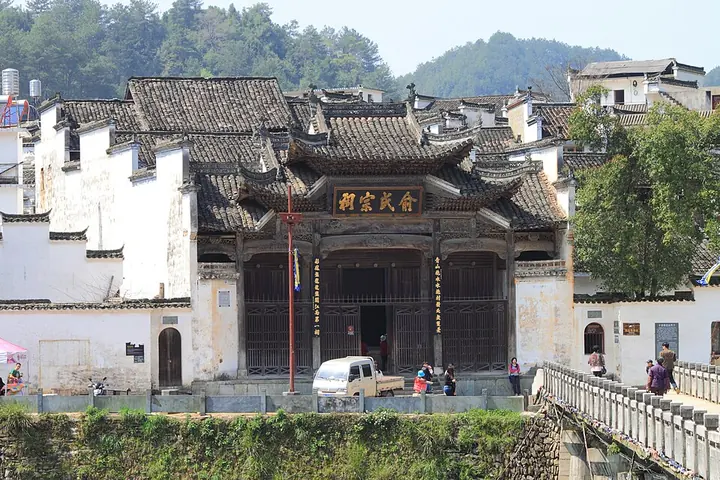
The Yu ancestral hall dates from 1736 and is a principal architectural landmark. Historic residences and the Pingdu weir add to the village’s built and riverside heritage.
Wangkou was anciently known as Yongchuan (永川) and was founded in the third year of the Song Daguan era (大观), 1110, by Yu Gao (俞杲); it grew as a Huizhou village settled mainly by the Yu lineage. Historically the village's literary culture flourished, producing fourteen holders of the jinshi degree and seventy-three officials of the seventh rank or above.
The village is recognized as a Chinese Historical and Cultural Famous Village (中国历史文化名村). The Yu ancestral hall (俞氏宗祠) is listed as a Major Historical and Cultural Site Protected at the National Level (全国重点文物保护单位), while the village's cluster of more than twenty old buildings, including the Jiang Guibin residence (江桂斌宅), is listed as a Wuyuan county-level cultural relic protection unit.
What to look for
- The Yu ancestral hall dates from 1736.
- Water on three sides and the historic Pingdu weir explain the village’s river setting.
Location & getting there
Getting to Wangkou
Approach Wangkou village in Jiangwan, Wuyuan. The Yu ancestral hall is a useful specific target within the riverside settlement.
- Confirm the visitor entrance and access to the named areas before departure.
Combine your visit
A suggested sequence through the named features described in the source.
-
Yu ancestral hall
Begin with the Yu family’s eighteenth-century ancestral hall.
-
Historic residences
Compare the hall with the village’s domestic architecture.
-
Pingdu weir setting
Finish with the historic weir and the village’s relationship to surrounding water.
The order is an editorial suggestion. Internal opening arrangements and transfers between sectors need checking; no walking duration or access entitlement is implied.
Find Wangkou
汪口 · 上饶市
The pin marks the area, not the entrance.
More places nearby
Approximate straight-line distances between map pins, not travel distances.
Huangling, Wuyuan 篁岭
12 km awayHuangling climbs a hillside above Wuyuan’s fields, its white walls and dark tiles arranged around the reconstructed Tianjie street. Wooden racks and round drying trays create the village’s celebrated shaiqiu imagery. The…
View guide →Yaoli 瑶里
46 km awayYaoli’s old streets follow the Yao River through a valley northeast of Jingdezhen. Merchant houses and ancestral buildings recall a settlement connected with porcelain materials and tea. Cheng Ancestral Hall gives a communal…
View guide →Sanqingshan 三清山
49 km awaySanqingshan’s granite pillars rise above forested slopes in shapes that have acquired memorable names. In Nanqingyuan, the narrow Giant Python column and the profile of the Oriental Goddess provide two contrasting examples of…
View guide →Sources & visit information
The linked encyclopedia sources support background and place descriptions. Current opening hours, ticket prices, booking rules and transport schedules have not been independently verified for this guide. Confirm them with the venue or operator before travelling.
Visitor information adapted and edited from Wikipedia contributors, “汪口村” · CC BY-SA 4.0. Source revision 92186697.
Background paragraphs translated and condensed from Wikipedia contributors, "汪口村", Chinese Wikipedia · CC BY-SA 4.0. Source revision 92186697.