

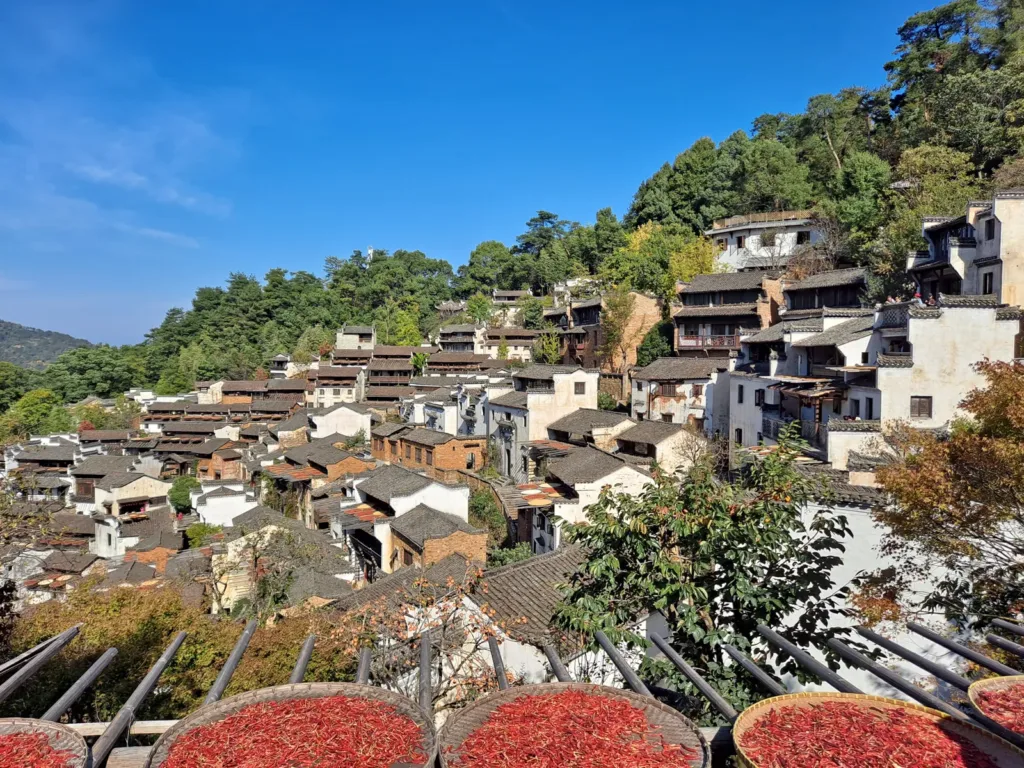
Explore the region
Huangling is a paid, managed scenic area in Jiangwan Town, Wuyuan County, rather than a freely wandering village. The operator describes a 7.8-square-kilometre area that combines a cableway, the restored village street of Tianjie, terraced fields and Shaiqiu-related folk displays. The mountain village is the part most visitors picture, but the lower visitor centre, cableway system and separate residential new village are part of the visit too.
The setting explains why the place looks so distinctive. A Ministry of Culture and Tourism report describes Huangling as a mountain settlement more than 500 years old, with houses arranged in a fan-like stepped pattern around a shuikou—the village’s water outlet and landscape threshold. Its difficult terrain once contributed to the village becoming under-populated; protective development and relocation produced the present arrangement of a scenic old village above and a new village where local residents live below. This means the old village should be read as a preserved and operated heritage landscape, not as an untouched community whose daily life is staged for visitors.
What to look for
Shaiqiu, or seasonal crop-drying. Look up from the street and viewing platforms rather than treating the racks as a single colour installation. Wooden drying racks, round trays and roof edges hold crops whose colours and types change with the agricultural season. The visual effect comes from the relationship between practical drying surfaces, white walls, dark roofs and the steep terraces behind them. The tradition is associated with household roof space, but today’s viewpoints and displays are part of a managed tourism setting.
Tianjie and the hillside houses. Walk Tianjie slowly and look at the depth of the street: shopfronts, timber details, rooflines and narrow changes in level reveal how the restored village is fitted to the slope. Some former homes now accommodate shops, lodging or visitor experiences, so do not assume that every doorway is an open historic interior. The official description presents the mountain village and its commercial facilities as one scenic-area operation.
Terraces and seasonal colour. From the village’s outlooks, compare the stacked roofs with the cultivated slopes instead of photographing only the nearest drying tray. Spring brings canola and other flowers; the Ministry of Culture and Tourism’s 2025 route describes flowers continuing from March into later spring, while autumn reports emphasise harvest colours. These are seasonal windows, not a promise that a named crop or event will be present on every date.
How to visit without confusing the parts
Aim first for 篁岭景区游客中心(下站), the lower visitor centre and cableway arrival area in Huangling Village, Jiangwan Town. The cableway is the normal link to the mountain village; arriving at a map pin for the old village is not the same as reaching the ticket and boarding area. Once uphill, expect steps and sloping paths. Wear shoes with a secure grip, leave time for the viewpoints, and stay on signed visitor routes rather than trying to improvise along steep edges.
Treat admission, cableway use and any special experience as separate questions when booking. The operator has published a 2026 ticket-price notice and maintains an online ticketing system, but prices, inclusions, opening hours and reservation controls can change by date or season. Check the current official product before paying; do not carry forward older figures for a combined ticket or assume that an activity, night programme or every exhibition room is included.
If you are travelling with a non-mainland passport, confirm the current ticket, identity-document and reservation procedure with the operator before departure rather than assuming a domestic-ID booking flow accepts every passport. The official site lists the visitor enquiry number 0793-7255555. This is especially useful during holiday dates when the operator may use reservation or visitor-flow controls.
Getting there and back
- Rail and direct bus: Take high-speed rail to Wuyuan Railway Station (婺源火车站). A 2026 route notice lists a direct bus to Huangling Scenic Area (篁岭景区), the terminal for the scenic area, via Civil Affairs Bureau (民政局), Laobei Station (老北站), Wunvzhou Resort (婺女洲度假区) and Jiangwan Scenic Area (江湾景区). The listed fare is RMB 19 per person. The same notice lists departures from Wuyuan Station from 07:30 to 17:25 and returns from Huangling from 09:40 to 18:30; confirm the live timetable and last return when you arrive, because holiday and seasonal services can change.
- Coach/bus from Wuyuan: The operator’s travel note also names Wuyuan New Bus Station (婺源新汽车站) as a departure point for tourist buses to Huangling, but its published times are older than the 2026 direct-route notice. Use the current station-board or ticketing information rather than treating the older interval as a guaranteed service.
- Taxi or ride-hailing: Show the driver “江西省上饶市婺源县江湾镇篁岭村,篁岭景区游客中心(下站)”. Say 游客中心(下站) so you are taken to the lower visitor and cableway area, not asked to stop at a mountain-top map pin. Do not rely on a fixed fare or journey time; confirm the return plan before entering the scenic area.
- Metro and water transport: There is no useful metro or water route for this mountain visit. The practical public-transport chain is Wuyuan Railway Station or Wuyuan’s bus network, then the Huangling scenic-area bus or a road vehicle to the lower visitor centre.
Huangling is most rewarding when you use the stairs, terraces and roofline views to understand how the old settlement works as a landscape. Come for the close reading of buildings, drying structures and cultivated slopes, and keep the managed scenic-area boundary in mind: a beautiful view does not by itself prove that a room, path, seasonal display or ticket product is open that day.
Combine your visit
A suggested sequence linking the specific features of this visit.
-
Tianjie
Begin with the restored street and its house fronts.
-
Crop-drying viewpoints
Look across the racks, trays and tiered roofs.
-
Terrace outlooks
Set the village against its cultivated hillside landscape.
This order is editorial. Confirm access and any transfers between stops; it does not establish a walking route, same-day connection or common admission ticket.
Find Huangling, Wuyuan
篁岭 · 上饶市
The pin marks the area, not the entrance.
More places nearby
Approximate straight-line distances between map pins, not travel distances.
Wangkou 汪口
12 km awayWangkou is a Huizhou village in Jiangwan, Wuyuan, surrounded by water on three sides. Founded in the Song period, it developed as a settlement of the Yu lineage.
View guide →Sanqingshan 三清山
46 km awaySanqingshan’s granite pillars rise above forested slopes in shapes that have acquired memorable names. In Nanqingyuan, the narrow Giant Python column and the profile of the Oriental Goddess provide two contrasting examples of…
View guide →Yaoli 瑶里
58 km awayYaoli’s old streets follow the Yao River through a valley northeast of Jingdezhen. Merchant houses and ancestral buildings recall a settlement connected with porcelain materials and tea. Cheng Ancestral Hall gives a communal…
View guide →Sources & visit information
Sources checked on 1 November 2026. Hours, tickets, reservations and transport can change; confirm with the operator before you go.
Image credits & notes (1)
- An overlook of Huangling Village in Wuyuan, with Huizhou-style hillside houses and drying trays in the foreground. Photo: EditQPhoto: CC BY-SA 4.0