

Explore the region
This is a compact cultural visit rather than a substitute for Shangrao’s mountain and village excursions. The two stops have different purposes: the museum gives you an indoor introduction to the region’s history and material culture, while Xinjiang Academy lets you look at how an old educational site is still used as a public cultural space. They are separate venues, so plan a local transfer instead of assuming a shared entrance, ticket, or walking route.
Start with Shangrao Museum
Shangrao Museum is at 19 Guangxin Dadao, Xinzhou District (上饶市信州区广信大道19号). General admission is free. The published visitor information lists 09:00–17:00 opening, last entry at 16:30, and closure on Mondays, Chinese New Year’s Eve, and during the Spring Festival except for other national holidays.
Use the permanent galleries as a way to read the region rather than trying to see every case at the same speed. The museum lists five exhibitions: Blood Monument on revolutionary history; A Land of Spiritual Beauty and Natural Grace on Shangrao’s historical sequence; A Continuous Cultural Lineage on cultural development; A Place Blessed with Natural Treasures on material life and economic development; and Folk Customs and Practices on local intangible heritage. Look for the links between the displays: rice cultivation and craft production, the Song-period She inkstone workshop material, Raozhou bronze mirrors, and the local memory of revolution and scholarship. The museum’s own description presents these as layers of Shangrao’s regional identity, not as isolated curiosities.
The free-admission statement above is general visitor information, not a passport-specific entry guarantee. The sources read for this visit do not establish whether an overseas passport can be used for any current reservation or registration process. If the museum’s current channel asks for advance booking or identity details, confirm that procedure before setting out.
Continue to Xinjiang Academy
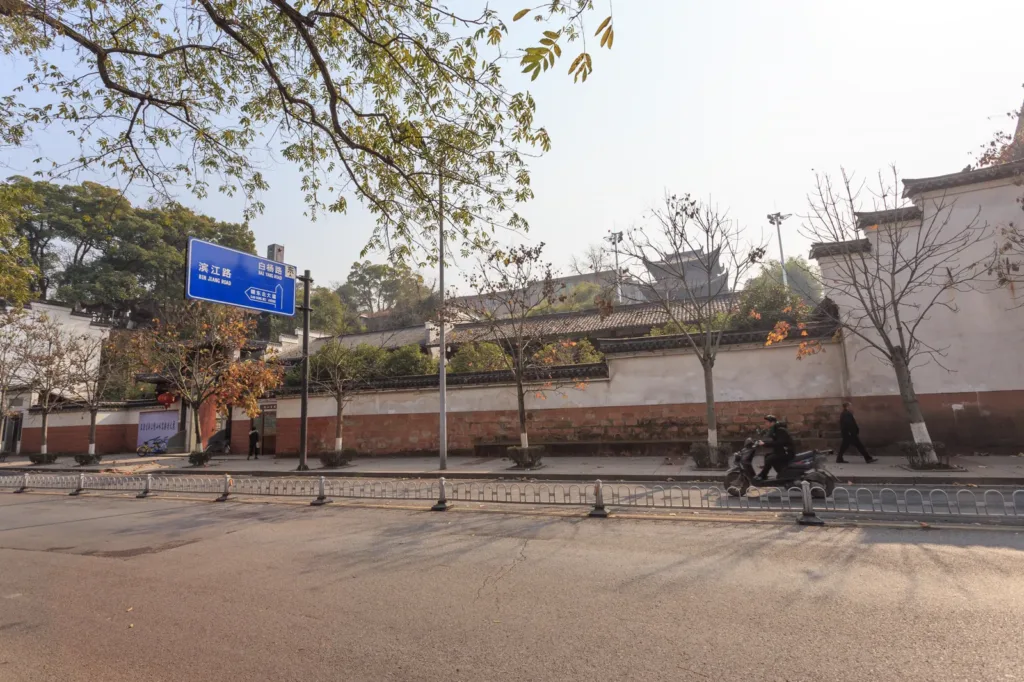
Xinjiang Academy (信江书院) stands on the south bank of the Xin River in Xinzhou District. A current venue listing gives 68 Shuyuan Road (上饶市信州区书院路68号) and lists 09:00–17:00 opening with last entry at 16:00; treat those hours as date-sensitive and recheck them before travel. The listing identifies the site as one of Jiangxi’s four historic academies and records its evolution from Qujiang Academy in the Kangxi period, through later names, to Xinjiang Academy in the Qianlong period.
The academy is worth slowing down for. Xinhua describes a hillside group of old buildings and pavilions, including Zhongling Terrace, Chunfeng Pavilion, Yita Xuan, and Rixin Study, as well as the main hall, lecture hall, Jinsi Hall, and Leyu Hall. Read the buildings as a relationship between study, ritual, slope, and river view rather than as a single grand hall. The site’s current cultural use also matters: recent reporting describes non-heritage displays, a free public reading room, lectures, exhibitions, and community activities in adapted academy spaces.
Those activities are a reason to return, not a promise of a daily show. Schedules can change, and the sources do not establish a fixed programme for an overseas visitor. Go for the architecture and the educational landscape first; treat any lecture, workshop, or exhibition as a bonus to confirm locally.
Getting there and moving between the stops
For an intercity rail arrival, use 上饶站 (Shangrao Railway Station) when checking tickets. The station is listed as an operating passenger station in Xinzhou District, served by the Shanghai–Kunming and Hefei–Fuzhou high-speed railway corridors. It is not either cultural venue, so arrange a separate road transfer to the museum or academy and check the return journey for your date in 12306.
For a taxi or ride-hailing request, show the full Chinese destination: 上饶市博物馆,江西省上饶市信州区广信大道19号 for the museum, or 信江书院,上饶市信州区书院路68号 for the academy. The read sources give venue addresses but do not identify a numbered visitor gate. Ask to be taken to the venue entrance and follow on-site signage rather than guessing an exit or drop-off point. After the second stop, arrange the return from that venue; do not assume that the two addresses form a single pedestrian circuit.
Check both venues again on the day of travel, especially around Mondays, Spring Festival, public holidays, and any planned lecture or exhibition. Keep the Chinese names and addresses available even when using an English map interface.
Combine your visit
A suggested sequence linking the specific features of this visit.
-
Shangrao Museum上饶博物馆
Start with regional craft and cultural history.
-
Xinjiang Academy
Continue to the historic educational landscape overlooking the river.
This order is editorial. Confirm access and any transfers between stops; it does not establish a walking route, same-day connection or common admission ticket.
Find Shangrao overview
上饶 · 上饶市
The pin marks the area, not the entrance.
More places nearby
Approximate straight-line distances between map pins, not travel distances.
Shangrao Museum 上饶博物馆
Less than 1 km awayShangrao Museum draws attention to crafts and scholarship rooted in northeastern Jiangxi. Its collection includes finds from Song-period She inkstone workshops and Raozhou bronze mirrors, alongside material on early rice…
View guide →Wangxian Valley 望仙谷
28 km awayWangxian Valley is a modern visitor landscape built around a restored former stone-production area in the Lingshan foothills. Its most striking buildings cling to the cliffs above the valley, while traditional-style lanes and…
View guide →Sanqingshan 三清山
53 km awaySanqingshan’s granite pillars rise above forested slopes in shapes that have acquired memorable names. In Nanqingyuan, the narrow Giant Python column and the profile of the Oriental Goddess provide two contrasting examples of…
View guide →Sources & visit information
Sources checked on 1 November 2026. Hours, tickets, reservations and transport can change; confirm with the operator before you go.
Image credits & notes (1)
- Exterior wall and traditional roofline of Xinjiang Academy (信江书院), Shangrao, seen from a roadside approach. Photo: ZhangzhugangPhoto: CC BY-SA 4.0