

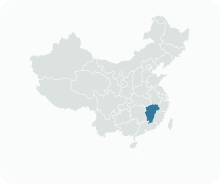
Get to know Xinzhou District
- Administrative area
- District · 市辖区
- Part of
- Shangrao
- Chinese name
- 信州区
- Local areas
- District guide
Area & population
- Area
- 339.00 km²
- Population · 2017
- 427,000
Source: English Wikipedia, as of the dates shown.
Xinzhou is the part of Shangrao where the city’s government, older riverfront cultural spaces and everyday urban life meet. The district sits on the upper Xin River and includes both the built-up centre and a wider administrative area, so “Xinzhou” is not one walkable old town with one entrance. The station area in Lingxi and the southern Maojialing memorial area belong to the same district but are separate planning points.
The most coherent visit stays near the river. On the south bank, Xinjiang Academy (信江书院) preserves the scale of a Qing-era educational compound; across the urban river landscape, Xinzhou’s Twin Pagodas (信州双塔) give the north bank a different architectural marker. The academy is also used as a public cultural venue: a recent local report describes its lecture hall, reading room, exhibitions and community programmes alongside the historic buildings. This makes Xinzhou interesting for the contrast between protected architecture and a place still used by local residents, rather than for a staged historical show.
What to see
Xinjiang Academy (信江书院)
Xinjiang Academy stands on the south bank of the Xin River along Xiangfu Road (相府路). It began in 1697 as Qujiang Academy, took the name Xinjiang Academy after an expansion in 1781, and later became Guangxin Middle School. The surviving complex includes timber study and teaching buildings, pavilions and terraces, and is a Jiangxi provincial heritage site.
Walk slowly enough to read the compound as a school: entrances, courtyards, teaching spaces and the relationship between the buildings and the river matter more than collecting names. The academy’s current cultural use includes the Zhongling Forum, a reading room, exhibitions and occasional traditional-culture or intangible-heritage activities. Those programmes are part of its public role, not a promise of a performance on every day; check the venue’s current notice before building a visit around an event.
Xinzhou Twin Pagodas (信州双塔) and Twin Pagoda Park
On the north bank, Twin Pagoda Park contains Kuiwen Pagoda (奎文塔) and Wugui Pagoda (五桂塔), the pair known as Xinzhou Twin Pagodas. They are Ming–Qing brick pagodas associated with the historic urban landscape and were listed together as a Jiangxi provincial heritage site in 2018.
Use the park as an outdoor architectural stop: compare the two towers, their proportions and their positions beside the river bridges. The protected towers are not the same thing as a ticketed museum or an indoor exhibition, and the source material does not establish a current climbing or interior-visit arrangement. Stay on public paths and follow signs or barriers on site.
Maojialing: the former camp and memorial complex
South of the riverfront core, the Shangrao Concentration Camp Revolutionary Martyrs’ Memorial Hall (上饶集中营革命烈士纪念馆) stands at 66 Lingyuan Road (陵园路66号), beside the Maojialing prison-site area. The memorial hall was established in 1978; the camp history it interprets begins in Shangrao in 1941. This is a place for quiet historical attention to imprisonment, resistance and commemoration, not an entertainment stop.
Treat this as a separate southern visit rather than assuming that a riverfront walk will lead to it. The address and the name “茅家岭” should be shown to a driver, because the wider camp history involved more than one historical site and “Shangrao Concentration Camp” can refer to the broader group rather than one building.
Planning the district
Arrival and movement
For long-distance arrival, use Shangrao Railway Station (上饶站), in Lingxi Subdistrict. The station is in current passenger use and is served by the Shanghai–Kunming railway, Shanghai–Kunming high-speed railway, Hefei–Fuzhou high-speed railway and the Fengfu connecting line. From the station, choose a specific destination and continue by taxi or a currently verified local bus; the station is a transport hub, not a visitor entrance for every Xinzhou site.
No usable metro route for these Xinzhou destinations is identified in the sources used here. For an arriving visitor, the practical fallback is the railway station followed by a taxi to the named venue; a bus route should be checked only after matching the exact Chinese destination.
For a taxi, show the exact Chinese destination: 信江书院(相府路), 信州双塔/双塔公园 Xìnzhōu Shuāngtǎ / Shuāngtǎ Gōngyuán, or 上饶集中营革命烈士纪念馆(陵园路66号). These are separate places with different operators and access conditions. Do not give a driver only “信州区,” and do not assume that a drop-off at one riverbank site is a practical entrance to another. For the return, arrange the next ride from the actual venue or return to 上饶站 only after checking the day’s train and local traffic.
A realistic visit pattern
A short urban outing can pair Xinjiang Academy with the riverfront and Twin Pagoda Park, with time to pause in the public spaces rather than rushing through a checklist. Add Maojialing only when you can give it a separate block of time and the subject suits your interests. If your main goal is the wider district, allow for the fact that Lingxi and the outlying towns are administrative parts of Xinzhou, not extensions of the riverside walking route.
Opening hours, reservation rules, ticket status and passport-specific entry arrangements are not stated here for the academy, Twin Pagoda Park or the memorial complex. Check the named venue’s current notice before setting out, especially if travelling for a scheduled lecture, exhibition or public programme. The historical and architectural visit remains useful without assuming that a temporary activity or a particular opening schedule will be in place.
Guide sources
Explore Xinzhou District
Core places to explore, with English and Chinese names.
Xinzhou District 信州区
Plan your visit
Getting there
Xinzhou District is about 3 km (straight-line distance) from central Shangrao. Search for 信州区 in a map app to find stations and your accommodation.
Where to stay →More in Shangrao
Sources & geographic information
Administrative names and parent areas: Official geographic directory (dmfw.mca.gov.cn) · Reference date 2026-09-06.
Background text adapted from Xinzhou, Shangrao — Wikipedia contributors, under CC BY-SA 4.0. Text has been shortened and reorganized; source revision 1331083405.
Map data © OpenStreetMap contributors. Pins mark approximate centres, not entrances or boundaries.
Image credits & notes (1)
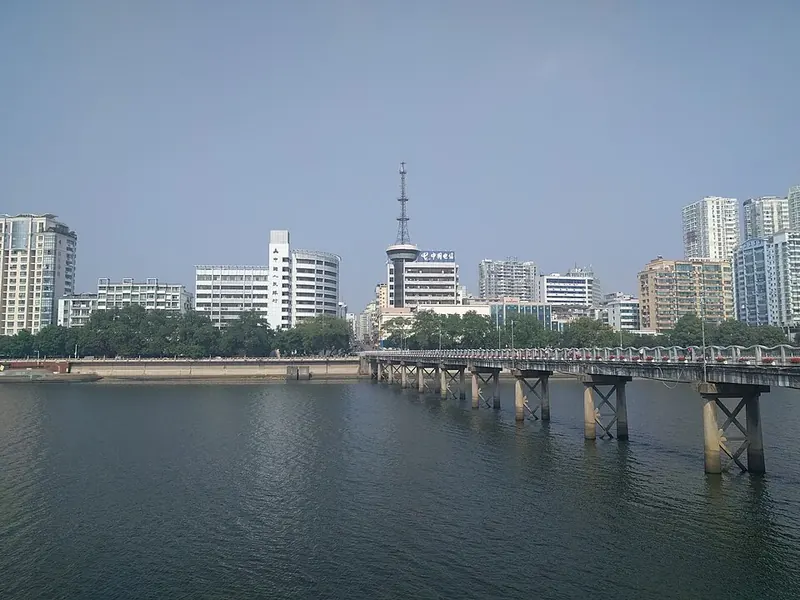
- Riverside skyline of Xinzhou District, Shangrao, with a bridge and communications tower · 上饶市信州区滨江天际线,可见大桥与电视塔Photo: Qa003qa003 · CC BY-SA 4.0 · taken 2017-10-28Resized for the web; the photo itself has not been edited. Thumbnails may show a cropped view.
