

Photo adjustments
Full frame retained; proportionally resized and converted to WebP. No retouching or changes to the photographed subject. Card displays may crop the view.
Explore the region
About Xingcheng
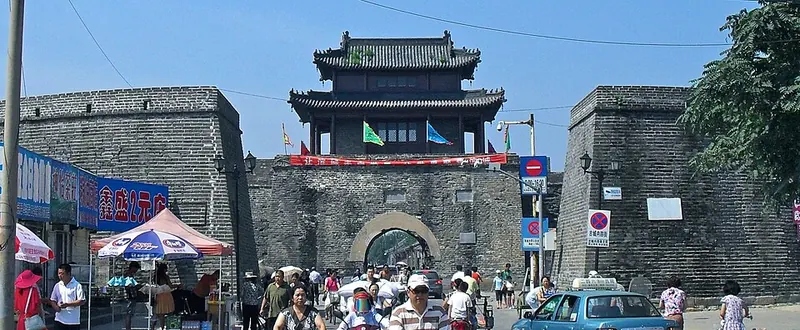
Four gates, corner defences and the central Drum Tower make its military organisation legible within a living town. South Street adds the stone memorial arches of the Zu brothers, linking the streetscape with the families associated with frontier service. The seaside and hot-spring areas belong to a wider Xingcheng trip; the walled town is a coherent visit in its own right.
The name Xingcheng originated in 990, during the Liao dynasty, when Xingcheng county (兴城县) was established with its seat on Taohua Island (桃花岛). In 1428, during the Ming dynasty, Ningyuan garrison (宁远卫) was established here as a border defense town, and the resulting walled city is now the most completely preserved Ming-dynasty city in China; its outer wall no longer survives, but the inner wall has been maintained through repeated repairs. Fighting here in 1626 is traditionally linked to the wounding of the Later Jin khan Nurhaci by cannon fire, though most Qing historians hold that he died of illness eight months later.
The square inner wall measures about 825.5 meters north-south and 803.7 meters east-west, with a total height of 10.1 meters, built of stone and brick around a rammed-earth core. Each side has a central gate with a semicircular barbican, named Chunhe (春和) in the east, Yanhui (延辉) in the south, Yongning (永宁) in the west and Weiyuan (威远) in the north, and the four corners carry raised platforms once used for cannon. At the crossing of the main streets stands a three-story Drum Tower (鼓楼), 17.2 meters high, whose interior now houses excavated artifacts.
What to look for
- The walls, four gates and central Drum Tower of the former Ningyuan garrison town.
- The Zu brothers' stone memorial arches on South Street.
Location & getting there
Getting to Xingcheng
For the old-town route, use Yanhui Gate, the south gate of the walled centre, and continue along South Street. Xingcheng's coastal resort area is a separate destination.
Combine your visit
Suggested order within this visit:
-
Yanhui Gate
Read the fortified entrance.
-
South Street memorial arches
Study the stone carving and family commemoration.
-
Central Drum Tower
See how the town's four principal streets meet.
This sequence is an editorial suggestion based on the features described in the sources. Access to individual buildings or areas should be checked locally; no travel time or shared admission is implied.
Find Xingcheng
兴城 · 葫芦岛市
The pin marks the area, not the entrance.
More places nearby
Approximate straight-line distances between map pins, not travel distances.
Bijia Mountain 笔架山
36 km awayBijia Mountain near Jinzhou is a small coastal island with three peaks resembling a writing-brush stand. Its defining feature is the natural gravel-and-sand causeway that emerges at low tide and disappears as the sea rises…
View guide →Liaoshen Campaign Memorial 辽沈战役纪念馆
66 km awayThe Liaoshen Campaign Memorial in Jinzhou interprets the 1948 campaign that changed control of northeastern China during the civil war. Its galleries combine campaign history with civilian-support and commemoration themes…
View guide →Red Beach (Panjin) 红海滩
97 km awayPanjin's Red Beach is a salt-marsh landscape coloured by seepweed rather than red sand. The plants, tidal channels and neighbouring reeds create the pattern seen from the designated viewing corridor. Colour intensity varies with…
View guide →Sources & visit information
The linked encyclopedia sources support background and place descriptions. Current opening hours, ticket prices, booking rules and transport schedules have not been independently verified for this guide. Confirm them with the venue or operator before travelling.
Visitor information adapted and edited from Wikipedia contributors · CC BY-SA 4.0. Source revision 94108908.
Background paragraphs translated and condensed from Wikipedia contributors, "兴城市", Chinese Wikipedia · CC BY-SA 4.0. Source revision 94108908.