

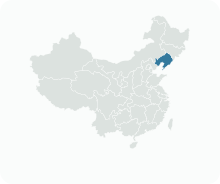
Get to know Guta District

Photo adjustments
Full frame retained; proportionally resized and converted to WebP. No retouching or changes to the photographed subject. Card displays may crop the view.
- Administrative area
- District · 市辖区
- Part of
- Jinzhou
- Chinese name
- 古塔区
- Local areas
- District guide
Area & population
- Area in the source
- 69.98 km²
- Population · 2020 census
- 252,209
Source: cited geographic source, as of the dates shown.
What to see
The Guangji Temple complex (广济寺古建筑群), a national key protected site since 2001, groups four buildings. The Guangji Temple Pagoda (广济寺塔) is a solid octagonal brick tower with thirteen tiers of close-set eaves, dated by a later record to 1057. The Liao emperor Daozong built it to hold relics of his mother, the Empress Dowager Renyi (仁懿皇太后); each face carries a seated Buddha in a niche and six inset bronze mirrors. The temple itself, renamed Guangji in 1060, burned in 1809 and was rebuilt by 1826, with a Guandi hall in the middle and the main hall at the rear.
Also in the complex, the Tianhou Palace (天后宫), a temple to the sea goddess Mazu, was founded in 1725 with money from merchants of Jiangsu, Zhejiang and Fujian; its seven-bay main hall has a double-eaved hip-and-gable roof. The Yi Army Memorial Shrine (毅军昭忠祠) of 1898 honours soldiers of Song Qing's (宋庆) Yi Army killed in the First Sino-Japanese War, in which the army lost more than 2,000 men fighting the Japanese at Tianzhuangtai (田庄台); the district government calls it the only shrine in China commemorating the war's land battles.
The district also contains Beiputuo Mountain (北普陀山), a national 4A scenic area, and the Erlang Cave (二郎洞) scenic area.
Getting oriented
Guta is divided into five subdistricts, and Jinzhou Petrochemical is among its large industrial employers. The district government counts 28 specialist shopping streets selling electronics, electrical goods and clothing, and notes that places of worship of Buddhism, Protestantism, Catholicism and Islam all stand in the district. Jinzhou North Station (锦州北站) on the Chaoyang–Linghai high-speed railway lies within it.
Folk arts
Guta shadow puppetry (古塔皮影戏) is on Liaoning's provincial intangible-heritage list and is still performed in the district.
Highlights
- Guangji Temple Pagoda 广济寺塔: Thirteen-eaved Liao brick pagoda built by Emperor Daozong to hold his mother's relics.
- Tianhou Palace 天后宫: Mazu temple founded in 1725 by merchants from Jiangsu, Zhejiang and Fujian.
- Yi Army Memorial Shrine 毅军昭忠祠: Shrine of 1898 to Yi Army soldiers of the war with Japan, who lost over 2,000 men at Tianzhuangtai.
- Beiputuo Mountain 北普陀山: National 4A scenic area within the district.
Sources for this guide
古塔区区情概况-古塔区人民政府 · Guta District People's Government, Jinzhou
广济寺古建筑群 - 维基百科,自由的百科全书 · Wikipedia (Chinese) · CC BY-SA 4.0
古塔区 - 维基百科,自由的百科全书 · Wikipedia (Chinese) · CC BY-SA 4.0
Original English written from the listed sources and checked sentence by sentence against quoted extracts by a separate reviewer. Updated 2026-09-25.
Explore Guta District
Core places to explore, with English and Chinese names.
Guta District 古塔区
Plan your visit
Getting there
Guta District is about 3 km in a straight line from central Jinzhou. Search for 古塔区 in a map app to find stations and your accommodation.
Where to stay →More in Jinzhou
Sources & geographic information
Administrative names and parent areas: Official geographic directory · Reference date 2026-09-06.
Some facts checked against 广济寺古建筑群 — Wikipedia contributors, CC BY-SA 4.0.
Some facts checked against 古塔区 — Wikipedia contributors, CC BY-SA 4.0.
Map data © OpenStreetMap contributors. Pins mark approximate centres, not entrances or boundaries.