

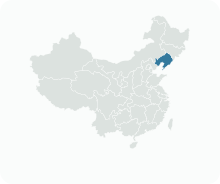
Get to know Shuangtaizi District

Photo adjustments
Full frame retained; proportionally resized and converted to WebP. No retouching or changes to the photographed subject. Card displays may crop the view.
- Administrative area
- District · 市辖区
- Part of
- Panjin
- Chinese name
- 双台子区
- Local areas
- District guide
Area & population
- Area in the source
- 99.35 km²
- Population · 2020 census
- 214,290
Source: cited geographic source, as of the dates shown.
Setting and landscape
Seven waterways run through the district, among them the Liao, the Xiaoliu (小柳河), the Taiping (太平河) and the Yitong (一统河), together with irrigation mains and the Goupan canal (沟盘运河). The district government describes it as the only main urban district in north-east China that the Liao River crosses, and people here live along the riverbanks.
History
The district is named after two beacon towers that labourers recruited by the Ming court built in the sixth month of 1394, under the Hongwu emperor, on the south bank of the Chaogou (潮沟), later called the Jianhe (减河) and the Shuangtaizi River (双台子河), for watch and signalling. In 1908 the Panshan sub-prefecture (盘山厅) moved its seat here from the Panshe post station (盘蛇驿), and from 1913 Shuangtaizi was the seat of Panshan County. Japanese troops occupied Panshan in December 1931; the county was taken by Communist forces in February 1948. When Panjin city was set up in 1984, its offices worked here at first; the area became Panshan District in December 1985 and took the name Shuangtaizi in November 1986.
What to see
The Liaohe Stele Forest (辽河碑林) is in Hubin Park (湖滨公园). The district government gives the Liaohe Stele Forest Park an area of 1.7 square kilometres and describes the stele forest as China's only one covering every period without a break. Its carved calligraphy includes Mao Zedong's rendering of the poem 'Qiang Jin Jiu' (将进酒, 'Bring in the Wine'). The district also keeps what it calls the largest wetland zoo in western Liaoning. The former site of the Panshan detachment of the Kwantung Army railway guard (侵华日本关东军护路守备队盘山分队旧址), dated 1932, is a national key protected site.
Getting oriented
The Beijing–Shenyang and Panjin–Haicheng–Yingkou expressways and the Qinhuangdao–Shenyang high-speed railway pass through the district, and both the high-speed rail station and the long-distance bus station are in the centre of town.
Highlights
- Liaohe Stele Forest 辽河碑林: Stele forest in Hubin Park with carved calligraphy including Mao Zedong's 'Qiang Jin Jiu'.
- Kwantung Army railway guard Panshan detachment site 侵华日本关东军护路守备队盘山分队旧址: 1932 site; national key protected site.
Sources for this guide
双区简介_双台子区人民政府 · Shuangtaizi District People's Government
碑林 - 维基百科,自由的百科全书 · Chinese Wikipedia · CC BY-SA 4.0
盘锦市文物保护单位名录(2025)_文物保护单位名录_盘锦市文化旅游和广播电视局 · Panjin Culture, Tourism, Radio and Television Bureau
双台子区 - 维基百科,自由的百科全书 · Chinese Wikipedia · CC BY-SA 4.0
Original English written from the listed sources and checked sentence by sentence against quoted extracts by a separate reviewer. Updated 2026-09-26.
Explore Shuangtaizi District
Core places to explore, with English and Chinese names.
Shuangtaizi District 双台子区
Plan your visit
Getting there
Shuangtaizi District is about 8 km in a straight line from central Panjin. Search for 双台子区 in a map app to find stations and your accommodation.
Where to stay →More in Panjin
Sources & geographic information
Administrative names and parent areas: Official geographic directory · Reference date 2026-09-06.
Some facts checked against 碑林 — Wikipedia contributors, CC BY-SA 4.0.
Some facts checked against 双台子区 — Wikipedia contributors, CC BY-SA 4.0.
Map data © OpenStreetMap contributors. Pins mark approximate centres, not entrances or boundaries.