

Explore the region
Tap any red Chinese text to hear it in Mandarin.
Najiahu Mosque stands in Najiahu Village, Yanghe Town, Yongning County, within Yinchuan’s wider municipal area rather than the urban centre. The national heritage list records it as a Qing-era ancient building, number 7-1485-3-783. This is a living religious site, not a museum reconstructed solely for sightseeing: an official report describes it as a place where religious figures and worshippers gather.
Published accounts trace the mosque’s foundation to the third year of the Ming Jiajing reign (1524), while the complex visible today reflects later rebuilding and repair. A 2012 architectural report records damage from an eighteenth-century earthquake and later conflict, followed by Qing-era reconstruction and subsequent repairs. The point of the visit is therefore not just an age claim, but the way a mosque’s religious function is carried in a recognisably Chinese architectural language.
What to look for
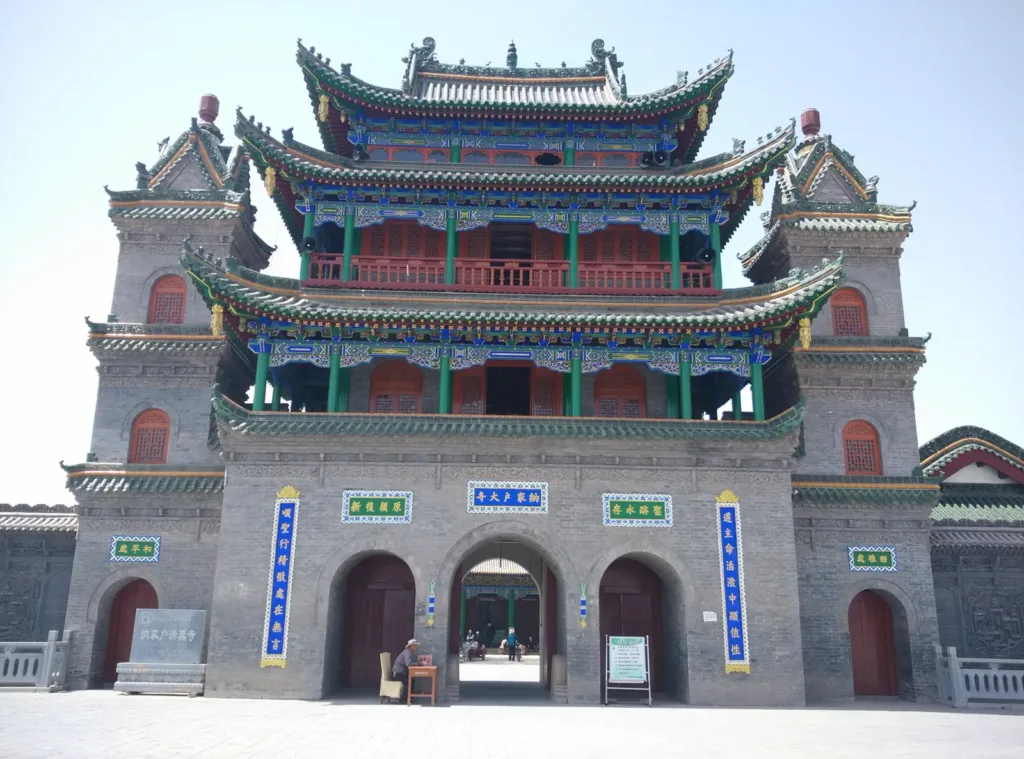
Begin from the village side and study the entrance before trying to enter. The complex is arranged around a rectangular courtyard, with a gate, prayer hall, side rooms and bathing facilities. The main gate is a passage-like masonry gateway; above it rises a three-tier, upturned-roof bangke lou, flanked by smaller moon-viewing towers. These are the details that make the building read as a Chinese courtyard complex at first glance, even though it serves Islamic worship.
The prayer hall is the functional centre. Historical descriptions identify it as a large timber-framed hall with Chinese roof forms and Islamic decorative elements. From a public area, look for the relationship between the gate, the layered roofs and the hall rather than treating the compound as an ordinary temple courtyard. Do not enter the prayer hall, take photographs, or cross a cordon unless staff or worshippers clearly permit it.
The setting matters. The address is Najiahu Village, so leave time to notice the village road and the mosque’s position within a Hui community rather than viewing the building as an isolated monument. Keep the visit quiet, avoid photographing people at prayer, and give way to worshippers. Confirm current visitor access to the courtyard and any interior area locally before you go.
Access and transport
Use the Chinese destination name 纳家户清真寺 Nàjiāhù Qīngzhēnsì and the full destination 宁夏回族自治区银川市永宁县杨和镇纳家户村 Níngxià Huízú Zìzhìqū Yínchuān Shì Yǒngníng Xiàn Yánghé Zhèn Nàjiāhù Cūn when asking for directions. The available visitor listings describe county-area bus approaches rather than a metro or railway stop at the mosque. They name route 312 at 宁朔街宁和路口 Níngshuò Jiē Nínghé Lùkǒu and route 316 at 永宁县清和苑 Yǒngníng Xiàn Qīnghéyuàn, followed by a local walk toward Najiahu Village.
The published information for route 302 conflicts: one listing names 汉延公园 Hànyán Gōngyuán, while another names 永通小区 Yǒngtōng Xiǎoqū. Treat that route as unconfirmed until a live transit app or local staff gives the current stop and direction. For any bus option, check the last service and the reverse direction before entering the mosque area; after the visit, return to the same verified stop or use a taxi/ride-hailing car to 永宁县城 Yǒngníng Xiànchéng. No reliable current fare, timetable, exact walking time, or authorised visitor entrance is stated here, so verify those details before setting out.
By road, give the driver the Chinese destination above and ask for the mosque in Najiahu Village, not just “Yinchuan.” The site is outside the urban core, and a map pin may mark the area rather than the entrance. A direct rail or metro leg to the mosque has not been confirmed.
Visiting respectfully
This is a place of worship as well as a protected historic building. Ask at the entrance whether visitors may enter the courtyard on the day of your visit. If access is limited, viewing the gateway from a public area is still a useful way to read the architecture. Follow staff instructions, do not interrupt prayer, and do not assume that a ticket listing or a map pin proves admission.
Combine your visit
Choose from these complementary stops when planning your visit.
-
Village approach纳家户村道路
Locate the authorised visitor approach.
-
Permitted courtyard获准开放的院落
Observe the arrangement without disrupting worship.
-
Gateway architecture清真寺门楼
Study the exterior details from a public area.
This is a suggested combination, not a timed route; confirm the opening and transport arrangements for your date.
Find Najiahu Mosque
纳家户清真寺 · 银川
The pin marks the area, not the entrance.
More places nearby
Approximate straight-line distances between map pins, not travel distances.
Yinchuan Hedong Airport 银川河东国际机场
14 km awayYinchuan Hedong International Airport is the air gateway to Ningxia, on the eastern side of the Yellow River outside central Yinchuan. Its rail connection makes it useful for journeys continuing beyond the capital, while road…
View guide →Mingcui Lake Wetland 鸣翠湖
17 km awayMingcui Lake is a freshwater wetland near Zhangzheng, east of central Yinchuan. Reed channels, lotus areas and bird habitat give it a different character from the desert attractions to the west. The wetland interpretation centre…
View guide →Chengtian Temple Pagoda 承天寺塔
20 km awayChengtian Temple Pagoda is Yinchuan’s Western Pagoda, an octagonal brick tower with eleven storeys. The original monument belonged to the Western Xia period, while the standing tower was rebuilt in 1820 after an earthquake…
View guide →Sources & visit information
Sources checked on 24 October 2026. Hours, tickets, reservations and transport can change; confirm with the operator before you go.
Image credits & notes (1)
- Najiahu Mosque’s front gateway in Najiahu Village, Yongning County, showing the layered Chinese roofline, central passage and flanking moon-viewing towers. Photo: 霧島聖Photo: CC BY-SA 4.0