

Explore the region
Tap any red Chinese text to hear it in Mandarin.
Why visit
Shuidonggou is easiest to understand as a layered landscape. The archaeological story begins with a site first found and excavated in 1923. After six large-scale excavation campaigns, the site complex had produced 12 Paleolithic localities and more than 10,000 important remains, giving the place a significance far beyond a scenic viewpoint.
The evidence is unusually tangible. Stone tools, animal remains, hearths and ostrich-eggshell ornaments help reconstruct hunting, butchery, fire use and symbolic expression. Research reported by Xinhua places the site’s cultural sequence at roughly 40,000 to 10,000 years ago and notes that its tool technology is important for discussing long-distance contact and movement between eastern and western Eurasia. The Ministry of Culture and Tourism also describes Shuidonggou as the first Paleolithic cultural site found in China and records its 2021 inclusion in the “100 Years, 100 Great Archaeological Discoveries” list.
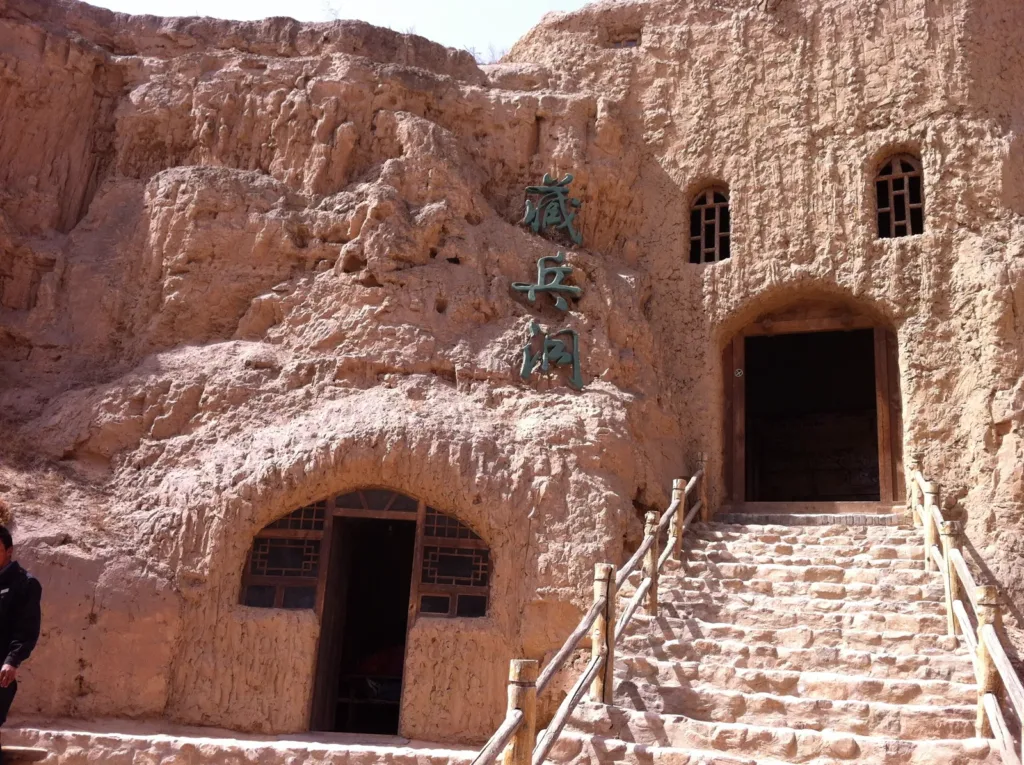
A very different chapter begins at the later frontier remains. The tourism area combines Ming Great Wall sections, beacon and fortification remains, Hongshan Fort and the underground troop-hiding caves. The caves and fort make more sense when read as part of a defensive system, not as an isolated tunnel attraction. Beyond the history, the route passes through sharply eroded gullies and Yardang landforms, giving the military and archaeological remains a distinctly dry, open setting.
What to see
Start at the Shuidonggou Site Museum, whose building and exhibition interpret the site’s stone-tool culture and prehistoric life. The official tourism listing also identifies a Stone-tool Square, an experiential hall, Zhang San’s Shop, Shuidonggou Village and an open archaeology area. These are useful before walking farther because they give names and context to the excavated landscape rather than leaving the displays and terrain as disconnected stops.
Then follow the signed route through the gullies and valley scenery toward the later defence remains. The government listing names the Ming Great Wall, the Grand Canyon, the troop-hiding caves, Ningxia Great Wall Museum and Hongshan Fort among the tourism area’s nodes. Do not assume that every show, internal vehicle, boat, raft, camel-cart section or tunnel experience is included in every ticket product or operating on every date; ask at the entrance what is open and where the route ends.
Allow enough time to return from the final fort or tunnel section to the actual exit. This is a spread-out tourism area rather than a single museum building. The most rewarding visit keeps the periods separate: first the archaeological evidence and landscape, then the much later frontier system.
Visiting and access
The Ningxia Culture and Tourism Department lists the address as Shuidonggou Tourism Area, Linhe Town, Lingwu City, Yinchuan, Ningxia (水洞沟旅游区,宁夏银川市灵武市临河镇) and lists opening hours of 08:00–18:00. Treat those as the published venue information, not a promise that every internal attraction runs for the whole interval. The same page gives the scenic-area telephone number 0951-5055816.
Getting there
For a coach, a Yinchuan local-travel listing identifies the Yinchuan North Gate Tourist Bus Station (银川市北门旅游汽车站), Nanguan Bus Station (银川市南关汽车站), Xinyue Square (新月广场) and the Yinchuan Railway Station Visitor Distribution Center (银川火车站游客集散中心) as departure points for the Shuidonggou tourist shuttle. That page was published in 2023 and its times and fares are therefore only route clues, not a current timetable. Confirm the day’s departure, the stop at the scenic area and the return departure by calling 0951-5055816 before setting out.
If you arrive at Yinchuan Railway Station (银川站), remember that the station is a city gateway, not the archaeological site. Use the visitor-distribution-center shuttle if it is operating, or take a taxi or ride-hailing car to the exact Chinese destination 水洞沟旅游区,宁夏银川市灵武市临河镇 Shuǐdònggōu Lǚyóuqū, Níngxià Yínchuān Shì Língwǔ Shì Línhé Zhèn. The same destination name is the safest instruction for a driver coming from Yinchuan Hedong International Airport.
Confirm the return before entering, especially if you plan to stay for the caves or a performance. The older shuttle listing gives a 15:30 return for services from Xinyue Square and the railway-station center, but that time is not confirmed for your date. If the operator cannot confirm a suitable return, arrange a taxi or ride-hailing pickup from 水洞沟旅游区 rather than relying on an unscheduled last bus.
Current sources read for this guide do not state a passport-specific booking or entry procedure, and the official tourism page does not publish a current ticket-product breakdown. International visitors should ask the venue directly whether a passport can be used for the chosen ticket or reservation and which internal transport is included. Do not infer those rules from domestic-ID booking instructions.
Combine your visit
Choose from these complementary stops when planning your visit.
-
Site museum水洞沟遗址博物院
Begin with the prehistoric discoveries.
-
Open excavation and landscape route开放发掘点与峡谷路线
Connect the displays with the archaeological setting.
-
Defence remains长城防御遗迹
Visit the available fort and tunnel section as a separate historical layer.
This is a suggested combination, not a timed route; confirm the opening and transport arrangements for your date.
Find Shuidonggou
水洞沟 · 银川
The pin marks the area, not the entrance.
More places nearby
Approximate straight-line distances between map pins, not travel distances.
Yinchuan Hedong Airport 银川河东国际机场
10 km awayYinchuan Hedong International Airport is the air gateway to Ningxia, on the eastern side of the Yellow River outside central Yinchuan. Its rail connection makes it useful for journeys continuing beyond the capital, while road…
View guide →Mingcui Lake Wetland 鸣翠湖
16 km awayMingcui Lake is a freshwater wetland near Zhangzheng, east of central Yinchuan. Reed channels, lotus areas and bird habitat give it a different character from the desert attractions to the west. The wetland interpretation centre…
View guide →Najiahu Mosque 纳家户清真寺
23 km awayNajiahu Mosque is a historic Hui Muslim religious complex in Najiahu village, south of Yinchuan. Its layout brings a gateway, prayer buildings and side rooms around a courtyard, using forms associated with traditional Chinese…
View guide →Sources & visit information
Sources checked on 24 October 2026. Hours, tickets, reservations and transport can change; confirm with the operator before you go.
Image credits & notes (1)
- Shuidonggou's troop-hiding cave façade in a loess cliff, with the Chinese sign 藏兵洞 and stairs leading into the cave complex. Photo: ping linPhoto: CC BY-SA 3.0