

Photo adjustments
Proportionally resized and converted to WebP without cropping, retouching or changing the photographed subject.
Explore the region
About Tangyue Memorial Archways
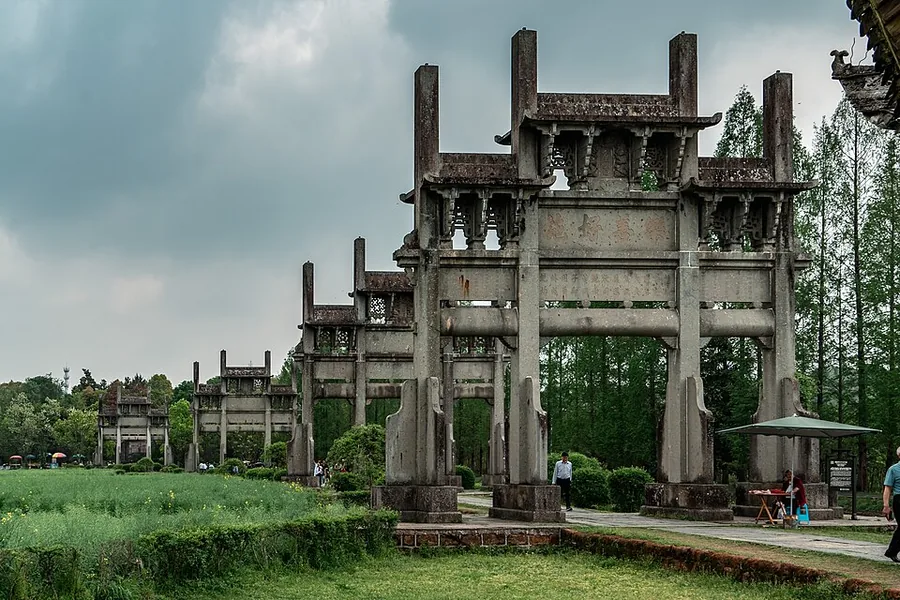
Seven Ming- and Qing-period arches commemorate members of the Bao family and the moral virtues celebrated by the imperial state.
Their carved inscriptions and differing construction dates make them a concentrated record of Huizhou memorial architecture. Nearby ancestral halls include Dunben Hall and the women’s Qingyi Hall.
The earliest of the seven arches, the Cixiaoli Arch (慈孝里坊), was built in 1420 to honor Bao Zongyan (鲍宗岩) and his son Bao Shousun (鲍寿孙), captured by bandits at the end of the Song dynasty, who each pleaded to die in the other's place until released. Later arches honor other family members: a 1534 arch for Bao Can (鲍灿), who tended his ailing mother; a 1622 arch for Bao Xiangxian (鲍象贤), who put down a revolt in Yunnan in 1538; and an 1820 arch, also called the Charity Arch (乐善好施坊), for the salt merchants Bao Shufang (鲍漱芳) and his son, who donated funds for military supplies and disaster relief.
Two further arches, built in 1776 and 1787, honor widows of the Bao family: one for the wife of Bao Wenling (鲍文龄), who preserved her chastity for twenty years while raising an orphaned son, and one for the second wife of Bao Wenyuan (鲍文渊), who came from Jiangsu and did so for sixty years while raising her predecessor's son and restoring the family's ancestral tombs.
The archway group was placed on the fourth batch of Major Historical and Cultural Sites Protected at the National Level (全国重点文物保护单位) in 1996. A third ancestral hall, the Shixiao Hall (世孝祠), stands beside the archways along with the two halls maintained by the Bao lineage.
What to look for
- Seven Ming- and Qing-period memorial arches record Bao-family stories through stone carving and inscriptions.
- Dunben Hall and the women’s Qingyi Hall give the memorial landscape a family and gender-history context.
Location & getting there
Getting to Tangyue Memorial Archways
Travel to Tangyue village in Zhengcun town, She County; the archway group and nearby ancestral halls form the core visiting area.
- Confirm the visitor entrance and access to the named areas before departure.
Combine your visit
A suggested sequence through the named features described in the source.
-
Memorial archway group
Compare the stone carving and inscriptions of the seven memorial arches.
-
Dunben Hall
Continue to the Bao family’s principal ancestral-hall setting.
-
Qingyi Hall
Examine the separate women’s ancestral hall and its family-history context.
The order is an editorial suggestion. Internal opening arrangements and transfers between sectors need checking; no walking duration or access entitlement is implied.
Find Tangyue Memorial Archways
棠樾牌坊群 · 黄山市
The pin marks the area, not the entrance.
More places nearby
Approximate straight-line distances between map pins, not travel distances.
She County, Anhui 歙县
5 km awayShe County’s historic core was the seat of Huizhou, and its monuments show the wealth of officials and merchants from the region. Xu Guo’s stone memorial arch anchors the old centre, while Doushan Street leads past high-walled…
View guide →Qiankou 潜口民宅
7 km awayQiankou’s historic residences form a collection of Huizhou buildings in Qiankou village. From the 1980s, threatened Ming-period structures from surrounding settlements were dismantled and reconstructed here.
View guide →Chengkan 呈坎
10 km awayChengkan’s village lanes lead between houses and communal buildings of the Luo clan. The Luo Dongshu ancestral hall is the main architectural focus: its courtyards lead to Baolun Pavilion, where painted timber framing gives the…
View guide →Sources & visit information
The linked encyclopedia sources support background and place descriptions. Current opening hours, ticket prices, booking rules and transport schedules have not been independently verified for this guide. Confirm them with the venue or operator before travelling.
Visitor information adapted and edited from Wikipedia contributors, “棠樾牌坊群” · CC BY-SA 4.0. Source revision 92993703.
Background paragraphs translated and condensed from Wikipedia contributors, "棠樾牌坊群", Chinese Wikipedia · CC BY-SA 4.0. Source revision 92993703.