

Photo adjustments
Proportionally resized and converted to WebP without cropping, retouching or changing the photographed subject.
Explore the region
About Foguang Temple
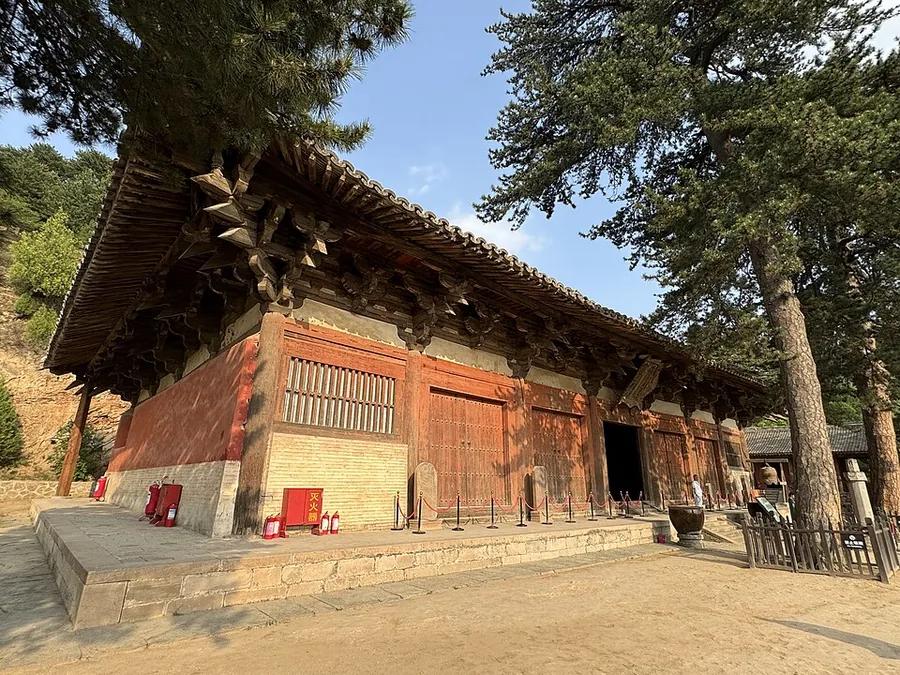
Its broad seven-bay front stands above a hillside courtyard, giving the hall a commanding presence without elaborate later ornament. The Manjusri Hall and the small Zushi Pagoda add contrasting periods and scales to the complex. Look closely at the roof supports and the relationship between the hall and its raised platform; the building itself is as important as the religious figures inside.
Foguang Temple was established in the fifth century during the Northern Wei dynasty. An active building period between 785 and 820 produced a three-storey, 32-meter pavilion, but the temple was burned to the ground during Emperor Wuzong's suppression of Buddhism in 845, leaving only the Zushi Pagoda standing. It was rebuilt in 857, when the Dongda Hall was raised on the pavilion's former site with funds from a woman named Ning Gongyu and construction led by the monk Yuancheng; the Wenshu Hall, dedicated to Manjusri, was added in 1137 during the Jin dynasty. Architectural historians Liang Sicheng and Lin Huiyin rediscovered the temple in 1937.
The complex covers approximately 8.4 acres and contains more than 120 structures dating from the Northern Wei to the Qing dynasty, including one of only two surviving Northern Wei pagodas in China. Built in 857, the Dongda Hall is the third earliest preserved timber structure in China and the only building to combine Tang-dynasty architecture, sculpture, mural painting and calligraphic inscriptions in a single structure, a combination known as the 'Four Supremacies'. The temple is inscribed as part of the Mount Wutai UNESCO World Heritage Site.
What to look for
- East Great Hall, built in 857, with its timber bracket structure and surviving Tang artistic material.
- Manjusri Hall and Zushi Pagoda, which reveal other periods of the temple's history.
Location & getting there
Getting to Foguang Temple
Foguang Temple is near Doucun in Wutai County, outside Taihuai's central temple cluster; arrange a road visit specifically to this site.
- Allow for the hillside approach and confirm access to the historic hall before travelling.
Combine your visit
Suggested order within this visit:
-
Lower courtyard and Manjusri Hall
Begin with the approach and the later hall.
-
East Great Hall
Make the Tang structure and its interior the main focus.
-
Zushi Pagoda
Compare the small masonry monument with the timber halls.
This sequence is an editorial suggestion based on the features described in the sources. Access to individual buildings or areas should be checked locally; no travel time or shared admission is implied.
Find Foguang Temple
佛光寺 · 忻州市
The pin marks the area, not the entrance.
More places nearby
Approximate straight-line distances between map pins, not travel distances.
Mount Wutai: Taihuai 五台山台怀镇
23 km awayTaihuai is the temple town at the heart of the Mount Wutai pilgrimage landscape, beside the Qingshui River. A compact first visit can link Pusading on its hill with Xiantong Temple and Tayuan Temple below. The white stupa at…
View guide →Nanchan Temple 南禅寺
30 km awayNanchan Temple's Great Buddha Hall is modest in size but unusually revealing about Tang timber building. The square, three-bay hall has no interior column forest, allowing the roof structure and sculptural platform to be read…
View guide →Yanmen Pass 雁门关
57 km awayYanmen Pass guards a mountain crossing north of Dai County. Its walls and gatehouses explain how a pass worked as a defended settlement, with a trading street below the military buildings. The Dili and Tianxian gates give the…
View guide →Sources & visit information
The sources below support the place-specific description and arrival information. Suggested combinations are editorial planning ideas; confirm current opening, entry arrangements and transport services for your date.
Visitor information adapted and edited from Wikipedia contributors · CC BY-SA 4.0. Source revision 1369880805.
Visitor information adapted and edited from Wikivoyage contributors · CC BY-SA 4.0. Source revision 5314166.
Background paragraphs condensed from Wikipedia contributors, "Foguang Temple", English Wikipedia · CC BY-SA 4.0. Source revision 1369880805.