

Entry & permits for Tibet (Xizang)
Foreign tourists need Tibet entry approval, commonly called a Tibet Travel Permit, and an organised visit arranged through a specialist travel agency in China. Confirm your approved route before booking transport. Requirements differ for Taiwan residents and for travellers using mainland or Hong Kong/Macao Chinese resident documents; check the document guide before you book.
Check the travel-document requirements →Policy scope verified: 2026-09-06. UK FCDO: China regional travel advice ↗ State Council Taiwan Affairs Office: Tibet entry approval ↗ Xizang Department of Culture and Tourism: Medog border permit notice ↗
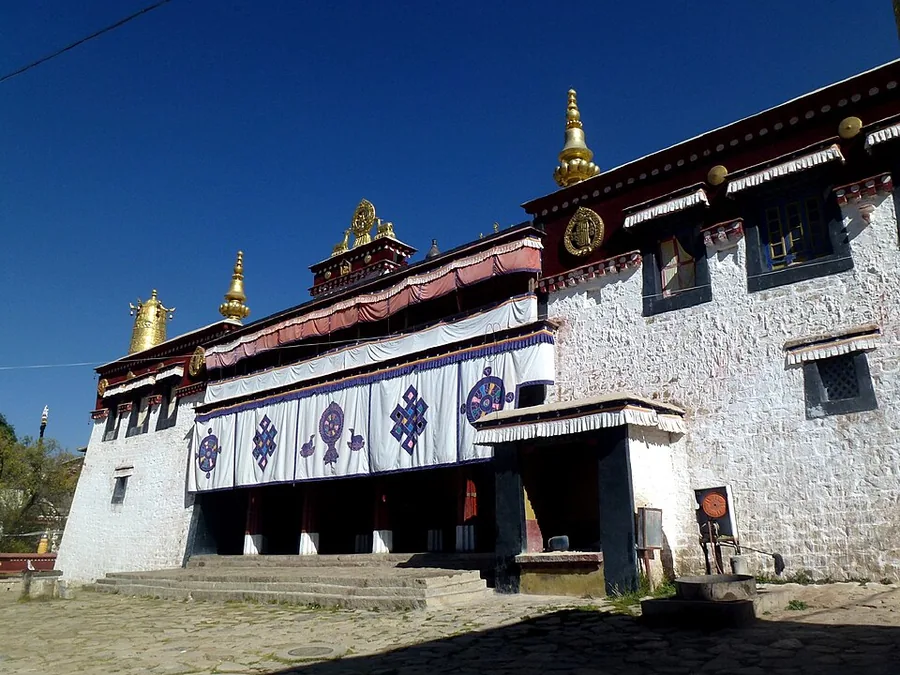
Photo adjustments
Proportionally resized and converted to WebP without cropping, retouching or changing the photographed subject.
Explore the region
About Sera Monastery
Founded in 1419, the monastery developed as a centre of Buddhist study, with the Je and Me colleges devoted to philosophy and the Ngakpa college to tantric ritual. Its assembly hall, college courtyards and chapels make the educational structure visible in the buildings themselves. Rather than treating the complex as one hall, follow a short sequence through the public areas and notice how teaching, communal worship and smaller shrines occupy different spaces.
The Great Assembly Hall (措钦大殿), built in 1710, occupies the northeastern part of the complex and serves as its principal gathering and administrative space. Its scripture hall rises through two storeys, with tall central columns creating a skylit area and shorter columns defining lower spaces for statues. The roof follows a Chinese hipped-and-gabled form and is covered with gilded copper tiles.
The wider complex covers about 115,000 square metres. Its stone-and-timber buildings have earth-covered roofs and white walls topped by purple-black decorative vegetation. Between the main buildings are khamtsen residences, organised around groups of monks from the same home regions. Sera is responsible for nineteen hermitages, including four nunneries. It became a Major Historical and Cultural Site Protected at the National Level (全国重点文物保护单位) in 1982.
What to look for
- The Great Assembly Hall and its columned entrance, surrounded by the monastery’s college buildings.
- The Je and Me college areas, which express Sera’s tradition of philosophical study.
The surrounding area
Palaces, monasteries, museums and a working old city with a strong tea-house culture.
Location & getting there
Getting to Sera Monastery
Approach Sera at the foot of the hills in northern Lhasa, north of the Jokhang and the old town.
- Arrange the return from the monastery entrance; confirm the public route through the college areas on arrival.
Combine your visit
Suggested order for this visit:
-
Main assembly hall
Begin with the communal religious centre of the complex.
-
Je College area
Look at the buildings associated with advanced Buddhist study.
-
Me College area
Compare the second philosophical college with the spaces already visited.
This is an editorial sequence based on the features described in the sources. Confirm access locally; no walking time, shared admission or guaranteed interior access is implied.
Find Sera Monastery
色拉寺 · 拉萨
The pin marks the area, not the entrance.
More places nearby
Approximate straight-line distances between map pins, not travel distances.
Pabongka Monastery 帕邦喀寺
3 km awayPabongka takes its name from the enormous rock supporting its temple buildings on Lhasa's northern hillside. The complex combines the Rigsum Gonpo shrine at the front, the upper Pabonka Potrang and a building traditionally…
View guide →Ramoche Temple 小昭寺
4 km awayRamoche stands north of the Barkhor and is traditionally paired with the Jokhang as one of Lhasa's two great early temples. Its central object of devotion is a gilded image representing Shakyamuni at eight years old, giving this…
View guide →Potala Palace 布达拉宫
5 km awayThe Potala rises from Marpo Ri, Lhasa’s Red Hill, as a stepped mass of white walls surrounding the crimson Red Palace. Its former residential and ceremonial spaces trace the history of the Dalai Lamas, while chapels and gilded…
View guide →Sources & visit information
The linked encyclopedia sources support background and place descriptions. Current opening hours, ticket prices, booking rules and transport schedules have not been independently verified for this guide. Confirm them with the venue or operator before travelling.
- Wikipedia: Sera Monastery ↗
- Chinese Wikipedia: 色拉寺 (revision 93415841, 2026-07-11) ↗
- English Wikipedia: Sera Monastery (revision 1367207730, 2026-08-01) ↗
Visitor information adapted and edited from Wikipedia contributors · CC BY-SA 4.0. Source revision 1367207730.
Background paragraphs translated and condensed from Wikipedia contributors, "色拉寺", Chinese Wikipedia · CC BY-SA 4.0. Source revision 93415841.
Background paragraphs condensed from Wikipedia contributors, "Sera Monastery", English Wikipedia · CC BY-SA 4.0. Source revision 1367207730.