

Entry & permits for Tibet (Xizang)
Foreign tourists need Tibet entry approval, commonly called a Tibet Travel Permit, and an organised visit arranged through a specialist travel agency in China. Confirm your approved route before booking transport. Requirements differ for Taiwan residents and for travellers using mainland or Hong Kong/Macao Chinese resident documents; check the document guide before you book.
Check the travel-document requirements →Policy scope verified: 2026-09-06. UK FCDO: China regional travel advice ↗ State Council Taiwan Affairs Office: Tibet entry approval ↗ Xizang Department of Culture and Tourism: Medog border permit notice ↗
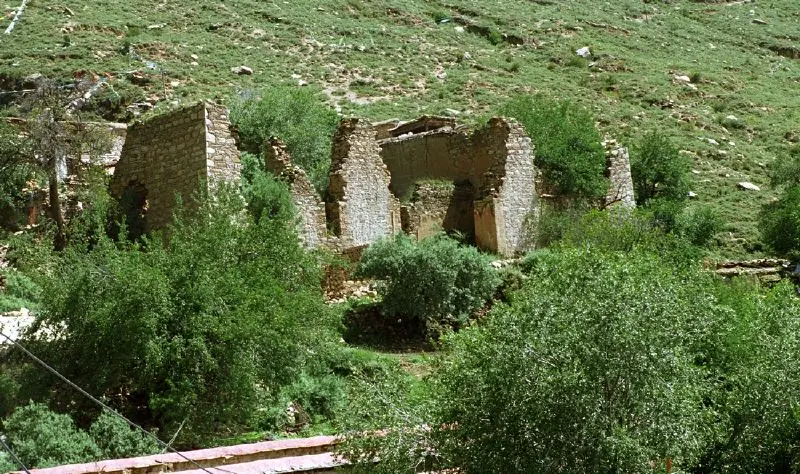
Photo adjustments
Full frame retained; EXIF orientation normalized, proportionally resized to at most 800 pixels and converted to WebP. No generated pixels or subject changes. Cards may crop the display.
Explore the region
About Pabongka Monastery
The complex combines the Rigsum Gonpo shrine at the front, the upper Pabonka Potrang and a building traditionally associated with Princess Wencheng. Its setting is as distinctive as the buildings: old peach trees surround the site, and clear views extend towards the Potala. Concentrate on the open shrines and hillside outlook rather than treating neighbouring hermitages or ritual grounds as part of a casual extension.
Songtsen Gampo (松赞干布) founded the hermitage in the seventh century. After a period of abandonment, Kadam teachers revived it, and it later came under Sera Monastery (色拉寺), to which it still belongs. Since the Qing dynasty, successive Dalai Lamas have come here to worship, receive ordination and celebrate the award of their geshe degrees. The teacher Pabongka (帕邦喀大师), who lived from 1878 to 1941, took his name from the monastery.
The present Pabonka Potrang (帕邦喀颇章) occupies the site of an earlier palace that was destroyed and subsequently revived by Kadam teachers and later generations. Its shrines contain images of Buddhist teachers, meditational deities and protectors. Below the great rock is Palden Lhamo Cave (吉祥天母洞), which contains sacred images including Padmasambhava (莲花生). The hermitage is also the starting point for the Sixth-Month Fourth-Day pilgrimage around the Sera mountains.
What to look for
- The giant-rock setting and the Rigsum Gonpo shrine at the front of the monastery.
- The upper Pabonka Potrang and peach-tree surroundings, with a distant Potala view when visibility allows.
The surrounding area
Palaces, monasteries, museums and a working old city with a strong tea-house culture.
Location & getting there
Getting to Pabongka Monastery
Approach Pabongka (帕邦喀) through Jisuo village in Niangre, on the northern side of Lhasa. The temple stands on the south-facing hillside of Tonggari above the village.
- Agree on the actual monastery drop-off before travelling; the final hillside visit is separate from Lhasa's level old-town circuit.
Combine your visit
Suggested order for this visit:
-
Rigsum Gonpo shrine
Start at the front of the complex and examine its relationship with the supporting boulder.
-
Open Pabonka Potrang area
Continue to the upper temple buildings where visitor access is allowed.
-
Peach-tree grounds and Lhasa outlook
Finish with the hillside setting and distant city view without entering private or ritual areas.
This is an editorial sequence based on the features described in the sources. Confirm access locally; no walking time, shared admission or guaranteed interior access is implied.
Find Pabongka Monastery
帕邦喀寺 · 拉萨
The pin marks the area, not the entrance.
More places nearby
Approximate straight-line distances between map pins, not travel distances.
Sera Monastery 色拉寺
3 km awaySera stands against the hills on Lhasa’s northern edge. Founded in 1419, the monastery developed as a centre of Buddhist study, with the Je and Me colleges devoted to philosophy and the Ngakpa college to tantric ritual. Its…
View guide →Potala Palace 布达拉宫
7 km awayThe Potala rises from Marpo Ri, Lhasa’s Red Hill, as a stepped mass of white walls surrounding the crimson Red Palace. Its former residential and ceremonial spaces trace the history of the Dalai Lamas, while chapels and gilded…
View guide →Ramoche Temple 小昭寺
7 km awayRamoche stands north of the Barkhor and is traditionally paired with the Jokhang as one of Lhasa's two great early temples. Its central object of devotion is a gilded image representing Shakyamuni at eight years old, giving this…
View guide →Sources & visit information
The sources below support the place-specific description and arrival information. Suggested combinations are editorial planning ideas; confirm current opening, entry arrangements and transport services for your date.
- Wikipedia: 帕邦喀 ↗
- China News Service: Pabongka peach trees and view towards the Potala ↗
- English Wikipedia: Pabonka Hermitage (revision 1367127825, 2026-08-01) ↗
Visitor information adapted and edited from Wikipedia contributors · CC BY-SA 4.0. Source revision 93289053.
Background paragraphs translated and condensed from Wikipedia contributors, "帕邦喀", Chinese Wikipedia · CC BY-SA 4.0. Source revision 93289053.
Background paragraphs condensed from Wikipedia contributors, "Pabonka Hermitage", English Wikipedia · CC BY-SA 4.0. Source revision 1367127825.