

Photo adjustments
Full frame retained; proportionally resized and converted to WebP. No retouching or changes to the photographed subject. Card displays may crop the view.
Explore the region
About Subashi Temple
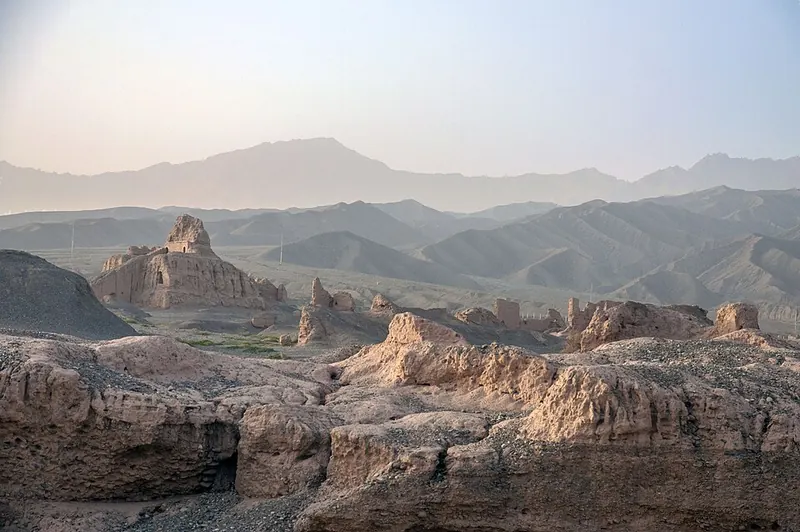
Its surviving towers and walls convey the scale of religious life in the ancient Kucha region. Objects recovered from the site, including a decorated reliquary now held in Tokyo, add details that the exposed ruins cannot preserve. The landscape and the archaeological interpretation work best when considered together.
What to look for
- Earthen towers and walls preserve the outline of a large Buddhist complex.
- The eastern and western areas show how the monastic landscape extended across the site.
Background & history
Subashi Temple (Chinese: 苏巴什佛寺遗址; pinyin: Sūbāshén fósì yízhǐ; lit. 'Subashi temple ruins') is a ruined Buddhist temple near Kucha in the Taklamakan Desert, on the ancient Silk Road, in Xinjiang, Western China. The city was partly excavated by the Japanese archaeologist Count Otani. Other famous sites nearby are the Ah-ai Grotto, Kizilgaha Caves, the Kumtura Caves, the Kizil Caves and the Simsim Caves. These sites and others along the Silk Road were inscribed in 2014 on the UNESCO World Heritage List as the Silk Roads: the Routes Network of Chang'an-Tianshan Corridor World Heritage Site. A sarira, a Buddhist relic box of the 6th–7th century, discovered in Subashi shows Central Asian men in long tunics, reminiscent of friezes produced by the Tocharians. The "Witch of Subashi" is another famous archaeological artifact, the mummy of a woman with a huge pointed hat, thought to be a representative of early Caucasian populations who lived in the region around the beginning of our era.
Excerpt from Wikipedia: Subashi Temple · Wikipedia contributors · CC BY-SA 4.0. Selected introductory sentences; formatting simplified. Background information, not current visitor-service advice.
Location & getting there
Getting to Subashi Temple
Use the Subashi Buddhist Temple Ruins visitor entrance north of Kuqa and confirm which area is open. Arrange the return road connection and remain on the authorised path around the fragile earthen structures.
Combine your visit
Choose from these complementary stops when planning your visit.
-
Site plan and interpretation遗址平面与解说
Understand the relationship between the two areas.
-
Open temple remains开放佛寺遗址
Compare the surviving walls and towers.
-
Kuqa heritage visit库车文化参观
Add an urban history stop after returning.
This is a suggested combination, not a timed route; confirm the opening and transport arrangements for your date.
Find Subashi Temple
苏巴什佛寺遗址 · 阿克苏地区
The pin marks the area, not the entrance.
More places nearby
Approximate straight-line distances between map pins, not travel distances.
Kuqa Royal Palace 库车王府
19 km awayKuqa Royal Palace presents the history of the local hereditary rulers in a reconstructed courtyard complex. The present buildings were rebuilt in the 2000s after the older palace was destroyed, so the visit is an interpretation…
View guide →Tianshan Mysterious Grand Canyon 天山神秘大峡谷
28 km awayKuqa’s Tianshan Mysterious Grand Canyon cuts through red-brown sandstone and conglomerate on the southern side of the Tianshan. Narrow passages, high walls and changing light give the walk its character. The attraction is a…
View guide →Kizil Caves 克孜尔千佛洞
46 km awayKizil’s cave shrines were cut into the Mingwudag cliffs above the river in Baicheng County. Their forms and painted scenes preserve an important part of ancient Kucha’s Buddhist culture. The surviving murals are fragmentary, and…
View guide →Sources & visit information
The linked encyclopedia sources support background and place descriptions. Current opening hours, ticket prices, booking rules and transport schedules have not been independently verified for this guide. Confirm them with the venue or operator before travelling.
Geographic and historical facts selectively adapted from Wikipedia contributors, Subashi Temple · CC BY-SA 4.0. Source revision 1365740525.