

Explore the region
About Guide Jade Emperor Pavilion
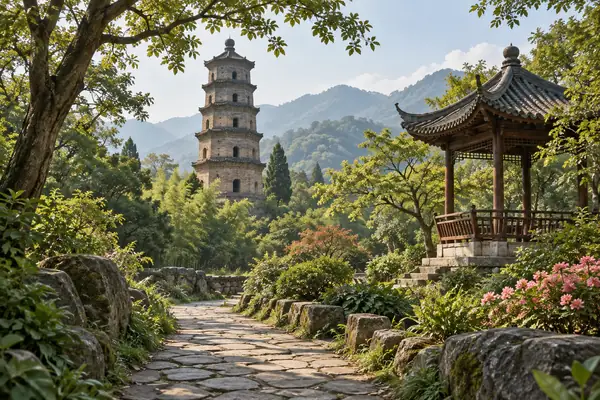
Their different dedications make the visit more than a climb to one tower. The group originated in the Ming period and was rebuilt after later destruction, so look at the arrangement of courts and halls as well as the dates attached to individual structures.
The pavilion complex was originally built during the Wanli era (万历年间) of the Ming dynasty. It was destroyed amid military disturbance in the sixth year of the Tongzhi era (同治六年), and was rebuilt in the second year of the Republic of China (民国二年), corresponding to 1912.
The complex is laid out in the shape of the Chinese character pin (品字形). It comprises three constituent buildings: a Confucian temple (文庙), the Guanyue Temple (关岳庙) and the Wanshou Temple (万寿观), also known as the Jade Emperor Pavilion (玉皇阁). The complex was designated a Major Historical and Cultural Site Protected at the National Level (全国重点文物保护单位) in the seventh batch of such designations, announced on 5 March 2013.
What to look for
- The pavilion forms part of Wanshou Temple.
- The Confucian temple introduces an educational and ritual tradition.
- Guanyue Temple adds another distinct dedication within the complex.
Location & getting there
Getting to Guide Jade Emperor Pavilion
Travel to the Jade Emperor Pavilion complex in Guide’s county town, Heyin. Use the full name 贵德玉皇阁 to distinguish it from similarly named monuments in Yinchuan and Pingluo.
Combine your visit
Choose from these complementary stops when planning your visit.
-
Jade Emperor Pavilion玉皇阁
Begin with the principal landmark.
-
Confucian temple文庙
Compare the ritual and educational spaces.
-
Guanyue Temple关岳庙
Complete the circuit where the compound is open.
This is a suggested combination, not a timed route; confirm the opening and transport arrangements for your date.
Find Guide Jade Emperor Pavilion
贵德玉皇阁 · 海南州
The pin marks the area, not the entrance.
More places nearby
Approximate straight-line distances between map pins, not travel distances.
Guide National Geopark 贵德国家地质公园
17 km awayGuide National Geopark’s Ashigong visitor area is known for red and multicoloured rock peaks. Its eroded ridges and exposed layers record changes in the plateau landscape and the development of the Yellow River system. The…
View guide →Kanbula 坎布拉
28 km awayKanbula combines red sandstone landforms, forest and the water landscape of Lijiaxia Reservoir. The contrast between rock, vegetation and water is more distinctive than any single viewpoint. The wider UNESCO Global Geopark…
View guide →Longyangxia Reservoir 龙羊峡水库
47 km awayLongyangxia Reservoir occupies a gorge setting on the upper Yellow River, where a major dam changed both the water landscape and the surrounding settlement. The broad reservoir contrasts with the narrower canyon and nearby…
View guide →Sources & visit information
The linked encyclopedia sources support background and place descriptions. Current opening hours, ticket prices, booking rules and transport schedules have not been independently verified for this guide. Confirm them with the venue or operator before travelling.
- 贵德玉皇阁 — Wikipedia geographic and historical reference ↗
- Chinese Wikipedia: 贵德玉皇阁 (revision 86493363, 2025-03-19) ↗
Geographic and historical facts selectively adapted from Wikipedia contributors, 贵德玉皇阁 · CC BY-SA 4.0. Source revision 86493363.
Background paragraphs translated and condensed from Wikipedia contributors, "贵德玉皇阁", Chinese Wikipedia · CC BY-SA 4.0. Source revision 86493363.