

Explore the region
Tap any red Chinese text to hear it in Mandarin.
Yaotou Kiln Site is in Yaotou Village, Yaotou Town, Chengcheng County, Weinan, Shaanxi. It is a spread-out historic settlement and kiln complex, not just one exhibition hall. Local records trace the craft to the Tang period, but the site reports no confirmed Tang-period product from the kiln area; the secure archaeological and documentary story becomes clearer from the later periods. The kilns flourished in the Ming and Qing, when Yaotou wares travelled across northern Shaanxi and neighbouring provinces.
The surviving landscape is the reason to come. Recent reports count 129 kiln sites from the Ming, Qing and Republican periods, 78 pottery workshops, 75 old dwellings, 17 temples and ancestral halls, and three layers of pottery-shard deposits. Brick-vaulted cave homes, stacked saggar walls and rough lanes make the production system legible at village scale. The four traditional kiln lines were bowl, jar, black-glazed and sand kilns. Black-glazed ware was especially associated with Yaotou, but the settlement also made white, celadon, white-slip brown-patterned and blue-and-white pieces, mostly practical vessels such as vats, basins, bowls, stoves and jars.
How to read the site
Begin at the operating visitor facility or the village arrival point, whichever is open on the day. Do not treat every doorway as a museum entrance: this is also a lived village and a protected heritage area. Walk slowly enough to compare the cliff-side cave dwellings with the kiln yards and workshop fronts. Look for the relationship between a work space, a storage wall made from stacked saggars, and the path by which vessels would have moved towards a kiln. The arrangement tells you more than a single restored object.
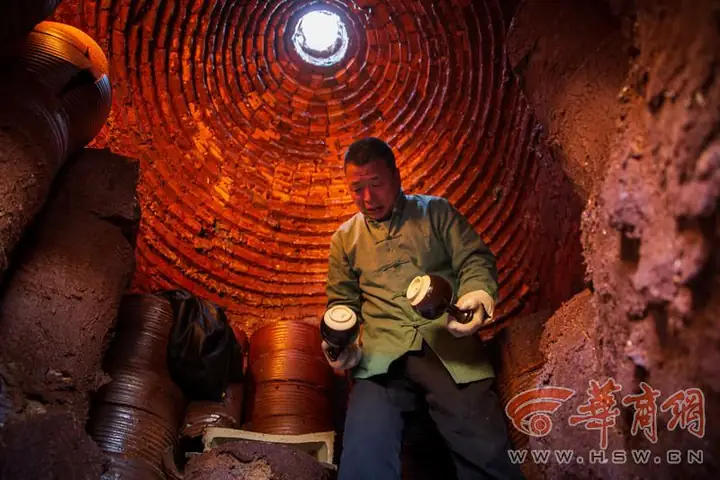
Inside an explicitly open kiln or courtyard, look at the firing marks on the walls. A China Daily report describes patterns that local guides read as landscape-like forms and a dragon-and-phoenix impression. Treat these as surfaces shaped by heat and later interpretation, not as a guaranteed painted mural. In the village, notice how everyday architecture and pottery debris sit alongside temples and ancestral spaces. Active religious spaces and protected structures may have separate rules; ask before entering, and do not photograph residents or private interiors without permission.
If a workshop or non-heritage experience is running, watch the making sequence rather than expecting a complete demonstration of all 72 steps. The documented technique includes selecting and kneading local clay, throwing and trimming a form, drying it, preparing and applying glaze, decorating, and firing in an inverted-flame, domed “mantou” kiln. The balance of clay, glaze, hand pressure, heat and kiln atmosphere is what produces the sturdy forms and changing black, brown or other surfaces. Demonstrations, sales and hands-on sessions are activities that can vary by day; do not assume that a workshop is open merely because the complex exists.
The most useful objects to compare are ordinary ones. Large vats, basins, bowls, jars and stoves show why Yaotou developed as a northern household-ware centre. In a current workshop or sales display you may also see black-glazed animal-shaped jars, “lazy-wife” child seats, tea ware or small decorative pieces. These are real documented forms and later adaptations, not a fixed list of products every visitor will find. The craft was placed on China’s first national representative intangible-cultural-heritage list in 2006, and the site has also been developed as a training and study destination.
Getting there and getting back
Keep the Chinese destination ready in a map app: 尧头窑文化旅游生态园区 Yáotóu Yáo Wénhuà Lǚyóu Shēngtài Yuánqū, 尧头窑 Yáotóu Yáo, or 陕西省渭南市澄城县尧头镇尧头村 Shǎnxī Shěng Wèinán Shì Chéngchéng Xiàn Yáotóu Zhèn Yáotóu Cūn. Published local descriptions place the village roughly 10–11 km southwest of Chengcheng County town, but the sources reviewed here do not establish a current fixed public-transport timetable, a numbered bus with a verified boarding stop, or a rail station-to-site shuttle. There is no applicable metro station.
For the final leg, use a taxi or ride-hailing car from Chengcheng County and show the full Chinese destination. Ask the driver to confirm the currently operating visitor entrance rather than dropping you at a generic village pin. If you are arriving from Weinan or Xi’an, confirm your intercity arrival and the onward car before departure; do not treat a regional railway station as if it were at the site. Arrange the return car before walking into the wider village, or ask the operating visitor facility where a local vehicle can be called. A dependable current return timetable, fare and travel time could not be independently verified, so they are not stated here.
Opening information to check
A county tourism notice published in February 2026 offered free admission from 1 January to 18 March 2026. That was a dated seasonal policy, not proof of a year-round rule. Current opening hours, admission, reservations, the availability of kiln interiors and the use of passports for any ticket or registration process should be confirmed for your travel date.
Find Yaotou Kiln Site
尧头窑 · 澄城县
The pin marks the area, not the entrance.
Sources & visit information
Sources checked on 2 November 2026. Hours, tickets, reservations and transport can change; confirm with the operator before you go.
Image credits & notes (1)
- Yaotou Kiln Site · 尧头窑Photo: news.hsw.cnResized for the web; the photo itself has not been edited.