

Explore the region
Tap any red Chinese text to hear it in Mandarin.
Why make the trip
The Shrine and Tomb of Sima Qian stands in Zhichuan Town, about 10 kilometres south of Hancheng, on Han’yi Slope. The hill faces the Yellow River to the east and Liang Mountain to the west, so the visit is shaped by a steep ascent and a wide view rather than by a single freestanding hall. Sima Qian, the Western Han historian associated with Records of the Grand Historian (Shiji), is remembered here in the landscape traditionally identified with his home region. The tomb and shrine were listed as a second-batch National Key Cultural Relics Protection Unit in 1982; a 2020 report also describes the wider attraction as a national 4A scenic area since 2014.
This is a worthwhile detour for visitors who want to connect a famous historical text with a real terrain: the path rises from the foot of the slope, the Yellow River opens beyond the site, and the shrine remains a place of remembrance as well as a protected monument. A public memorial ceremony documented in March 2024 brought descendants, scholars, local residents and visitors to the site, showing that the shrine is not only a museum-like stop. Such ceremonies are occasional events, not a daily performance.
Read the climb, not just the tomb
Begin with the approach and its timber archways. The ascent passes through four raised terraces connected by 99 stone steps. Look for the inscriptions on the archways, including “High mountains are looked up to” (Gaoshan yangzhi), then notice how the route tightens as it reaches the main courtyard. The steep steps are part of the site’s visual argument: respect for the historian is expressed through a climb.
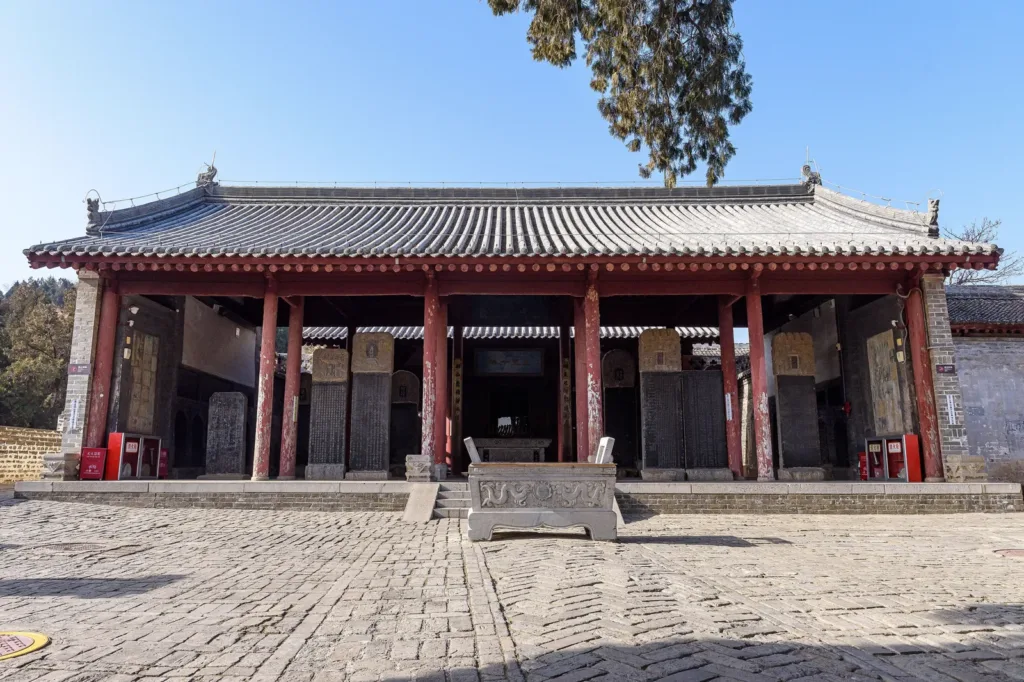
At the upper courtyard, look for the offering hall and sleeping hall, the seated image of Sima Qian, and the old cypresses. The shrine walls hold steles recording repairs, commemorations and later reflections from the Song, Jin, Yuan, Ming and Qing periods. Behind the courtyard is the circular, blue-brick tomb, with the “Han Grand Historian Sima’s Tomb” inscription associated with the Qing-era stele and an old cypress rising from the mound. Read the inscriptions slowly rather than treating the courtyard as a photo backdrop.
Be precise about the chronology. The People’s Daily account, drawing on the Hancheng county gazetteer, identifies the present mountain gate and sleeping hall as Song-period remains. A field report published through the Chinese Social Sciences Network, however, notes that the visible form of the tomb is later and that the exact ancient burial form and chronology should not be presented as settled fact. The safest way to understand the site is as a layered memorial landscape, repeatedly repaired and reinterpreted over centuries.
Practical visit
Search for 司马迁祠墓 韩城市 Sīmǎ Qiān Címù Hánchéng Shì or 司马迁祠墓 芝川镇 Sīmǎ Qiān Címù Zhīchuān Zhèn in Amap (Gaode Maps). Published sources place the site on Han’yi Slope in Zhichuan Town, south of Hancheng; use the Chinese name when confirming the entrance with a driver or at a local transport point. The current official opening hours, admission price, reservation rule and the parts of the shrine that can be entered were not confirmed from a current venue notice. Check these before setting out, especially if you are planning to enter the halls rather than view the exterior route.
The climb is steep and the stone steps can be tiring. Wear shoes with secure grip, allow time for the ascent and return, and do not touch the steles, tomb or old trees. This is both a protected cultural site and an active place of remembrance. If a ritual or worshippers are present, keep to visitor paths, avoid photographing people closely without permission, and wait rather than crossing a ceremony.
Getting there and back
A publicly listed city-bus pairing is the 大禹庙—司马迁祠线 (Dayu Temple–Sima Qian Shrine line), with 芝东村 (Zhīdōng Village) given as the stop for the shrine. The page that lists it does not provide a current timetable or a reliable return schedule, so verify the line, direction and operating day in Amap or at the departure point before boarding.
For a taxi or ride-hailing car, enter 司马迁祠墓,陕西省韩城市芝川镇 Sīmǎ Qiān Címù, Shǎnxī Shěng Hánchéng Shì Zhīchuān Zhèn and show the driver the Chinese name. Ask where the current visitor entrance is and arrange how you will return before walking uphill. No fixed fare, journey time or pickup point is claimed here. Before beginning the climb, confirm whether the bus will run back toward Hancheng or whether a driver can collect you; the return connection was not verifiable from the public sources available for this guide.
Find Shrine and Tomb of Sima Qian
司马迁祠墓 · 韩城市
The pin marks the area, not the entrance.
Sources & visit information
Sources checked on 2 November 2026. Hours, tickets, reservations and transport can change; confirm with the operator before you go.
Image credits & notes (1)
- The shrine hall and its stele-filled courtyard at the Shrine and Tomb of Sima Qian in Hancheng. Photo: N509FZPhoto: CC BY-SA 4.0