

Explore the region
Tap any red Chinese text to hear it in Mandarin.
Why this place matters
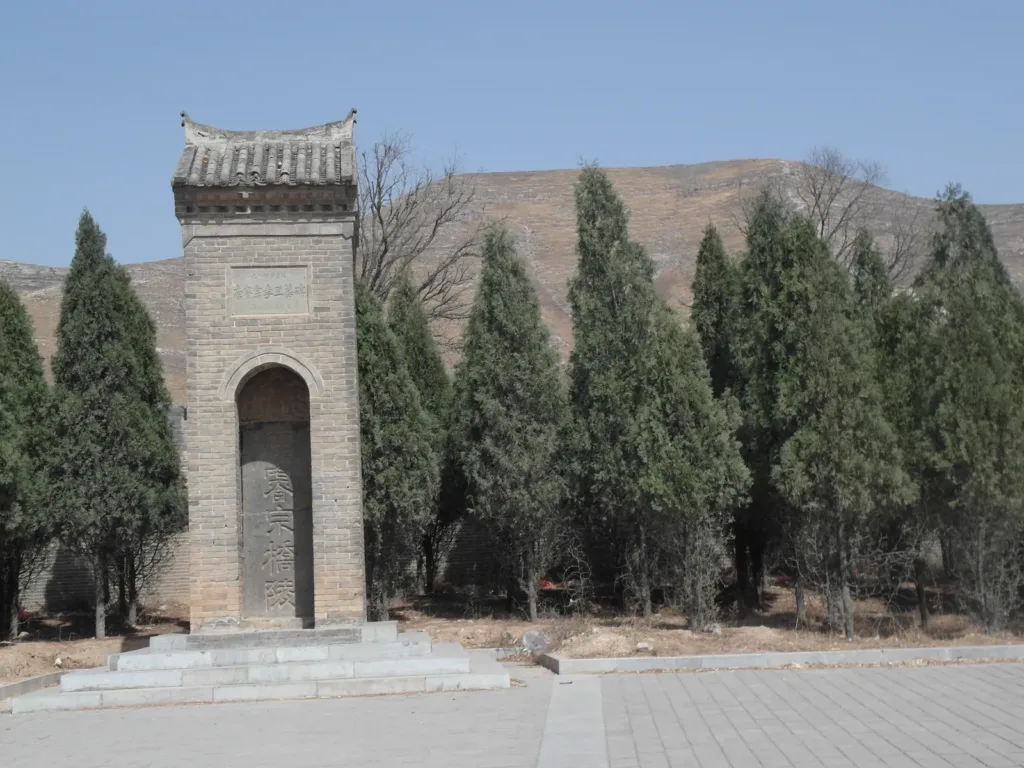
Pucheng’s northwestern edge opens into a mountain-and-plain landscape where the scale of a Tang imperial burial ground is easier to understand than in a museum case. Qiaoling is the mausoleum of Li Dan, Emperor Ruizong of Tang, and was built in the fourth year of the Kaiyuan era, in 716, when his son Li Longji was emperor. The tomb chamber was cut into Mount Feng and the cemetery was enclosed by walls; the site is a National Key Cultural Relics Protection Unit.
The appeal is not a restored palace or an accessible underground tomb. It is the surviving arrangement of a ceremonial landscape: a long spirit way, monumental stone guards, traces of rammed-earth walls and the remains of the southern Vermilion Bird Gate. A 2025 local report says that protection planning, an archaeological-site-park project and environmental work around Qiaoling are still progressing, so treat the site as protected heritage rather than an ordinary open-air park.
What to look for
Begin with the stone procession if the current visitor route allows it. Walk from the outer approach toward the gate and read the change in scale: ornamental columns, mythical Xiezhi beasts, ostrich reliefs, saddled horses, stone officials and lions formed a visual guard of honour. The Xiezhi is especially useful for a first close observation: it is a legendary beast associated with distinguishing right from wrong, and the pair at Qiaoling is described as large, winged and carved from single blocks of stone. Do not touch, climb or tap the sculptures; look instead at their silhouettes, damaged areas, tool marks and the way the figures face the route.
The spirit way is also a lesson in Tang political language. The stone animals are not a random collection of statues: their positions and ceremonial roles made the approach to the emperor legible. Compare the formal stillness of the officials with the more animated bodies of the horses and guardian beasts. A 2017 account identifies the surviving groups as huabiao, Xiezhi, ostriches, horses, stone officials and lions, while noting that some elements are damaged or incomplete.
At the Vermilion Bird Gate site, look for the difference between an archaeological trace and a complete building. A 2010 conservation report described the restoration and display of the gate base, rammed-earth layers and part of the mausoleum wall, and said the display was designed to let visitors experience the remains and their scale. That report records an earlier presentation phase, not a guarantee that every platform or inner area is accessible today. The burial chamber cut into the mountain is part of the mausoleum’s historical construction; it is not an invitation to seek an entrance underground.
Getting there and getting back
First reach Pucheng County town, then confirm the current visitor entrance before leaving town. Older public travel guidance names Pucheng West Gate Bus Station and a “Pucheng–Dakong” bus, but it does not provide a current operator notice or a verifiable 2026 timetable. I therefore do not present that bus as a live route.
For the final leg, show a driver the Chinese name 桥陵 Qiáolíng or 唐桥陵 Táng Qiáolíng, together with 蒲城县、丰山、安王村 Púchéng Xiàn, Fēngshān, Ānwáng Cūn, and ask for the current visitor gate rather than assuming that a map pin marks the open entrance. Use Amap (高德地图) to compare the result with the latest venue or local transport information. Arrange a return pickup or keep the same taxi/ride-hailing vehicle: no current public return connection to the county seat was confirmed in the sources reviewed. Do not rely on an old fare, travel time or a supposed gate-side bus stop.
Opening hours, admission, reservations, the exact present-day entrance and any current restrictions on entering the Vermilion Bird Gate display were not confirmed by a current official visitor notice in the sources read for this article. Check those points before departure, and remain on marked routes around the protected stones and earthworks.
Find Qiaoling Mausoleum
桥陵 · 蒲城县
The pin marks the area, not the entrance.
Sources & visit information
Sources checked on 2 November 2026. Hours, tickets, reservations and transport can change; confirm with the operator before you go.
Image credits & notes (1)
- A gate structure bearing the inscription “Tang Ruizong Qiaoling” stands against Mount Feng at Qiaoling Mausoleum. Photo: 申威隆Photo: CC BY-SA 3.0