

Photo adjustments
Proportionally resized and converted to WebP without cropping, retouching or changing the photographed subject.
Explore the region
About Han Chang'an City Ruins
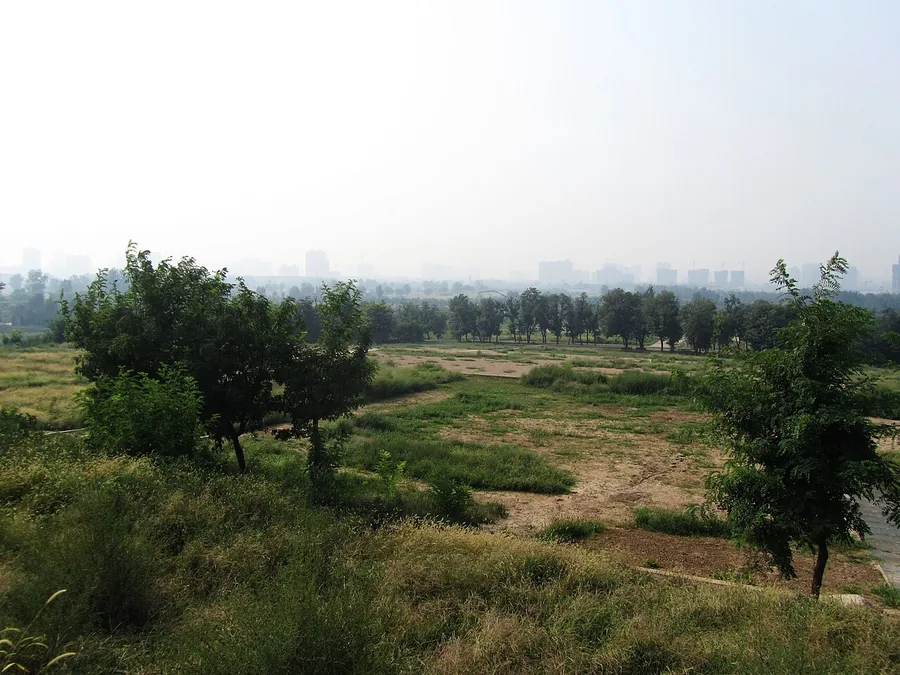
At Weiyang Palace, earth platforms and open ground reveal the scale of the Han court without reconstructing an entire palace. The Front Hall foundations are the main orientation point. Farther north, Tianlu Pavilion preserves the site of an imperial library; the visible buildings there are later commemorative structures, and the underlying platform is the key archaeological survivor.
The Han capital was built up from the Qin dynasty's detached Xingle Palace (兴乐宫), which Emperor Gaozu of Han (汉高帝) repaired and completed in 200 BCE as the renamed Changle Palace (长乐宫), when the court formally moved to Chang'an; the city walls, with twelve gates enclosing about 36 square kilometres, were begun under Emperor Hui (汉惠帝) and finished in 190 BCE. The city served as the capital of ten successive regimes until Emperor Wen of Sui (隋文帝) built a new capital, Daxing City (大兴城), to its southeast because of the old city's poor conditions, and Han Chang'an was gradually abandoned; the site was listed as a Major Historical and Cultural Site Protected at the National Level (全国重点文物保护单位) in 1961.
Within the walls lay the Changle and Weiyang Palace (未央宫) complexes, a small residential quarter and an armory; outside them, residential wards lay to the north and east, sacrificial sites to the south, and an imperial garden to the west. Changle Palace, the earlier of the two, had a perimeter of more than 10,000 metres and an area of 60,000 square metres, linked to Weiyang Palace by an elevated walkway; Weiyang Palace, the emperors' audience residence from Emperor Hui onward, covered about 5 square kilometres and was likewise linked by walkway to Jianzhang Palace (建章宫) and Changle Palace.
What to look for
- Weiyang Palace’s Front Hall earth platform and the extensive open archaeological landscape.
- Tianlu Pavilion’s surviving platform, with later buildings marking the former library site.
Location & getting there
Getting to Han Chang'an City Ruins
Use the Weiyang Palace archaeological park as a defined starting area within the much larger Han city ruins.
- Dengliu Road on the north side provides an approach toward Tianlu Pavilion; decide which park entrance serves your intended section.
Combine your visit
Suggested order within this visit:
-
Weiyang Palace Front Hall site
Read the palace’s scale in its surviving raised foundations.
-
Tianlu Pavilion site
Continue to the library-site platform and view the later memorial buildings from permitted public areas.
This sequence is an editorial suggestion based on the features described in the sources. Access to individual buildings or areas should be checked locally; no travel time or shared admission is implied.
Find Han Chang'an City Ruins
汉长安城遗址 · 未央区
The pin marks the area, not the entrance.
More places nearby
Approximate straight-line distances between map pins, not travel distances.
Hancheng Lake Park 汉城湖
5 km awayHancheng Lake is a long urban water park beside the Han Chang’an ruins in northwestern Xi’an. It reuses the former Tuanjie Reservoir corridor and combines flood-management functions with a modern Han-themed landscape. Dafeng…
View guide →Guangren Temple 广仁寺
7 km awayGuangren is a Tibetan Buddhist temple tucked inside the northwest corner of Xi’an’s city wall. Established under the Kangxi emperor in 1705, it belongs to the Gelug tradition and has a particular association with Green Tara. Its…
View guide →Tang West Market Museum 大唐西市博物馆
7 km awayTang West Market Museum was built over excavated remains of Chang’an’s western market. The original crossroad, wheel ruts, shop foundations and drainage works are the essential exhibits, showing how a commercial district…
View guide →Sources & visit information
The sources below support the place-specific description and arrival information. Suggested combinations are editorial planning ideas; confirm current opening, entry arrangements and transport services for your date.
Visitor information adapted and edited from Wikipedia contributors · CC BY-SA 4.0. Source revision 92992802.
Background paragraphs translated and condensed from Wikipedia contributors, "汉长安城", Chinese Wikipedia · CC BY-SA 4.0. Source revision 92992802.